
Exploring the Meaning of Lips in Greek
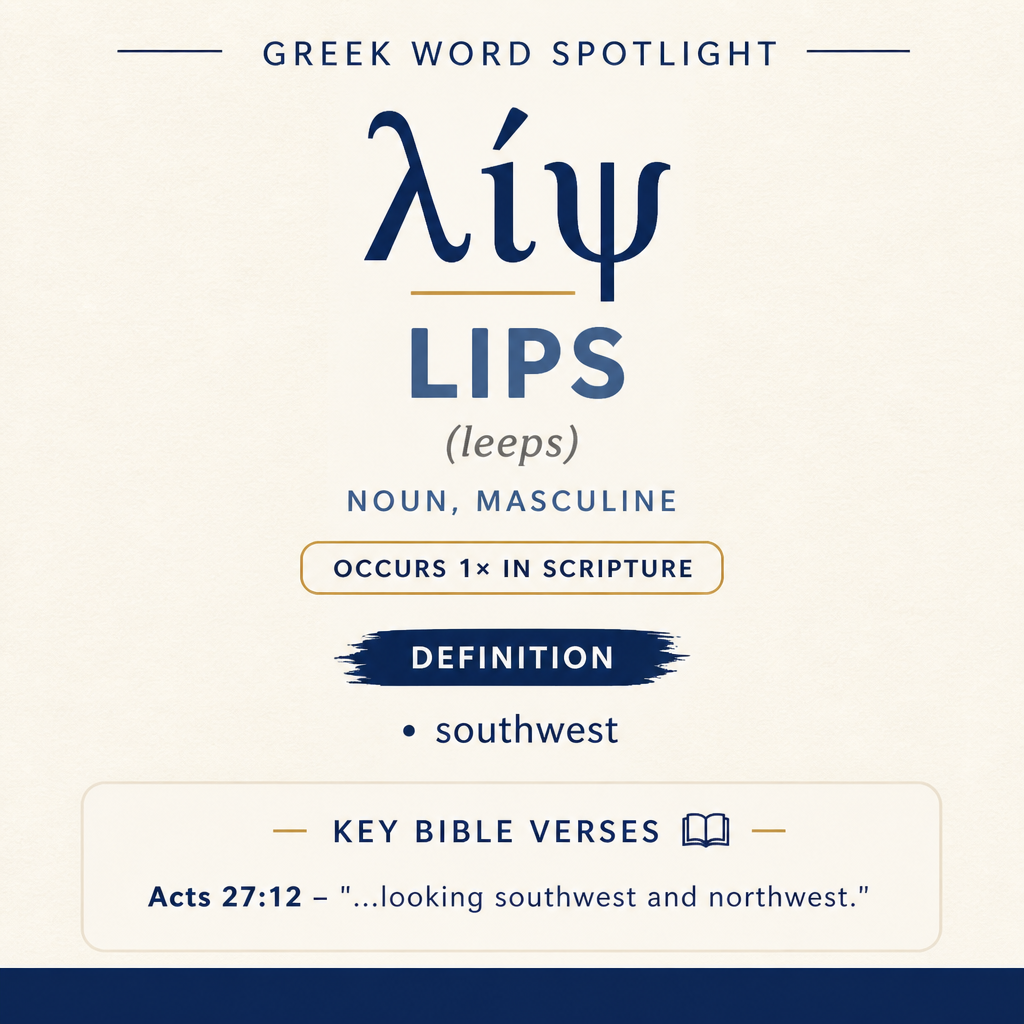
λίψ means “southwest” and appears once in Scripture, in Acts 27:12.
Context Note
In Acts 27:12, it appears within a discussion about leaving an unsuitable haven to winter in.
Learn More →λίψ refers to the direction “southwest” and appears in a single New Testament narrative detail about navigation. In Acts it helps specify how a Cretan harbor is oriented, shaping the crew’s judgment about where to spend the winter.
Occurrences
“Because the haven was not suitable to winter in, the majority advised going to sea from there, if by any means they could reach Phoenix, and winter there, which is a port of Crete, looking southwest and northwest.” (Acts 27:12)
Here λίψ anchors the description of Phoenix as a usable wintering place by indicating the way the port “look[s].” The decision in the verse is explicitly practical: “the haven was not suitable to winter in,” so “the majority advised going to sea” in hopes of reaching a different harbor. Within that reasoning, the note that Phoenix is “a port of Crete, looking southwest and northwest” functions as more than a travelogue flourish. It gives concrete directional orientation to the harbor itself, portraying it as a place whose exposure or opening can be described in terms of the compass—an important detail when “winter” is the immediate concern and the group is weighing whether to remain where they are or attempt to reach a better-situated port.
By pairing λίψ (“southwest”) with “northwest,” the verse frames Phoenix as a harbor with a particular directional set to its outlook. That pairing makes the description spatial and visual: Phoenix is not merely named; it is located and characterized by how it faces. In the narrative logic of the sentence, this directional description sits at the end, almost as a supporting reason for why Phoenix, rather than the current haven, is the proposed destination for wintering. The word thus contributes a technical-sounding, navigational precision to a communal decision (“the majority advised”) made under conditions where the suitability of a harbor could determine safety and survival through the season.

Sense and Usage
As “southwest,” λίψ belongs to the language of orientation—how a place is situated in relation to the horizon and how that situation can be expressed in standardized directional terms. In Acts 27:12 the word is used not to describe a person’s movement (“go southwest”) but to describe a fixed feature of a location: a “port of Crete” is said to be “looking southwest and northwest.” The sense is therefore adjectival in effect (though expressed by a noun), assigning a directional facing to the harbor. This is the kind of use that turns a simple geographical reference into a functional description: a harbor can be assessed and compared based on its exposure, and that exposure can be communicated with directional labels.
The immediate co-text also shows that λίψ works within decision-making language. The verse begins with a problem (“the haven was not suitable to winter in”) and moves to a proposal (“going to sea from there”) whose aim is conditional (“if by any means they could reach Phoenix”). The directional note that includes λίψ then appears as a defining clause identifying Phoenix: “which is a port of Crete, looking southwest and northwest.” In other words, λίψ participates in a chain of reasoning in which the crew’s plan depends on reaching a specific kind of place. The word’s contribution is to help characterize that place with navigational specificity.
Because λίψ is paired with “northwest,” it is also used relationally: it occupies one pole within a small set of directions used to mark the harbor’s outlook. The verse does not treat “southwest” as an abstract concept; it treats it as a describable property of a real port. That concreteness is reinforced by the maritime setting: “haven,” “winter,” “going to sea,” “reach Phoenix,” and “port of Crete” keep the word in the realm of seamanship and geographic orientation, where directions are not decorative but serve planning, route choices, and the selection of safe anchorage.
In this single attestation, λίψ therefore carries a distinctly practical force. It is part of a sentence that is crowded with purpose and constraint: winter conditions make one harbor inadequate, the majority’s counsel presses for a change, and the hoped-for destination is defined with enough exactness to be recognized and evaluated. “Southwest” is not simply “where” Phoenix is; it is how Phoenix is said to face, adding a detail that fits the verse’s emphasis on suitability for wintering.
Imagery
The imagery surrounding λίψ in Acts 27:12 is maritime and directional: a harbor evaluated for winter, a voyage proposed as a solution, and a destination harbor described by the way it opens toward the sea. “Looking southwest and northwest” evokes the visual of a port’s mouth oriented between two directions, as if the shoreline itself could be read like a compass. In the verse’s economy of words, λίψ helps turn geography into an actionable assessment—one more detail in the careful weighing of whether to stay put or risk the sea to reach a better wintering place.
Sources: Lexical data from Strong’s Exhaustive Concordance and the Translators Brief Lexicon of Extended Strongs for Greek (STEPBible, CC BY). Occurrence data from the Translators Amalgamated Greek New Testament (STEPBible, CC BY). Scripture quotations from the World English Bible (public domain).





