Exploring the Meaning of Liparos in Greek
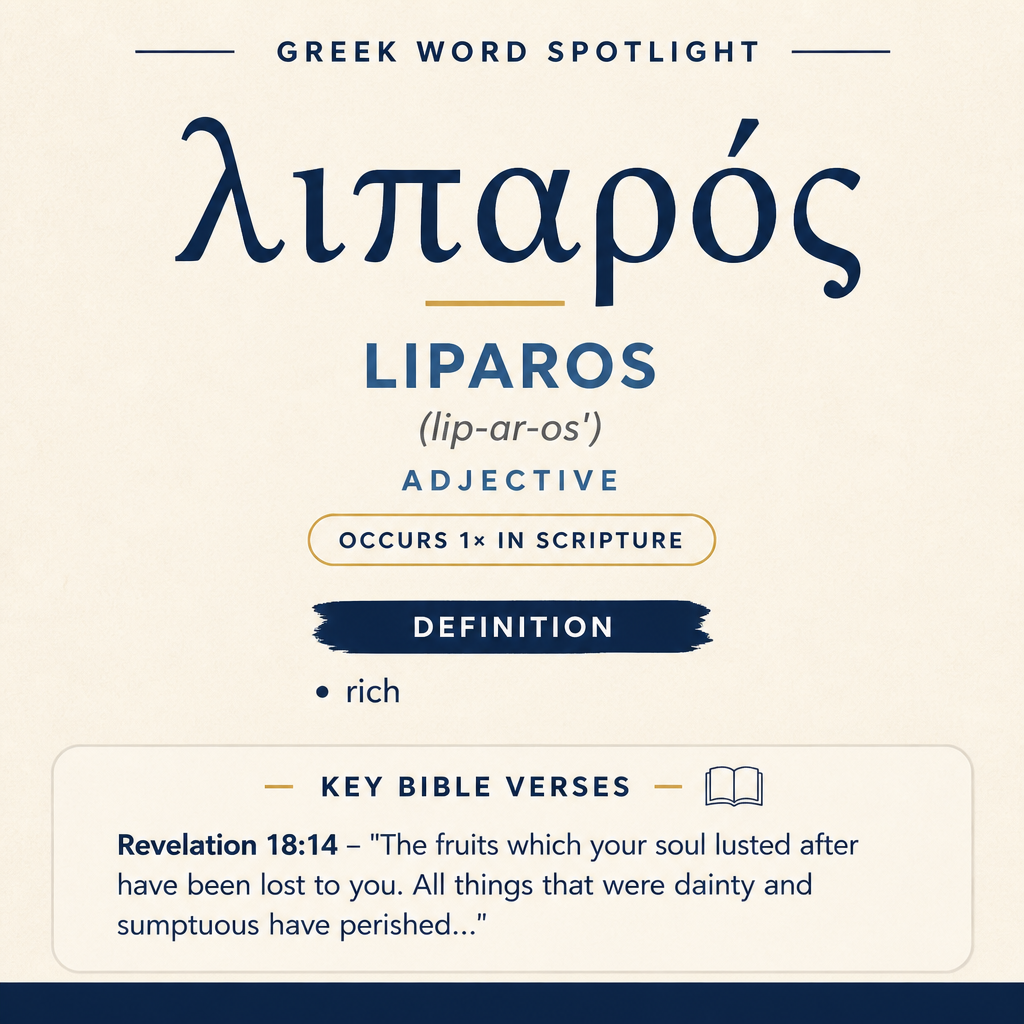
λιπαρός (Liparos) means “rich” and appears once in Scripture, in Revelation 18:14.
Verse Context
In Revelation 18:14, it appears within a lament over lost fruits and perished dainty, sumptuous things.
Learn More →λιπαρός expresses the idea of what is rich, and it appears in a single New Testament passage describing luxury that has vanished. In its lone occurrence, the word helps paint the texture of opulence as something once possessed, now irretrievably gone.
Occurrences
“The fruits which your soul lusted after have been lost to you. All things that were dainty and sumptuous have perished from you, and you will find them no more at all.” (Revelation 18:14)
In Revelation 18:14, λιπαρός belongs to a lament-like address to a “you,” where desire, consumption, and loss are set side by side. The statement begins with appetite—“The fruits which your soul lusted after”—and turns immediately to deprivation: “have been lost to you.” Within that movement from craving to emptiness, λιπαρός contributes to the description of what the speaker calls “things” that once marked a life of abundance. The verse pairs “dainty” with “sumptuous,” and λιπαρός supports this portrayal of wealth in sensory terms: goods that were not merely adequate but rich in their character and appeal. The result is not a general claim about poverty or misfortune but a targeted picture of the collapse of a particular kind of lifestyle—one built around richly furnished enjoyments and the capacity to obtain them.
The word also functions rhetorically through contrast. The verse does not linger on the pleasures themselves; it emphasizes their disappearance: “have perished from you,” and “you will find them no more at all.” λιπαρός therefore strengthens the force of the loss by specifying the quality of what is gone. The richer the things, the sharper the sense of reversal when they “have perished.” The language is absolute—no recovery is envisioned (“no more at all”)—so λιπαρός intensifies the finality: what is lost is not trivial comfort but the rich trappings of an indulgent existence.

Sense and Usage
As an adjective, λιπαρός characterizes items or experiences by the standard of richness. In Revelation 18:14 that richness is not described in the abstract; it is tied to desire (“your soul lusted after”) and to possession (“have been lost to you”). The word’s contribution is thus not merely economic but experiential: it evokes the sort of richness that can be tasted, collected, and enjoyed—goods that are “dainty and sumptuous.” The verse keeps the focus on consumables (“fruits”) and on the broader category of luxury (“all things”), and λιπαρός helps those “things” register as high-quality, indulgent, and plentiful.
The immediate co-text sharpens how the idea of richness is being used. “Dainty” suggests delicacy and refined appeal; “sumptuous” suggests lavishness and costly splendor. λιπαρός sits comfortably within this cluster of luxury terms, reinforcing that the objects in view are rich in what they offer—rich in pleasure, rich in desirability, rich in the impression they create. At the same time, Revelation 18:14 does not present richness as stable. The verse’s verbs (“have been lost,” “have perished,” “you will find…no more at all”) place richness under the sign of disappearance. The adjective therefore serves an ironic purpose in the sentence: richness is named only to be declared gone. The impression is of a life once surrounded by rich things, now exposed as unable to hold onto them.
The construction “All things that were dainty and sumptuous” also indicates breadth. λιπαρός is not restricted to one item; it helps describe a whole class of possessions and pleasures. The phrase “all things” turns the scene into a total inventory of luxury, and the word’s sense colors that inventory: what vanishes is the richness of a whole way of living. Even without listing specific objects beyond “fruits,” the verse’s wording suggests that the “rich” quality belonged widely across the person’s prized belongings and experiences.
Finally, the address “from you” repeated in the verse (“have been lost to you… have perished from you”) gives λιπαρός a relational edge: rich things are pictured as belonging to someone, surrounding someone, and then being removed from that person’s reach. The richness does not remain an impersonal attribute; it becomes part of the speaker’s indictment of a soul oriented toward luxury. In this single attestation, λιπαρός is therefore bound to the themes of craving, possession, and irreversible loss, with richness serving as the texture of what desire once grasped and what judgment (or calamity) strips away.
Imagery
The imagery of Revelation 18:14 is dominated by the disappearance of luxuries: fruits once craved, “dainty and sumptuous” things once enjoyed, now gone beyond recovery. λιπαρός helps those luxuries feel weighty and attractive in the imagination—rich enough to be lusted after—so that the declaration “you will find them no more at all” lands with stark finality. The verse leaves a picture not of richness displayed but of richness slipping away, turning opulence into absence.
Sources: Lexical data from Strong’s Exhaustive Concordance and the Translators Brief Lexicon of Extended Strongs for Greek (STEPBible, CC BY). Occurrence data from the Translators Amalgamated Greek New Testament (STEPBible, CC BY). Scripture quotations from the World English Bible (public domain).