Exploring the Meaning of Libue in Greek
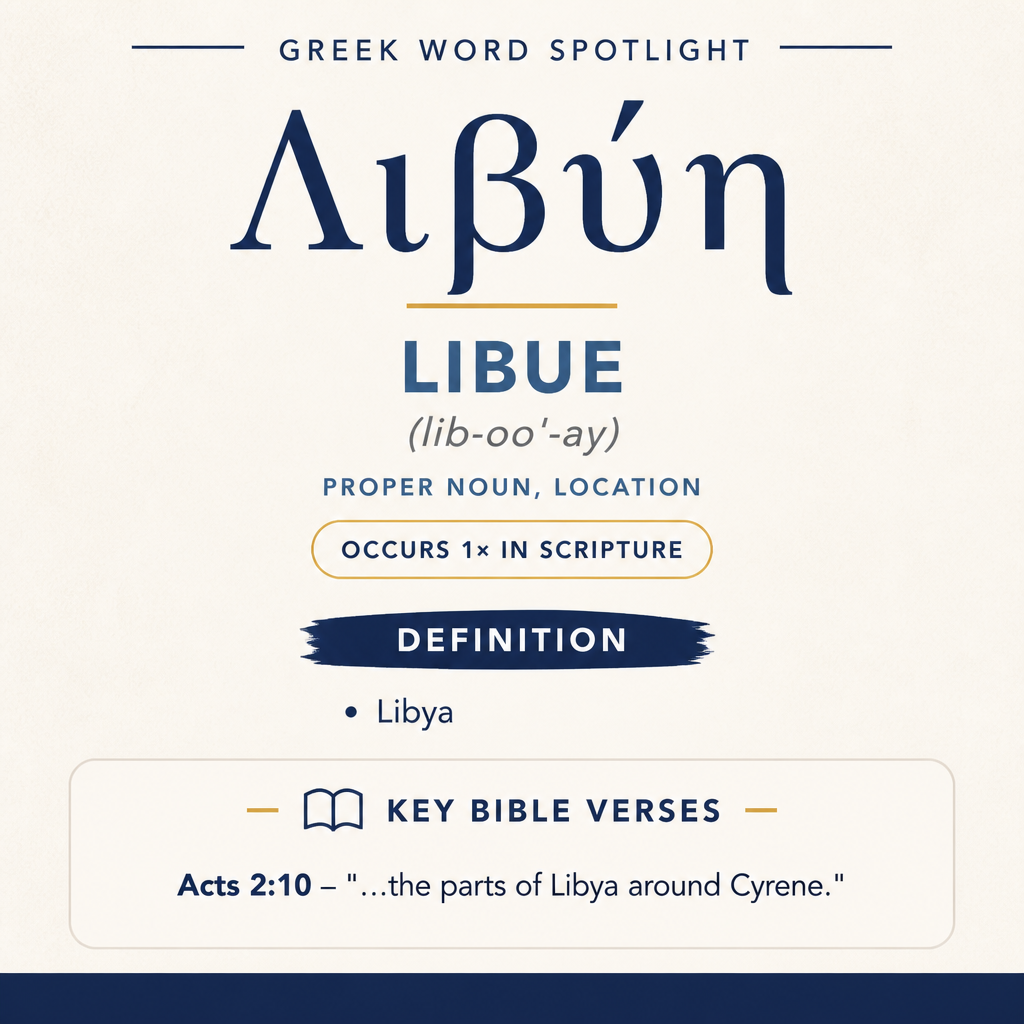
Λιβύη (Libue) means “Libya” and appears once in Scripture in Acts 2:10.
Acts Context
Acts 2:10 mentions “the parts of Libya around Cyrene” among the regions represented.
Learn More →Λιβύη refers to Libya and appears once in the New Testament, in a list of places represented at Jerusalem during the events of Pentecost. In that context it marks a recognizable geographic region and helps portray the wide reach of the assembled crowd.
Root and Related Words
Λιβύη (Libue) is linked to λίψ (lips), “southwest” (Strong’s G3047). The relationship connects the place-name with a directional term, tying the name to a point of the compass rather than to a personal name or title.

Occurrences
“Phrygia, Pamphylia, Egypt, the parts of Libya around Cyrene, visitors from Rome, both Jews and proselytes,” (Acts 2:10)
Here Λιβύη appears inside a long, carefully layered catalogue of regions. Its placement is not bare (“Libya” alone) but qualified: “the parts of Libya around Cyrene.” That phrasing does two things in the flow of the verse. First, it gives a concrete geographic anchoring within Libya, narrowing the reference to a particular area (“around Cyrene”) rather than invoking the whole territory as an undifferentiated expanse. Second, it makes Libya one coordinate in a sequence that moves through well-known locales: “Phrygia, Pamphylia, Egypt,” then Libya, then “visitors from Rome.” The effect is cumulative: the verse is constructing a map-like impression of people gathered from multiple directions, and Libya supplies a distinct point on that map.
The mention of “Egypt” immediately before and “the parts of Libya around Cyrene” immediately after keeps the reference in a North African frame inside the larger list. In the syntax of the verse, Libya is presented as a place from which members of the crowd have come. The subsequent phrase “visitors from Rome, both Jews and proselytes” indicates that the list concerns identifiable groups within the assembled hearers, and Λιβύη functions as one of the geographic descriptors by which those hearers are recognized.
Because the verse specifies “the parts of Libya around Cyrene,” the term is not merely decorative. It signals that the narrator expects the audience to understand Libya as a real region with notable subregions, and it portrays the gathering at Jerusalem as including people from that identifiable Libyan area. In a passage whose purpose is to itemize the breadth of origins, Λιβύη contributes a particular regional marker within the larger portrayal of an international crowd.
Sense and Usage
As a place-name, Λιβύη functions straightforwardly: it designates Libya as a geographic location. Yet even in a single occurrence, the way it is used shows that the term carries more than a bare label. Acts 2:10 does not treat Libya as an isolated destination; it is integrated into a structured list that has a surveying, almost itinerary-like quality. The list names multiple places in succession, and each name adds another coordinate to the reader’s sense of the crowd’s diversity. In that rhetorical setting, Λιβύη helps the narrative portray the assembled hearers as drawn from a wide spread of lands.
The phrase “the parts of Libya around Cyrene” also shows the word’s flexibility within normal geographic description: Λιβύη can take a limiting qualifier that identifies a particular area associated with it. Rather than using the name only as an all-or-nothing label, the text uses it as a larger regional frame within which a more specific locale can be identified. That is, the term comfortably supports subdivision (“parts of”) and localization (“around Cyrene”) in ordinary prose, which is typical of how place-names operate when the author wants both a broad reference and a precise focus.
In addition, the ordering in Acts 2:10 matters for how the term is heard. Libya is not introduced with explanation; it is simply named in company with other geographic terms. That unelaborated naming suggests it functions as a recognized location within the narrative’s geography. The effect is not to describe Libya’s features but to use Libya’s name as an index of origin: it identifies some of the people present by the land connected with them. In this way the place-name serves a social function in the verse—distinguishing groups within the crowd by where they come from—while remaining a strictly geographic reference.
Imagery
The single mention of Λιβύη in Acts 2:10 evokes the image of distant travel converging on one place: a gathering that includes people linked with “Egypt” and with “the parts of Libya around Cyrene,” alongside “visitors from Rome.” Without describing routes or journeys, the verse’s list invites the reader to picture a wide arc of origins feeding into the scene at Jerusalem, with Libya forming one recognizable segment of that world-spanning panorama.
Sources: Lexical data from Strong’s Exhaustive Concordance and the Translators Brief Lexicon of Extended Strongs for Greek (STEPBible, CC BY). Occurrence data from the Translators Amalgamated Greek New Testament (STEPBible, CC BY). Scripture quotations from the World English Bible (public domain).