Exploring the Meaning of Leios in Greek
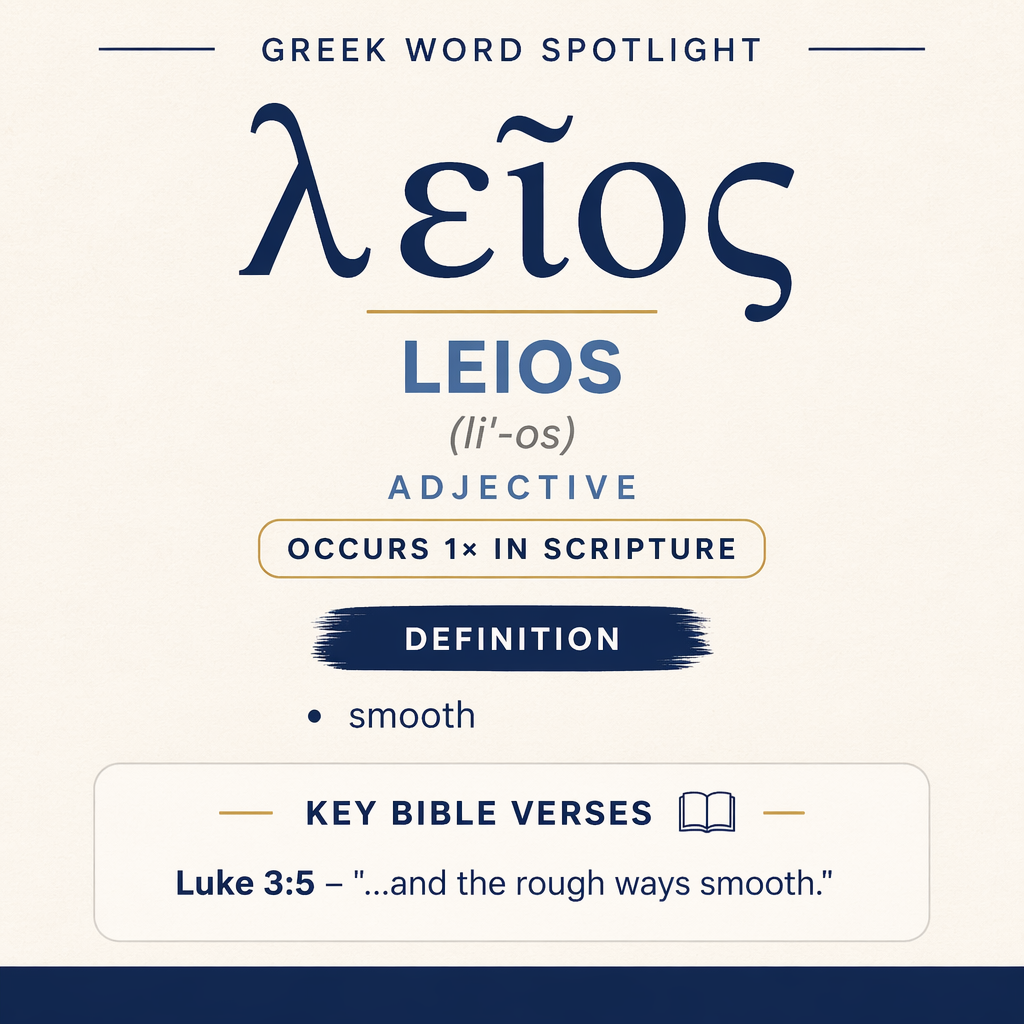
λεῖος means “smooth” and appears once in Scripture in Luke 3:5.
Context in Luke
In Luke 3:5, it appears in the phrase “the rough” within a sequence of landscape images: valleys filled, mountains lowered, crooked made straight.
Learn More →λεῖος expresses the idea of what is smooth, and it appears in a single New Testament setting that pictures the preparation of a people through the reshaping of a path. In that scene, the word belongs to a chain of paired contrasts that move from what obstructs to what is fit for travel.
Occurrences
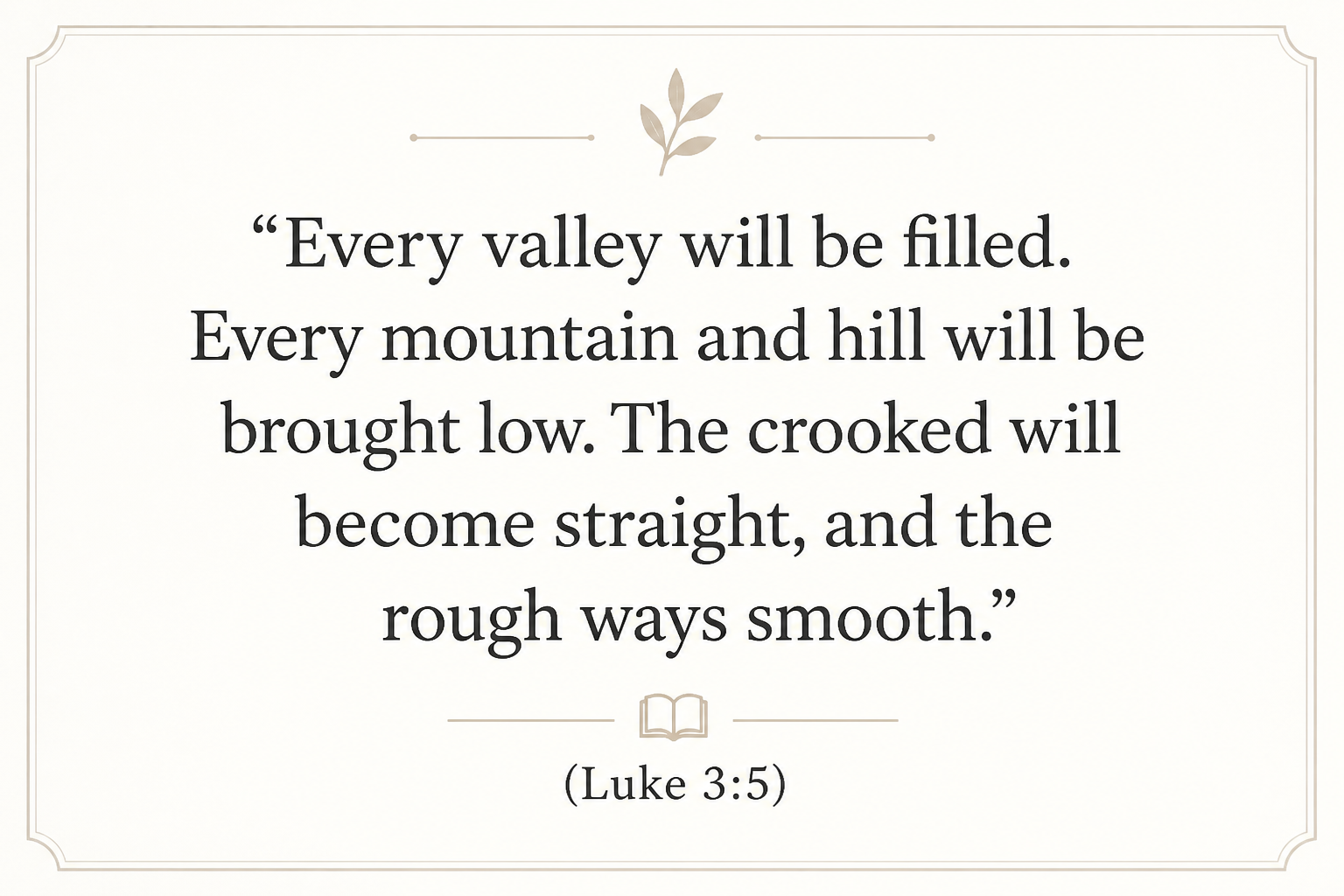
“Every valley will be filled. Every mountain and hill will be brought low. The crooked will become straight, and the rough ways smooth.” (Luke 3:5)
In Luke 3:5, λεῖος stands at the end of a series of transformations: valleys are “filled,” heights are “brought low,” what is “crooked” becomes “straight,” and “rough ways” become “smooth.” The sentence is built of parallel clauses, each describing a movement from impediment to accessibility. Within that sequence, λεῖος names the final condition of the “ways” once the obstacles implied by “rough” have been removed. The imagery is concrete: a “way” that had an uneven surface becomes fit for travel because it is rendered smooth.
The immediate pairing “rough ways” and “smooth” makes λεῖος function as the counterpart of what is uneven in a road or path. It does not stand alone as an abstract quality; it is attached to “ways,” the route by which someone moves from one place to another. By placing λεῖος as the concluding word of the verse, the line draws attention to the end-result of the whole pictured work: after the filling and lowering and straightening, the path itself is smooth, no longer hindering movement.
Luke 3:5 also links λεῖος to two other spatial changes: lowering what is too high (“Every mountain and hill will be brought low”) and filling what is too low (“Every valley will be filled”). These changes compress extremes and remove hazards. In the same way, making rough ways smooth depicts the elimination of smaller-scale irregularities—those bumps, ruts, and jaggedness that would still trouble a traveler even if the large landscape features were corrected. λεῖος therefore contributes a tactile, surface-level finish to the larger work of making a route passable.

Sense and Usage
As an adjective, λεῖος describes a quality that can be attributed to something experienced by touch and movement, especially a “way.” In Luke 3:5 it is not presented as a minor decorative detail but as part of a structured picture of preparation. The verse moves from topography (“valley,” “mountain,” “hill”) to geometry (“crooked,” “straight”) to surface condition (“rough ways,” “smooth”). That progression narrows from the broad shape of the land, to the direction of a path, and finally to the immediate feel of traveling along it. λεῖος belongs to this last level: the state of the surface once the route has been prepared.
The contrastive structure is essential to how λεῖος is heard in the line. The word gains its force from being set against “rough ways,” where “rough” suggests unevenness and difficulty. λεῖος does not need further description because the verse has already framed what kind of change is envisioned: it is a reversal from an obstructed route to an unobstructed one. In that context, “smooth” is not merely the opposite of “rough” in isolation; it is the condition that results when the earlier obstacles have been dealt with. It is the practical outcome of the whole series of actions: a way that is traversable.
Because λεῖος modifies “ways,” its sense is inseparable from movement and passage. A smooth “way” implies a route that can be followed without the interruptions caused by irregular ground. The verse’s repeated “Every…” gives the imagery a comprehensive scope: valleys, mountains, hills, crookedness, and roughness are all included in the envisioned transformation. λεῖος thus participates in a picture of thorough preparation, where not only major barriers but also the finer hindrances to travel are addressed.
The placement of λεῖος at the end of the verse gives it a rhetorical role: it serves as a final landing point for the cadence of the sentence. The earlier clauses use passive verbs (“will be filled,” “will be brought low,” “will become”), which emphasize an accomplished result rather than the agents or means. In the same way, “the rough ways smooth” presents smoothness as an achieved condition. The adjective marks the end-state: the road is no longer defined by its roughness but by its smoothness.
In Luke 3:5, then, λεῖος contributes a vivid, sensory element to a broader picture of rectification and readiness. It depicts the removal of what makes progress difficult—not at the level of grand obstacles alone, but at the level of the path’s texture. The word’s simplicity is part of its effectiveness: “smooth” is immediately grasped in relation to travel, and it rounds out the verse’s portrayal of a prepared way.
Imagery
The imagery carried by λεῖος in Luke 3:5 is the feel of a prepared road underfoot. Valleys filled and hills lowered create a level approach; crookedness straightened creates a direct line; rough ways made smooth create an easy surface. Within this sequence, λεῖος evokes the final refinement of the route—the last removal of unevenness—so that the “ways” envisioned in the verse are not merely possible to take, but are made fit for unhindered passage.
Sources: Lexical data from Strong’s Exhaustive Concordance and the Translators Brief Lexicon of Extended Strongs for Greek (STEPBible, CC BY). Occurrence data from the Translators Amalgamated Greek New Testament (STEPBible, CC BY). Scripture quotations from the World English Bible (public domain).