Exploring the Meaning of Leimma in Greek
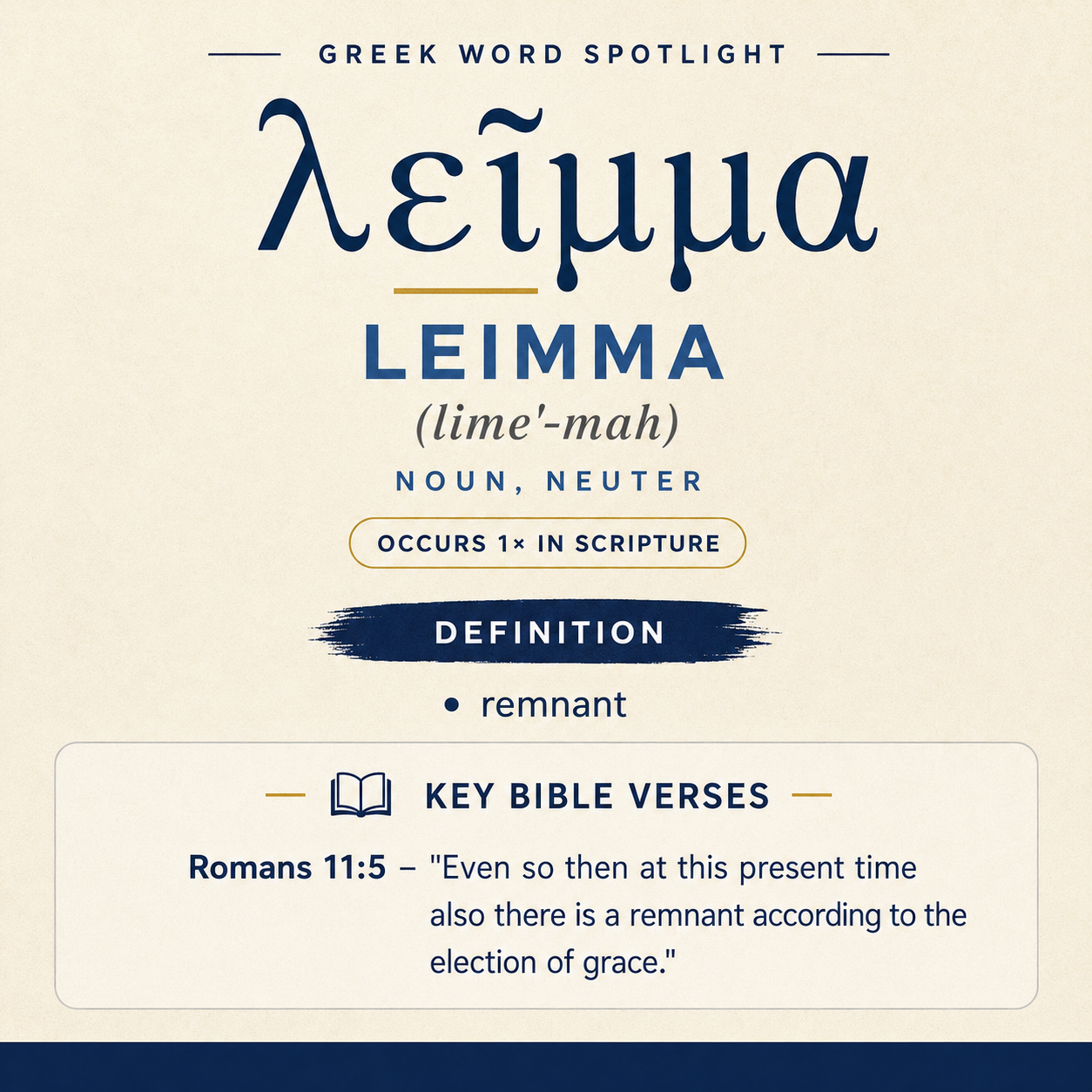
λεῖμμα means “remnant” and appears once in Scripture in Romans 11:5.
Scripture Occurrence
It occurs 1 time in Scripture. Its only reference is Romans 11:5.
Learn More →Context in Romans
Romans 11:5 says there is “a remnant according to the election of grace” at the present time.
Learn More →λεῖμμα means “remnant” and appears in the New Testament in Romans 11:5. In that single setting it names what remains within a larger whole, and it is described in terms of divine choice and grace.
Root and Related Words
λεῖμμα is associated with the verb leipo (λείπω), “to lack” (Strong’s G3007). The relationship sets the noun in the orbit of what is left or what remains in view of what is missing.

Occurrences
“Even so then at this present time also there is a remnant according to the election of grace.” (Romans 11:5)
Here λεῖμμα stands as the subject of an assertion about the present: “at this present time also there is a remnant.” The word contributes a concrete category within the verse’s logic: something exists in the present that can be designated as what remains. The statement does not treat the remnant as a vague possibility but as an actual, identifiable reality (“there is”).
The verse immediately frames that remnant with a specific standard: “according to the election of grace.” This phrase governs how the remnant is to be understood in the sentence. The remnant is not defined by numbers, geography, or social visibility in this line; instead, its distinguishing feature is that it stands in alignment with “election” and “grace.” λεῖμμα therefore functions as a theological and communal marker in Paul’s present-tense argument: the group he names is characterized by a mode of existence traced to grace-shaped choosing.
The placement of “Even so then” situates the remnant within a comparison or inference drawn from what precedes in the broader discussion, but the verse itself keeps the focus tight: the remnant’s significance is that it is present (“at this present time also”) and that its existence corresponds to grace in the form of election. In this sentence, λεῖμμα is the noun that bears the weight of continuity—something remains—while the appended qualifier directs the reader to see that remaining as ordered by grace.
Sense and Usage
In Romans 11:5, “remnant” carries the idea of a remaining portion within a larger whole. The verse speaks of a situation in which not everything is described as remaining; rather, what persists is a portion that can be singled out and named. λεῖμμα, by its very usefulness here, presupposes contrast: if there is a remnant, there is also more than the remnant—an implicit larger field from which the remnant is distinguished. The word does not need to specify the size of the remainder; it simply identifies the reality that a remainder exists.
The verse’s qualifier (“according to the election of grace”) shapes how the reader understands the nature of this remaining. The remnant is not presented as the mere residue of historical processes or human achievement. Instead, the statement explicitly aligns the remnant with “election” and locates that election in “grace.” Within the verse’s boundaries, λεῖμμα therefore points to a remainder whose defining explanation lies outside itself: it is a remnant, and it stands in accordance with gracious election. The noun carries the communal sense of a “remaining group,” while the attached phrase gives the governing criterion by which that remaining group is to be reckoned.
The connection with leipo (λείπω), “to lack,” helps illuminate the contour implied by “remnant” in this usage. A remnant is what is left in a context where something is lacking—where the whole is not fully present in the way one might assume or expect. Romans 11:5 does not describe the mechanism of that lack in this line, but the noun’s conceptual background makes the sentence’s claim sharper: despite any absence implied by the wider context, there remains something real and present.
Because λεῖμμα appears here with an explicit temporal marker (“at this present time also”), its sense is not only quantitative (a portion) but also situational: it is the remainder as it exists now. The word thus serves Paul’s purpose of speaking about present reality. Whatever the broader narrative behind the statement, the verse makes one point with λεῖμμα: in the current moment, there is a remaining body characterized by gracious election.
Imagery
The imagery of “remnant” in Romans 11:5 is the imagery of what endures: something that can be spoken of as still there, still extant, still definable, even when the larger whole is not described as intact. The verse pairs this endurance with the language of “grace,” so the remnant is pictured not simply as what survives but as what stands in line with gracious choosing. The word thus evokes the idea of a remainder that persists in the present and carries a distinct identity shaped by grace.
Sources: Lexical data from Strong’s Exhaustive Concordance and the Translators Brief Lexicon of Extended Strongs for Greek (STEPBible, CC BY). Occurrence data from the Translators Amalgamated Greek New Testament (STEPBible, CC BY). Scripture quotations from the World English Bible (public domain).