Exploring the Meaning of Kuriakos in Greek
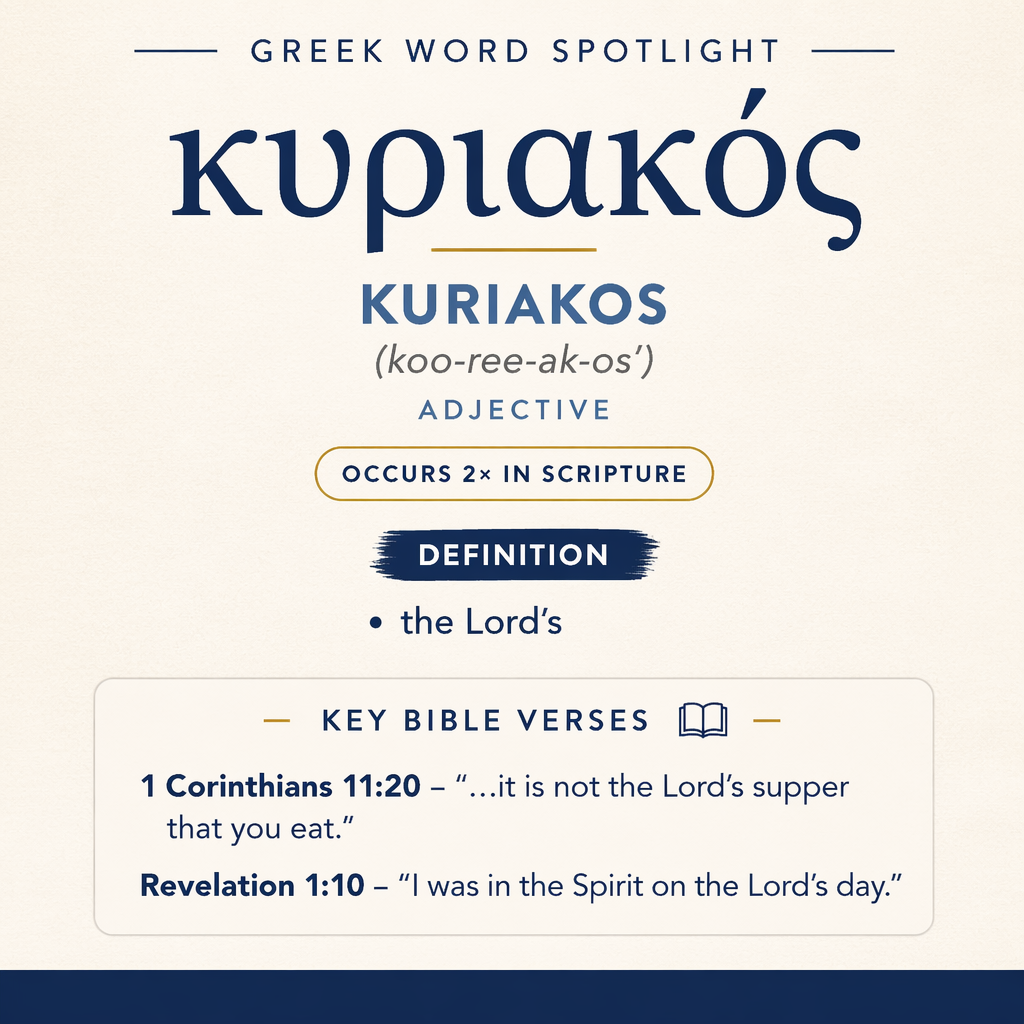
κυριακός means “the Lord’s” and appears in 1 Corinthians 11:20 and Revelation 1:10.
Core Meaning
κυριακός is defined as “the Lord’s.” It is used to describe something belonging to the Lord.
Learn More →Scripture Occurrences
It occurs 2 times in Scripture. These are 1 Corinthians 11:20 and Revelation 1:10.
Learn More →Context Examples
In 1 Corinthians 11:20 it modifies “supper” (“the Lord’s supper”). In Revelation 1:10 it modifies “day” (“the Lord’s day”).
Learn More →κυριακός means “the Lord’s” and appears twice in the New Testament: once modifying “supper” in a church gathering, and once modifying “day” in a prophetic setting. In both places it marks something out as belonging to the Lord and therefore not available to be defined merely by ordinary custom.
Root and Related Words
κυριακός (Kuriakos) is derived from κύριος (kyrios, κύριος), “lord: God” (Strong’s G2962). The adjective form expresses relationship to, or possession by, the one designated as Lord.

Occurrences
“When therefore you assemble yourselves together, it is not the Lord’s supper that you eat.” (1 Corinthians 11:20)
Here κυριακός qualifies “supper,” identifying the meal in view as one defined by the Lord’s claim upon it. The sentence is framed as a correction: when the church “assemble yourselves together,” what they are in fact eating is being measured against what it ought to be. By calling it “the Lord’s supper,” the text sets a standard that does not arise from the act of eating itself, nor simply from the community’s decision to eat together, but from the Lord to whom the supper belongs. The force of the adjective is therefore boundary-setting: it distinguishes a particular communal meal—one associated with the gathered assembly—from an ordinary supper by grounding its identity in the Lord. Paul’s point in the line quoted is that their present practice fails to match that identity; the adjective makes the discrepancy visible by naming whose supper it is.
“I was in the Spirit on the Lord’s day, and I heard behind me a loud voice, like a trumpet” (Revelation 1:10)
In this visionary narrative, κυριακός qualifies “day,” locating the experience in a time marked out as belonging to the Lord. The surrounding details are sensory and immediate: the speaker is “in the Spirit,” and then hears “behind me a loud voice, like a trumpet.” Against that vivid scene, “the Lord’s day” functions as the temporal setting for revelation—an appointed day whose defining feature is its relation to the Lord. The adjective does not describe what the day feels like (quiet, solemn, joyful) but whose day it is. That ownership-language fits the movement of the verse: the day is named, and on that day a commanding sound intrudes from behind, initiating the sequence of communication. By pairing “in the Spirit” with “on the Lord’s day,” the text frames the hearing of the voice as taking place in a context already characterized by the Lord’s claim and presence.
Sense and Usage
Across its two uses, κυριακός operates as a strong marker of belonging. It does not merely add piety to a noun; it identifies the noun as defined by relationship to “the Lord.” In 1 Corinthians 11:20 this belonging creates a criterion for evaluating a community practice: if the supper is “the Lord’s,” then it carries an identity that can be honored or violated, and the apostle can say plainly that what they are eating does not correspond to that identity. The adjective thus turns an act as common as eating into an act accountable to the Lord whose supper it is.
In Revelation 1:10 the same belonging functions not as a rebuke but as a frame for encounter. A “day” is normally a neutral unit of time; calling it “the Lord’s” makes it a time distinguished by the Lord’s association with it. The following auditory image—a voice “like a trumpet”—fits that distinguished setting: the day is named as the Lord’s, and communication from the Lord’s side breaks in with authority. In this way κυριακός can attach to both an event (a supper) and a time (a day) while keeping the same basic force: what it modifies is not self-owned or self-defined, but set apart by its relation to the Lord.
Because it is an adjective, κυριακός does its work by close attachment to a noun, forming a compact expression: “the Lord’s supper,” “the Lord’s day.” That compactness is part of its rhetorical strength. Rather than spelling out a longer explanation (“the supper that belongs to the Lord,” “the day that belongs to the Lord”), the adjective places ownership in the foreground and lets the context supply the implications—whether those implications are corrective (as in the mismatch between assembling and truly eating what is “the Lord’s”) or revelatory (as in the setting in which the voice is heard).
Imagery
The two phrases built with κυριακός evoke concrete scenes. In 1 Corinthians 11:20, the word sits at a table: an assembly gathered, a meal being eaten, and the contested question of whether that meal truly deserves the name “the Lord’s.” In Revelation 1:10, the word opens onto a different sensory field: a particular “day” named as belonging to the Lord, and within that day the sudden, clear intrusion of a “loud voice, like a trumpet.” In both, the adjective quietly concentrates attention on the Lord as the defining reference point for what is happening—whether at the table or within the day.
Sources: Lexical data from Strong’s Exhaustive Concordance and the Translators Brief Lexicon of Extended Strongs for Greek (STEPBible, CC BY). Occurrence data from the Translators Amalgamated Greek New Testament (STEPBible, CC BY). Scripture quotations from the World English Bible (public domain).