Exploring the Meaning of Kurios in Greek
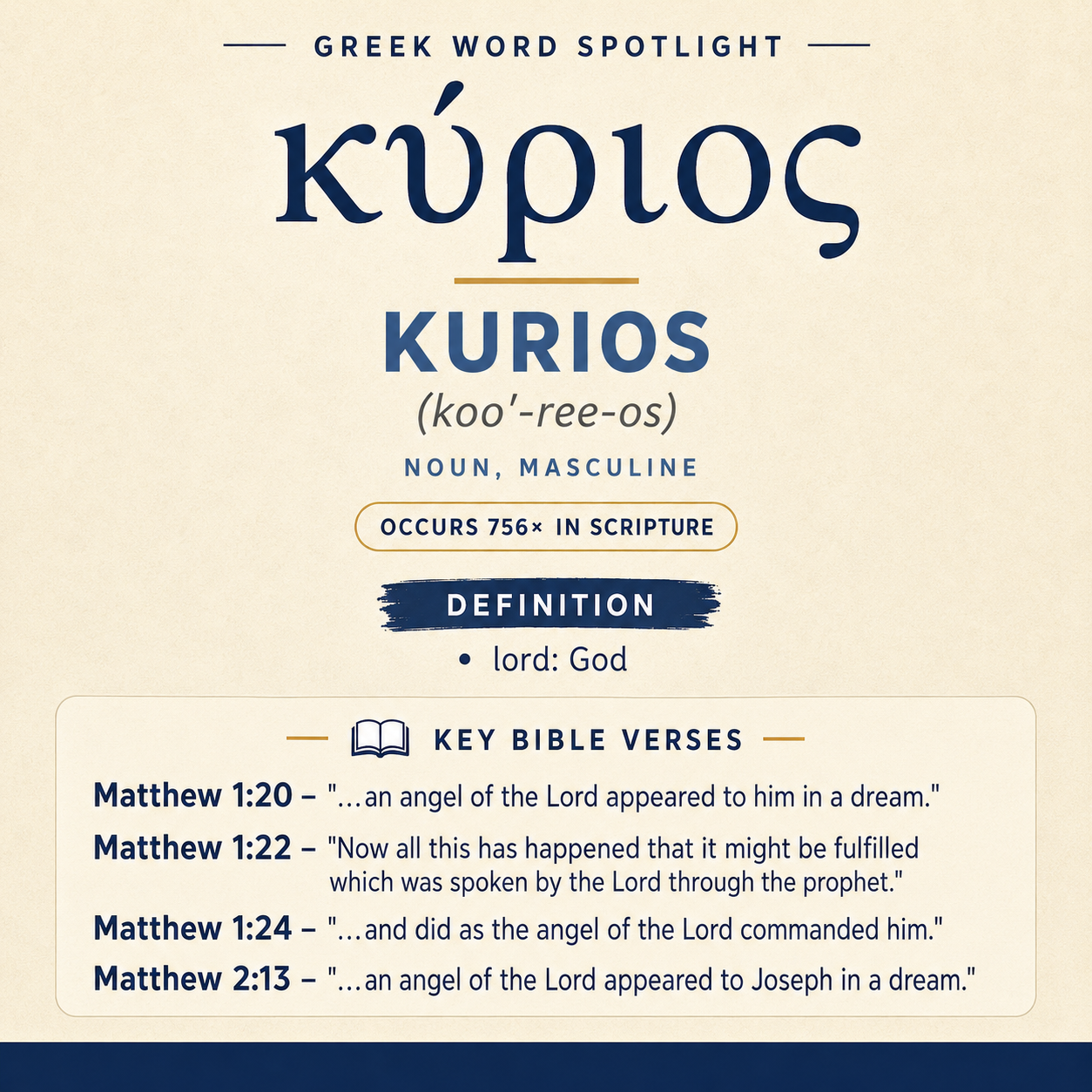
κύριος (Kurios) means “lord: God” and appears 756 times in Scripture, including Matthew 1:20; 1:22; 1:24; 2:13; 2:15; 2:19; 3:3; 4:7.
Matthew Examples
In Matthew it appears in phrases like “angel of the Lord” (Matthew 1:20; 1:24; 2:13; 2:19). It also appears in Matthew 4:7: “You shall not test the Lord, your God.”
Learn More →Kurios means “lord: God,” and in these passages it anchors divine speech, divine command, and exclusive divine claim. The selected occurrences cluster in Matthew’s opening narratives and in sayings of Jesus that invoke “the Lord” as the proper object of fear, worship, and vow-keeping.
Occurrences
Matthew 1:20 — “But when he thought about these things, behold, an angel of the Lord appeared to him in a dream, saying, “Joseph, son of David, don’t be afraid to take to yourself Mary, your wife, for that which is conceived in her is of the Holy Spirit.”
Here Kurios identifies the angel as belonging to, and acting under the authority of, God. The dream scene is framed as divine initiative: Joseph’s private deliberation is met by a messenger whose commission is marked by “of the Lord,” and the angel’s speech addresses fear and directs Joseph’s next step.
Matthew 1:22 — “Now all this has happened that it might be fulfilled which was spoken by the Lord through the prophet, saying,”
Kurios is the ultimate speaker standing behind prophetic words. The verse presents a chain of communication (“spoken by the Lord through the prophet”), and Kurios supplies the origin point: what is about to be cited carries the weight of God’s own speech, not merely a human report.
Matthew 1:24 — “Joseph arose from his sleep, and did as the angel of the Lord commanded him, and took his wife to himself;”
Kurios again marks the angel’s authority, and here that authority is expressed as command. Joseph’s obedience is narrated as a direct response to a command associated with God: the messenger’s instruction is not optional counsel but a directive backed by Kurios.
Matthew 2:13 — “Now when they had departed, behold, an angel of the Lord appeared to Joseph in a dream, saying, “Arise and take the young child and his mother, and flee into Egypt, and stay there until I tell you, for Herod will seek the young child to destroy him.”
Kurios frames another dream-warning as divine protection and guidance. The angel’s identity (“of the Lord”) authorizes urgent imperatives—“Arise,” “take,” “flee,” “stay”—and the instruction includes a time limit tied to further revelation (“until I tell you”), keeping Joseph dependent on God’s direction amid danger.
Matthew 2:15 — “and was there until the death of Herod; that it might be fulfilled which was spoken by the Lord through the prophet, saying, “Out of Egypt I called my son.””
Kurios appears again as the speaker whose prior word is now being brought to completion. The narrative movement (flight, residence, return-timing) is interpreted through fulfillment language, and Kurios supplies the authoritative voice behind the quoted line, giving theological meaning to what could otherwise look like mere refuge-seeking.
Matthew 2:19 — “But when Herod was dead, behold, an angel of the Lord appeared in a dream to Joseph in Egypt, saying,”
Kurios continues to define the dream-messenger as God’s agent at a decisive transition: Herod’s death changes the situation, and a new word is introduced by the same formula. The phrase “angel of the Lord” signals that the coming instruction arises from God’s oversight of events and timing.
Matthew 3:3 — “For this is he who was spoken of by Isaiah the prophet, saying, “The voice of one crying in the wilderness, make the way of the Lord ready! Make his paths straight!””
Kurios is the one for whom a “way” is to be prepared. The quoted proclamation sets Kurios at the center of expectation: preparation is not for a merely human visitor but for God, and the imagery of roadwork (“make…ready,” “Make…straight”) conveys readiness and access for the Lord’s arrival.
Matthew 4:7 — “Jesus said to him, “Again, it is written, ‘You shall not test the Lord, your God.’ ”
Kurios functions as the divine party toward whom human conduct must be restrained: “not test” sets a boundary. In the temptation exchange, Kurios is paired with “your God,” placing the Lord in the position of rightful authority who is not to be treated as an object for experiments or demands.
Matthew 4:10 — “Then Jesus said to him, “Get behind me, Satan! For it is written, ‘You shall worship the Lord your God, and you shall serve him only.’ ”
Kurios is the exclusive recipient of worship and service. The verse makes Kurios the decisive standard against competing claims: worship belongs to “the Lord your God,” and the adverb “only” sharpens the exclusivity, rejecting any rival allegiance that would divert devotion from God.
Matthew 5:33 — ““Again you have heard that it was said to the ancient ones, ‘You shall not make false vows, but shall perform to the Lord your vows,’”
Kurios is the one to whom vows are owed and before whom vow-making is accountable. The issue is not simply interpersonal honesty; it is fidelity “to the Lord,” so the moral seriousness of vows arises from their direction toward God, who stands as the one addressed by such commitments.
Matthew 6:24 — ““No one can serve two masters, for either he will hate the one and love the other; or else he will be devoted to one and despise the other. You can’t serve both God and Mammon.”
Though Kurios itself is not quoted here, the scene clarifies the kind of exclusive claim associated with God as Lord: service cannot be divided. The logic of “two masters” prepares the reader to hear lordship in terms of total allegiance, and the explicit contrast—“both God and Mammon”—portrays God as the rightful singular master in competition with another claimant.
Matthew 7:21 — “Not everyone who says to me, ‘Lord, Lord,’ will enter into the Kingdom of Heaven; but he who does the will of my Father who is in heaven.”
Kurios appears as a direct address—repeated for emphasis—and is placed on the lips of those appealing to Jesus. The saying distinguishes verbal confession (“says to me, ‘Lord, Lord,’”) from obedience (“does the will of my Father”), so Kurios functions as a weighty title that, by itself, does not guarantee entry; rightful lordship is validated by alignment with the Father’s will.

Sense and Usage
Across these occurrences, Kurios consistently marks God as the personal authority who speaks, commands, and rightly receives human response. In the infancy narratives (Matthew 1:20, 1:22, 1:24; 2:13, 2:15, 2:19), Kurios is encountered indirectly through a messenger or through prophetic speech: God guides Joseph by dreams mediated by “an angel of the Lord,” and God interprets events by words “spoken by the Lord through the prophet.” In both patterns, Kurios is not a distant label but the active origin of direction: commands are issued (“commanded him”), warnings are given (“flee into Egypt”), and timing is governed (“until I tell you”).
In the public and teaching contexts (Matthew 3:3; 4:7; 4:10; 5:33; 7:21), Kurios shapes posture and behavior. Preparation is demanded because the Lord is the one whose way must be made ready; reverence is demanded because the Lord is not to be tested; worship and service are demanded because the Lord alone is worthy of them; and integrity is demanded because vows are performed “to the Lord.” The address “Lord, Lord” shows that Kurios can be used as an appeal, even intensely, yet Matthew 7:21 insists that the claim of lordship presses beyond speech into obedience to “the will of my Father.” Together these scenes present the lordship of God as an authority that orders revelation (what is spoken), guidance (what is commanded), and devotion (how one worships, serves, and keeps vows).
Imagery
The passages attach Kurios to vivid images of access and allegiance: a messenger entering dreams with urgent instruction, a wilderness cry calling for a road to be cleared, and courtroom-like speech where vows are performed to God. Even where the conflict is moral or spiritual (testing, worship, service), Kurios is pictured as the single rightful center—one whose claim cannot be shared with another master and whose will defines what genuine acknowledgment entails.
Sources: Lexical data from Strong’s Exhaustive Concordance and the Translators Brief Lexicon of Extended Strongs for Greek (STEPBible, CC BY). Occurrence data from the Translators Amalgamated Greek New Testament (STEPBible, CC BY). Scripture quotations from the World English Bible (public domain).