
Exploring the Meaning of Kurenaios in Greek
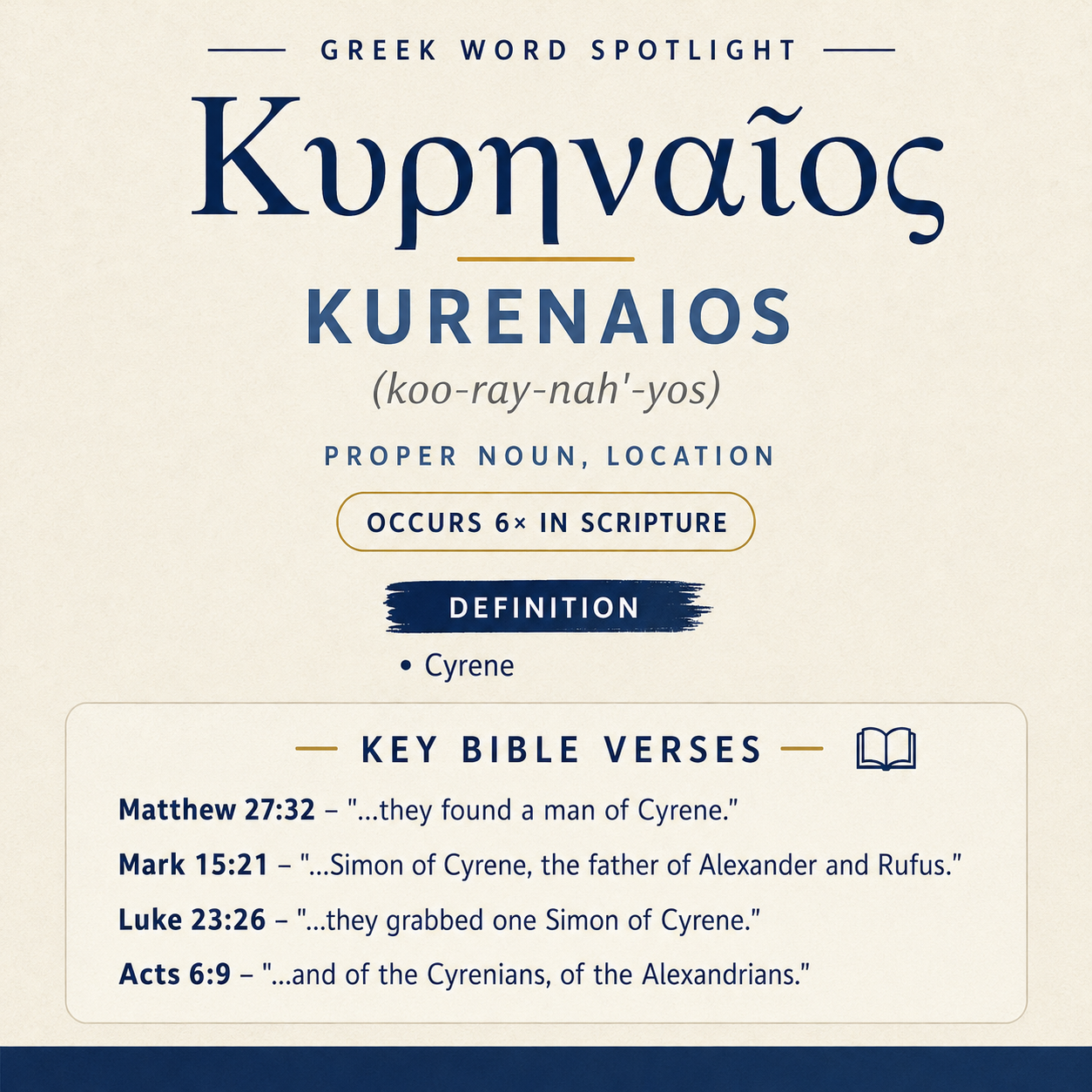
Κυρηναῖος (Kurenaios) means “Cyrene” and appears in Matthew 27:32; Mark 15:21; Luke 23:26; Acts 6:9; Acts 11:20; Acts 13:1.
Meaning
Κυρηναῖος is defined as “Cyrene.” It identifies a connection with Cyrene in the listed passages.
Learn More →Gospel Occurrences
In Matthew 27:32, Mark 15:21, and Luke 23:26, it describes Simon as “of Cyrene.” In these verses, Simon is compelled to carry the cross.
Learn More →Acts Occurrences
In Acts 6:9 it refers to “the Cyrenians” in a synagogue context. In Acts 11:20 and Acts 13:1 it appears in settings connected with Antioch.
Learn More →Κυρηναῖος names Cyrene, functioning in these passages as a geographic identifier that places particular individuals and groups in relation to that location. Across the Gospel accounts it marks Simon in the crucifixion procession, and in Acts it marks synagogue affiliation, missionary witness, and a named leader in the Antioch assembly.
Occurrences
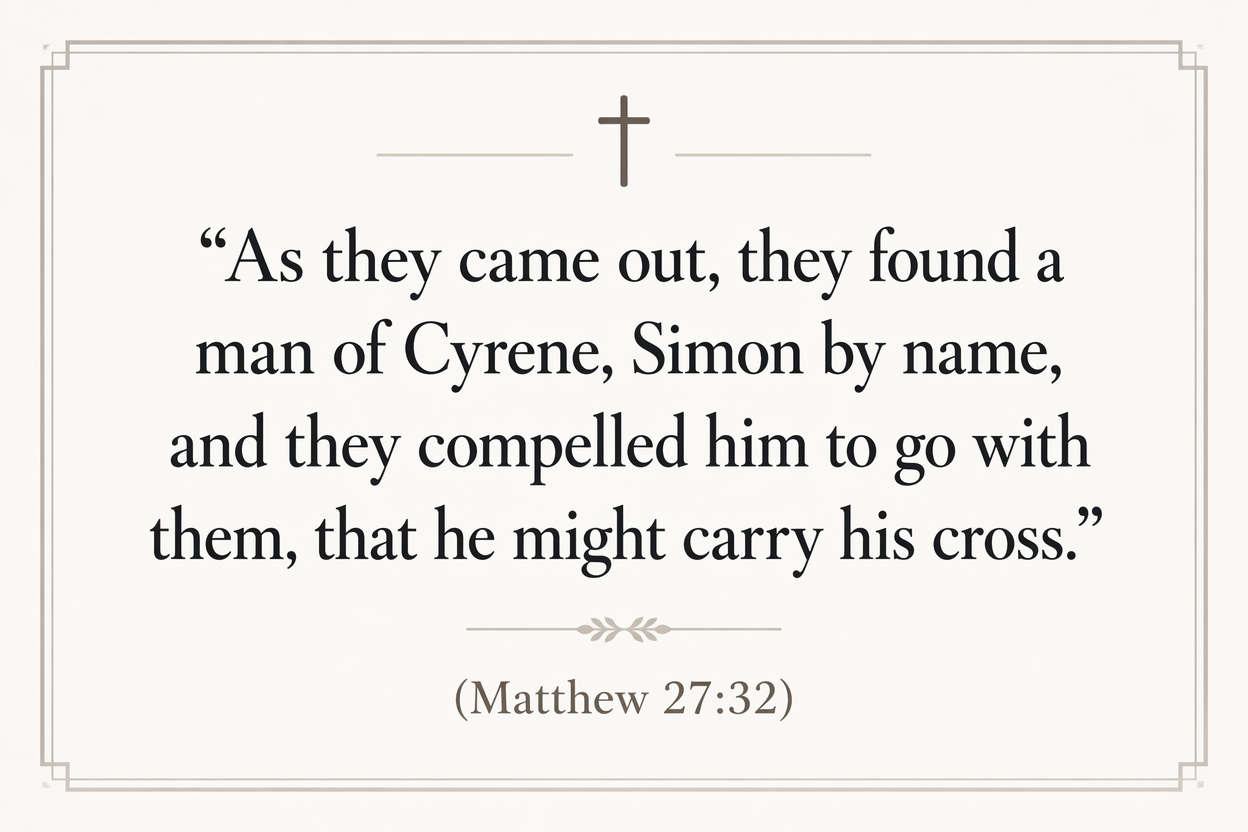
“As they came out, they found a man of Cyrene, Simon by name, and they compelled him to go with them, that he might carry his cross.” (Matthew 27:32)
Here Κυρηναῖος (“of Cyrene”) ties Simon to a specific place, distinguishing him from the other figures moving through the scene. The narrative action is forceful—“they compelled him”—and the geographic label helps present Simon as someone encountered on the way out, not a previously introduced disciple. The effect is to anchor an otherwise unfamiliar name to an identifiable origin: a man whose connection to the moment begins with where he is from as he is pressed into service to “carry his cross.”
“They compelled one passing by, coming from the country, Simon of Cyrene, the father of Alexander and Rufus, to go with them, that he might bear his cross.” (Mark 15:21)
Mark frames the same compelled assistance with extra identifiers: Simon is “one passing by,” “coming from the country,” and “the father of Alexander and Rufus.” Κυρηναῖος works as the central geographic tag amid these relational descriptions. It locates Simon while the other phrases position him socially and narratively: a passerby drawn into the procession. By attaching “of Cyrene” to a man simultaneously described by movement (“passing by,” “coming”) and family ties, the verse portrays the crucifixion route as intersecting the lives of people with known origins and known households, not only the immediate circle around Jesus.
“When they led him away, they grabbed one Simon of Cyrene, coming from the country, and laid on him the cross, to carry it after Jesus.” (Luke 23:26)
Luke also uses the Cyrene designation as the primary marker for Simon’s identity in the moment he is seized—“they grabbed one Simon of Cyrene.” The phrase “coming from the country” again sets him in motion, and Κυρηναῖος supplies a stable point of identification as the authorities “laid on him the cross.” The wording “to carry it after Jesus” places Simon physically behind Jesus in the procession; the geographic label thus accompanies a vivid spatial image: a man defined by his origin now positioned in the wake of Jesus, bearing the cross that has been transferred to him.
“But some of those who were of the synagogue called “The Libertines”, and of the Cyrenians, of the Alexandrians, and of those of Cilicia and Asia arose, disputing with Stephen.” (Acts 6:9)
In Acts 6:9 the Cyrene connection shifts from an individual descriptor to a group descriptor within synagogue life. Κυρηναῖος underlies the English “of the Cyrenians,” naming a contingent associated with Cyrene as part of a wider set—Libertines, Alexandrians, and others from “Cilicia and Asia.” The label functions to categorize those who “arose, disputing with Stephen,” presenting the dispute as involving identifiable communities distinguished by origin. The geographic naming suggests a synagogue context where multiple place-linked groups are recognized enough to be listed, and where those affiliations matter for understanding who is engaged in the confrontation.
“But there were some of them, men of Cyprus and Cyrene, who, when they had come to Antioch, spoke to the Hellenists, preaching the Lord Jesus.” (Acts 11:20)
Here the Cyrene designation appears in tandem with Cyprus, describing “men of Cyprus and Cyrene” whose movement culminates in Antioch. Κυρηναῖος contributes to the portrait of the Antioch mission as carried by people with clear geographic origins who have arrived elsewhere—“when they had come to Antioch.” The verse emphasizes their speech-act—“spoke to the Hellenists”—and their message—“preaching the Lord Jesus.” The Cyrene label thus frames them as outsiders to Antioch whose origins accompany them into their evangelistic work, highlighting that the preaching in Antioch is not confined to one locality but is propelled by travelers identified by where they are from.
“Now in the assembly that was at Antioch there were some prophets and teachers: Barnabas, Simeon who was called Niger, Lucius of Cyrene, Manaen the foster brother of Herod the tetrarch, and Saul.” (Acts 13:1)
Acts 13:1 places a Cyrene-linked individual among the recognized leadership of the Antioch assembly. “Lucius of Cyrene” carries the geographic identifier as part of a list of named “prophets and teachers.” In this setting Κυρηναῖος no longer marks a passerby compelled into a single act (as in the Passion narratives) nor a disputing group (as in Acts 6), but a stable identity within the community’s ongoing life. The label distinguishes Lucius from the other leaders by origin, contributing to the sense that the Antioch assembly includes figures whose backgrounds are diverse enough to be specified in the roll of teachers.

Sense and Usage
Across these passages Κυρηναῖος functions as a geographic label tied to Cyrene, and its narrative value lies in how it locates people and groups in relation to that place while they act in other settings. In the crucifixion accounts (Matthew 27:32; Mark 15:21; Luke 23:26), the label attaches to “Simon,” giving him a defined identity at the precise moment he is drawn into an event not of his own choosing. The repeated association of Simon with travel—“coming from the country” (Mark; Luke) and the situational discovery of him on the road (Matthew)—lets “of Cyrene” serve as a concise anchor: he is not introduced by role, office, or prior relationship to Jesus, but by where he is from as he becomes the one compelled to carry the cross.
In Acts, the same place-label supports broader social mapping. Acts 6:9 uses the Cyrene connection in the plural (“of the Cyrenians”) as part of a synagogue roster, grouping people by recognizable origin alongside “Alexandrians” and others. The label thus participates in a pattern of naming communities by place in order to clarify who is involved in a public dispute with Stephen. Acts 11:20 then uses Cyrene (paired with Cyprus) to characterize missionaries whose origins travel with them into Antioch; their geographic identity is mentioned not to explain conflict but to describe the human channels through which preaching occurs. Finally, Acts 13:1 presents “Lucius of Cyrene” within an established list of teachers, showing the Cyrene designation functioning as an enduring identifier inside the church’s leadership, not merely an incidental tag in a passing encounter.
Taken together, these uses show Κυρηναῖος operating at three levels: (1) as a personal identifier in a single high-pressure event (Simon compelled to bear the cross), (2) as a communal identifier within a synagogue context (“of the Cyrenians”), and (3) as a biographical identifier among Christian witnesses and leaders in Antioch (“men of Cyprus and Cyrene”; “Lucius of Cyrene”). The word’s consistency across these scenes helps the reader track how people connected to the same named place appear in very different roles—compelled participant, disputant, evangelist, teacher—without the geographic term itself needing to carry more than its basic function of locating origin or association.
Imagery
Κυρηναῖος carries a quiet but persistent imagery of movement and intersection. In the Gospels the man marked by Cyrene is “passing by” and then forced into the procession, where the cross is “laid on him” and he carries it “after Jesus” (Mark 15:21; Luke 23:26). In Acts, Cyrene-linked people appear wherever the action is: in synagogue dispute (Acts 6:9), in preaching upon arrival in Antioch (Acts 11:20), and in the settled rhythms of an Antioch assembly led by prophets and teachers (Acts 13:1). The place-name thus accompanies both the road and the gathering, attaching a geographic point of origin to scenes of compulsion, argument, proclamation, and leadership.
Sources: Lexical data from Strong’s Exhaustive Concordance and the Translators Brief Lexicon of Extended Strongs for Greek (STEPBible, CC BY). Occurrence data from the Translators Amalgamated Greek New Testament (STEPBible, CC BY). Scripture quotations from the World English Bible (public domain).





