
Exploring the Meaning of Kullos in Greek
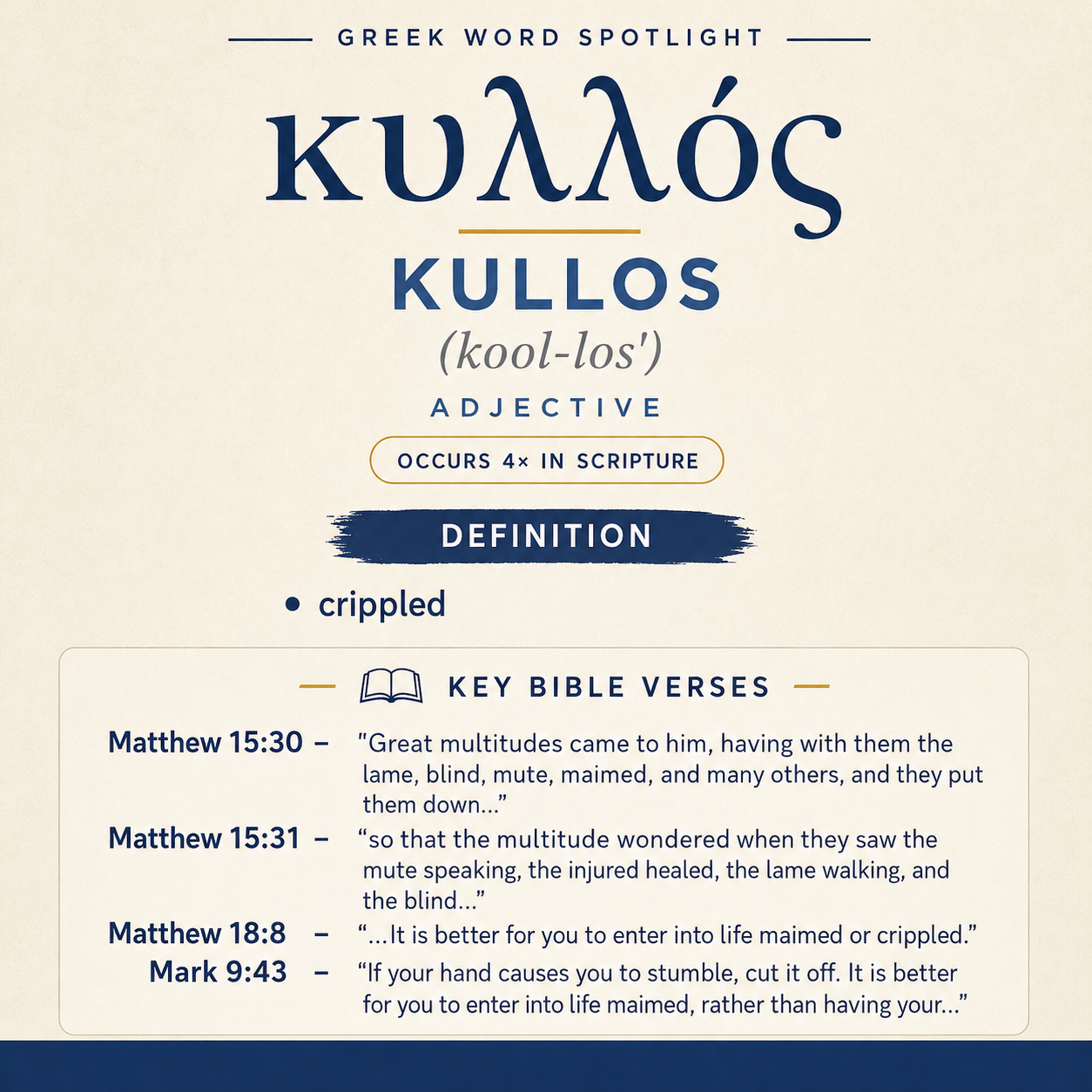
κυλλός means “crippled” and appears four times in Scripture: Matthew 15:30–31; Matthew 18:8; Mark 9:43.
Gospel Occurrences
This word occurs 4 times in Scripture. Its references are Matthew 15:30–31, Matthew 18:8, and Mark 9:43.
Learn More →Context Snapshots
In Matthew 15:30–31 it appears in a scene where the injured are healed. In Matthew 18:8 and Mark 9:43 it is used in an exhortation about cutting off a stumbling hand or foot.
Learn More →κυλλός means “crippled” and appears in Gospel contexts where bodily impairment is either brought to Jesus for healing or used in a warning about the cost of avoiding stumbling. The word sits alongside other terms for disability and injury, and it helps set a stark contrast between present loss and the hope of “life.”
Root and Related Words
κυλλός is related to the verb kylioō (κυλίω), “to wallow” (Strong’s G2947).

Occurrences
“Great multitudes came to him, having with them the lame, blind, mute, maimed, and many others, and they put them down at his feet. He healed them,” (Matthew 15:30)
In this gathering scene, the word belongs to a catalog of conditions carried into Jesus’ presence: “the lame, blind, mute, maimed, and many others.” The list is not merely descriptive; it frames the scale of need (“Great multitudes”) and the concrete helplessness of those who are “put…down at his feet.” Within that grouped portrayal of impairment, “crippled” functions as one more clear instance of bodily limitation that is brought into direct contact with Jesus’ ability to heal. The word therefore contributes to the portrait of a crowd defined by visible weakness and dependence, with attention focused on what happens when such people are placed near him.
“so that the multitude wondered when they saw the mute speaking, the injured healed, the lame walking, and the blind seeing—and they glorified the God of Israel.” (Matthew 15:31)
This verse describes the outcome of the previous scene in a series of before-and-after observations. Although the English list here does not repeat every item from Matthew 15:30, it provides the interpretive lens for the earlier catalogue: conditions of impairment become public, observable reversals (“mute speaking…lame walking…blind seeing”). In that setting, “crippled” belongs to the class of afflictions whose reversal produces communal astonishment: “the multitude wondered.” The term thus participates in a larger narrative movement from bodily restriction to restored function, and that restoration becomes a reason for worship, as the crowd “glorified the God of Israel.”
“If your hand or your foot causes you to stumble, cut it off, and cast it from you. It is better for you to enter into life maimed or crippled, rather than having two hands or two feet to be cast into the eternal fire.” (Matthew 18:8)
Here the word is drawn into a vivid conditional warning: a body part that “causes you to stumble” is to be removed. The adjective “crippled” stands in a paired alternative—“maimed or crippled”—describing the condition in which one might “enter into life” after such a drastic action. The force of the term is intensified by the comparison that follows: being “crippled” is set over against “having two hands or two feet” yet being “cast into the eternal fire.” In this saying, the word does not focus on healing but on the acceptability—even the preferability—of severe bodily loss when weighed against the danger of final judgment. The adjective names a diminished physical state that, in the logic of the verse, is still compatible with entering “into life.”
“If your hand causes you to stumble, cut it off. It is better for you to enter into life maimed, rather than having your two hands to go into Gehenna, into the unquenchable fire,” (Mark 9:43)
This parallel warning uses the same kind of bodily imagery and the same “better…than” structure. Although the English here uses “maimed” rather than repeating both descriptors, the scene is clearly the same kind of comparison: decisive loss in the present is contrasted with retaining “your two hands” yet going “into Gehenna, into the unquenchable fire.” In the orbit of this saying, “crippled” (as it is expressed in Matthew’s version) belongs to the conceptual picture of entering “into life” with an impaired body. The term contributes to the sharpness of the warning by keeping the bodily consequence concrete: the alternative to judgment is not pictured as comfort but as a life entered through costly, even disfiguring, refusal of what causes stumbling.
Sense and Usage
Across these passages, the word is used with a plain, bodily sense: it describes a person whose physical condition is impaired. In Matthew 15 it sits among multiple categories of disability and injury presented to Jesus in a mass scene of need. The term’s impact there depends on the crowd’s action—people are brought and laid “at his feet”—and on the observable result that follows, where visible limitations give way to visible restoration. The word therefore contributes to the narrative emphasis on the breadth of suffering present in the crowd and the breadth of healing that answers it.
In Matthew 18, “crippled” is no longer a condition passively suffered and then healed; it becomes an imagined outcome of decisive self-amputation. The adjective is chosen precisely because it names a diminished condition that most people would instinctively avoid. That instinct is used rhetorically: even a severely reduced physical state is declared “better” than being cast into “the eternal fire.” The word thus helps place bodily wholeness on the scale and finds it wanting when compared to the stakes of “life” versus final punishment.
Read together, these uses show that the word can sit naturally in two kinds of discourse: (1) descriptive reporting about the disabled who come to Jesus and the wonder that follows their restoration; and (2) moral warning that presses the listener to accept drastic, bodily cost rather than endure catastrophic loss. In both settings, the adjective is concrete and unembellished, relying on the hearer’s immediate grasp of physical limitation to support either amazement at healing or urgency about avoiding judgment.
Imagery in Context
The word carries two complementary images in these passages. In Matthew 15 the image is communal and compassionate: many impaired bodies are gathered and placed at Jesus’ feet, and the crowd’s “wonder” is tethered to what they “saw” after healing. In Matthew 18 (and the parallel warning in Mark 9) the image is individual and severe: a person enters “into life” not as triumphant and intact, but as someone who has accepted impairment rather than be “cast…into the eternal fire” or go “into Gehenna.” Together these scenes hold bodily frailty in view—either met with healing power or used as a sober measure of what is worth losing to avoid ruin.
Sources: Lexical data from Strong’s Exhaustive Concordance and the Translators Brief Lexicon of Extended Strongs for Greek (STEPBible, CC BY). Occurrence data from the Translators Amalgamated Greek New Testament (STEPBible, CC BY). Scripture quotations from the World English Bible (public domain).




