
Exploring the Meaning of Kulisma in Greek
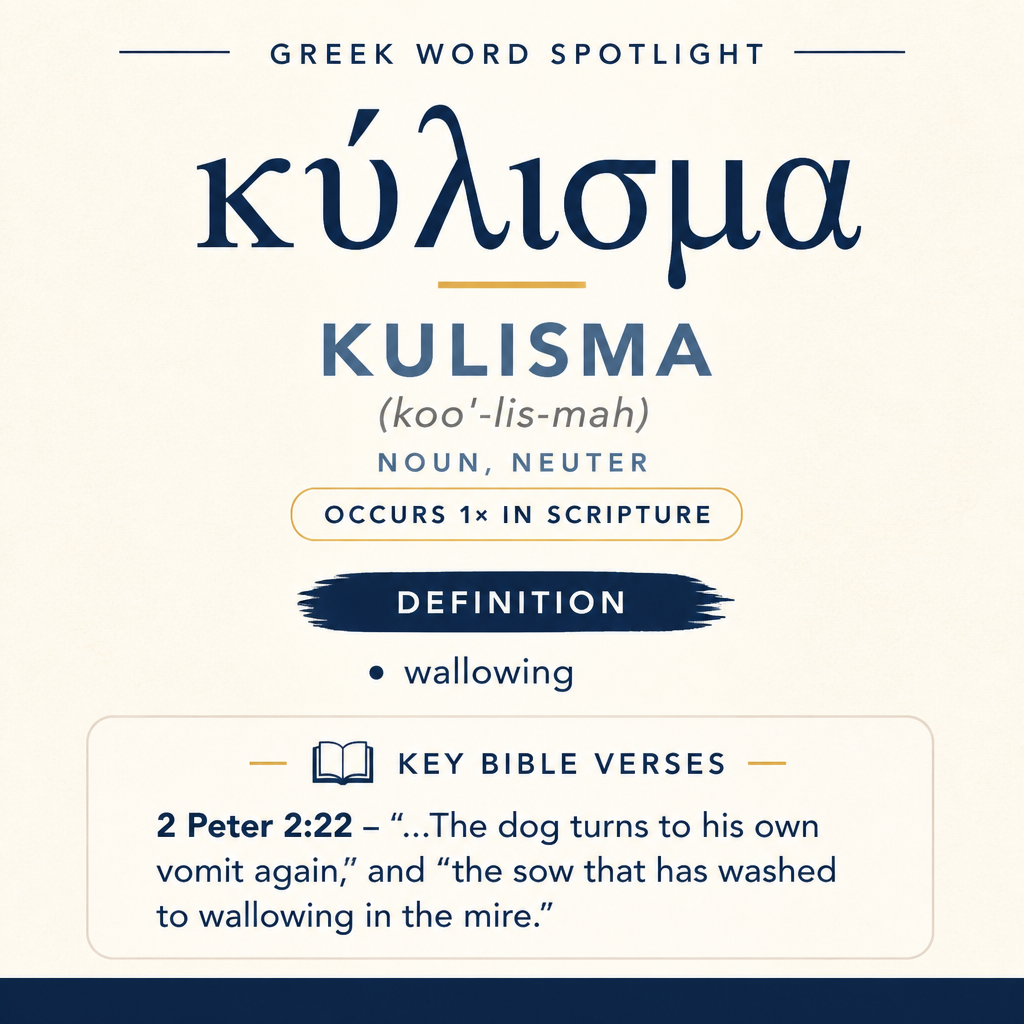
κύλισμα means “wallowing” and appears once in Scripture, in 2 Peter 2:22.
κύλισμα denotes “wallowing,” a vivid term for rolling or plunging about in something defiling. It appears once in the New Testament, in 2 Peter 2:22, where it completes a proverb-like picture of relapse into filth.
Root and Related Words
κύλισμα is related to the verb Kulisma derives from, κυλίω (kylioo, “to wallow”; Strong’s G2947). The noun expresses the action as a concrete event or state: the act of wallowing as an identifiable “wallowing” rather than merely a motion.
Occurrences
“But it has happened to them according to the true proverb, “The dog turns to his own vomit again,” and “the sow that has washed to wallowing in the mire.”” (2 Peter 2:22)
In this verse κύλισμα belongs to the second of two paired animal images introduced as “the true proverb.” The first image describes a dog returning to what it has already expelled; the second describes a sow that has undergone washing yet goes “to wallowing in the mire.” The noun κύλισμα supplies the endpoint of the sow’s movement: not a mere touch of dirt, but an immersion in it characterized as “wallowing.” The word therefore sharpens the proverb by portraying a deliberate, bodily re-entry into what is dirty, intensifying the sense of reversal that follows washing.
The phrasing “the sow that has washed to wallowing in the mire” sets κύλισμα in explicit contrast with cleansing. The wash suggests a change of condition, while κύλισμα names an opposite condition—one defined by rolling about in mire. The proverb’s force depends on that contrast: the animal’s washing is not final, because the sow’s direction is “to” κύλισμα. In the verse’s logic, κύλισμα is not simply an incidental mishap but a destination, a chosen outcome that marks the collapse of whatever change the washing represented.
κύλισμα also participates in the verse’s parallelism. “The dog turns to his own vomit again” is matched with “the sow that has washed to wallowing in the mire.” By placing κύλισμα at the end of the second line, the proverb lands with a concrete, sensory image. The dog’s “again” underscores repetition; κύλισμα, by naming the act of wallowing, underscores the depth and thoroughness of the return. Together, the two images depict not a minor lapse but a full re-embrace of what was left behind.
Sense and Usage
The sense “wallowing” in κύλισμα is presented through physical imagery: an animal rolling around in mire. Within 2 Peter 2:22, the term carries a strongly embodied and spatial feel. Wallowing is not a distant association with filth but an action involving weight, movement, and contact—something done with the whole body. Because κύλισμα is paired with “mire,” the word’s sense is anchored in a setting where wallowing belongs: mud thick enough to receive an animal’s rolling and to cling to it. The noun thus evokes a condition that is both enacted (an activity) and endured (a state of being coated and affected by the mire).
The verse’s wording also frames κύλισμα as a reversal after washing. The sow “has washed,” yet moves “to” wallowing; κύλισμα is the term that makes the reversal graphic. Washing implies removal of grime; wallowing implies the restoration of grime through active engagement. In that contrast, κύλισμα functions rhetorically as an image of relapse: not merely being found dirty again, but returning to the very behavior that produces and embraces dirt.
Because κύλισμα is used within a “proverb,” it operates as a compressed, memorable picture rather than a technical description. Its value in the sentence is imagistic: it invites the reader to picture the sow’s movement and the texture of the mire. The proverb’s structure implies that κύλισμα represents a recognizable pattern—an outcome so familiar it can be cast in proverbial form. In the immediate setting of the verse, κύλισμα therefore serves as the culminating term in an image meant to explain how people can revert after an apparent change; its concreteness makes the explanation hard to evade or soften.
At the level of nuance, κύλισμα suggests more than contact with mud. The proverb does not say the sow “steps in” mire or becomes splattered; it goes “to wallowing.” That choice of expression portrays an activity that is self-involving and lingering. The sow is not merely dirtied by circumstance but engages in an action that assumes comfort or desire in the mire. κύλισμα therefore helps the proverb present relapse as a return that is not accidental but embraces what defiles.
Imagery
The imagery carried by κύλισμα in 2 Peter 2:22 is deliberately unrefined: mire, an animal, and the physical act of rolling in filth. Set beside the image of a dog returning to vomit, κύλισμα contributes a second scene that is equally visceral, pressing the proverb’s point through sensory disgust. The term’s strength lies in its ability to make the reversal after washing feel tangible: the reader can picture the washed animal’s renewed descent into mud as a single, decisive movement “to wallowing in the mire.”
Sources: Lexical data from Strong’s Exhaustive Concordance and the Translators Brief Lexicon of Extended Strongs for Greek (STEPBible, CC BY). Occurrence data from the Translators Amalgamated Greek New Testament (STEPBible, CC BY). Scripture quotations from the World English Bible (public domain).




