
Exploring the Meaning of Kruptos in Greek
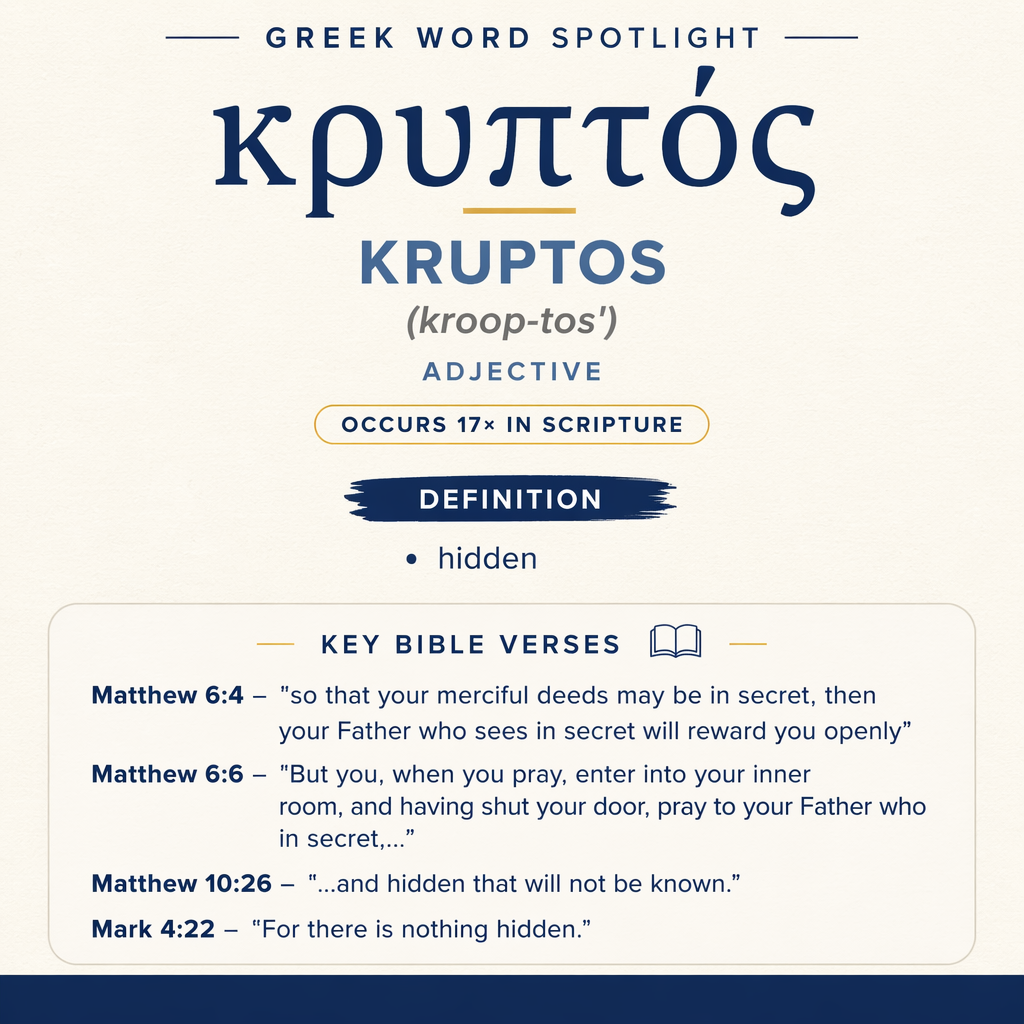
κρυπτός means “hidden” and appears 17 times in Scripture, including Matthew 6, Matthew 10, Mark 4, Luke 8 and 12, and John 7.
Core Meaning
κρυπτός means “hidden.” It describes what is in secret rather than openly seen.
Learn More →Gospel Contexts
In Matthew 6 it describes deeds and prayer done “in secret,” where the Father “sees in secret.” In John 7 it contrasts acting “in secret” with being known openly.
Learn More →Revealed Hiddenness
In Matthew 10:26, Mark 4:22, Luke 8:17, and Luke 12:2, what is hidden is destined to be revealed and made known.
Learn More →κρυπτός describes what is hidden, whether an action done away from human notice, a movement kept from public view, or inner realities concealed from others. Across its New Testament uses, it regularly stands in contrast to what is open, revealed, known, or brought to light.
Occurrences
Matthew 6:4: “so that your merciful deeds may be in secret, then your Father who sees in secret will reward you openly.”
Here κρυπτός frames the setting of “merciful deeds” as deliberately concealed from public display. The point is not that the deeds are unreal or denied, but that their performance is located where they are hidden from human spectators, while still fully seen by “your Father who sees in secret.” The verse also sets up a strong contrast: what is “in secret” is met with a reward “openly.”

Matthew 6:6: “But you, when you pray, enter into your inner room, and having shut your door, pray to your Father who is in secret, and your Father who sees in secret will reward you openly.”
κρυπτός again marks a sphere hidden from others: an “inner room” with a “shut” door. Prayer is directed to “your Father who is in secret,” and the same wording returns: the Father “sees in secret.” The hiddenness here is not merely physical privacy; it is the opposite of public performance, reinforced by the repeated pairing of concealed praying with open reward.
Matthew 10:26: “Therefore don’t be afraid of them, for there is nothing covered that will not be revealed; and hidden that will not be known.”
In this saying, κρυπτός is placed under an eschatological certainty: what is “hidden” is destined “to be known.” The force of the word lies in its temporary character; hiddenness is real in the present (“hidden”), but it does not remain permanent because it stands under the promise of disclosure.
Mark 4:22: “For there is nothing hidden, except that it should be made known; neither was anything made secret, but that it should come to light.”
κρυπτός is set beside “secret” and contrasted with “made known” and “come to light.” The statement treats hiddenness as purposive and limited: what is hidden is linked to eventual manifestation. The imagery turns on movement from concealment to visibility (“come to light”), so κρυπτός names the condition from which disclosure proceeds.
Luke 8:17: “For nothing is hidden that will not be revealed; nor anything secret that will not be known and come to light.”
Luke pairs κρυπτός with a double future: the hidden will be “revealed,” and what is secret will be “known and come to light.” κρυπτός therefore functions as a present state that is incompatible with the future outcome described. The verse’s rhythm piles up verbs of disclosure, emphasizing that hiddenness will be overcome in multiple ways: revealing, knowing, and lighting.
Luke 12:2: “But there is nothing covered up that will not be revealed, nor hidden that will not be known.”
κρυπτός appears in a compact parallelism: “covered up” corresponds to “hidden,” and “revealed” corresponds to “known.” The word thus helps define the second half of the pair: hiddenness is the sort of concealment that ends in exposure to knowledge. The statement’s absoluteness (“nothing… nor…”) makes κρυπτός an all-encompassing category—no hidden matter is exempt from being known.
John 7:4: “For no one does anything in secret while he seeks to be known openly. If you do these things, reveal yourself to the world.”
κρυπτός is part of a social logic: acting “in secret” conflicts with the goal “to be known openly.” The verse makes hiddenness the opposite of public recognition and self-manifestation. Within the sentence, κρυπτός characterizes a mode of action that keeps deeds out of view, while “openly” and “to the world” describe the public sphere of visibility.
John 7:10: “But when his brothers had gone up to the feast, then he also went up, not publicly, but as it were in secret.”
κρυπτός here describes the manner of going up to the feast: “not publicly” but “in secret.” The term marks a deliberate avoidance of public appearance. Unlike the earlier sayings about eventual revelation, this use is descriptive and situational: κρυπτός labels a choice to remain hidden in movement and presence.
John 18:20: “Jesus answered him, “I spoke openly to the world. I always taught in synagogues, and in the temple, where the Jews always meet. I said nothing in secret.”
κρυπτός is negated to assert transparency: “I said nothing in secret.” The surrounding claims fill out the contrast—speaking “openly,” teaching in public gathering places (“synagogues” and “the temple”), and doing so where people “always meet.” κρυπτός therefore denotes the kind of speech that would be hidden from public hearing, and its denial underscores that his teaching did not belong to that concealed category.
Romans 2:16: “in the day when God will judge the secrets of men, according to my Good News, by Jesus Christ.”
κρυπτός characterizes “the secrets of men” as the object of divine judgment. Hiddenness here is inward and moral rather than spatial; the word points to realities within human life that are concealed from ordinary public scrutiny but still fall within God’s evaluating gaze “in the day when God will judge.”
Romans 2:29: “but he is a Jew who is one inwardly, and circumcision is that of the heart, in the spirit not in the letter; whose praise is not from men, but from God.”
Although κρυπτός is not explicitly visible in this English verse, the scene centers on an inward dimension: “one inwardly,” and “of the heart.” In this setting, hiddenness coheres with the contrast between what can be assessed “from men” and what is evaluated by God. The verse’s internal/external axis provides a natural home for κρυπτός as a descriptor of what is concealed within a person rather than displayed outwardly.
1 Corinthians 4:5: “Therefore judge nothing before the time, until the Lord comes, who will both bring to light the hidden things of darkness, and reveal the counsels of the hearts. Then each man will get his praise from God.”
κρυπτός modifies “things” that belong to “darkness,” and it is paired with the Lord’s action of illumination: “bring to light.” The verse also parallels “hidden things” with “the counsels of the hearts,” linking concealment to internal deliberations and motives. κρυπτός thus names what is presently veiled—especially in the moral and psychological realm—awaiting disclosure at the Lord’s coming.

Sense and Usage
Across these passages, κρυπτός consistently draws a boundary between what is concealed and what is publicly accessible. In Matthew 6 it belongs to the ordinary disciplines of life—giving and praying—where hiddenness functions as a location (“in secret”) and as a relational sphere where God is the primary witness (“your Father who sees in secret”). In John 7 and John 18, κρυπτός marks a contrast between secrecy and openness in public life: actions can be done “in secret” or “publicly,” and speech can be “openly” addressed to “the world” rather than withheld.
In the Synoptic sayings about disclosure (Matthew 10:26; Mark 4:22; Luke 8:17; Luke 12:2), hiddenness is treated as a temporary condition. κρυπτός is not presented as a stable refuge where realities permanently remain; instead it is the present state of what will be “revealed,” “made known,” “known,” and “come to light.” The repeated future-oriented verbs do more than predict disclosure: they define hiddenness as a status that invites reversal. What is hidden is precisely what will be uncovered.
In Paul, κρυπτός extends beyond outward concealment to inward realities. “The secrets of men” (Romans 2:16) and “the hidden things of darkness” alongside “the counsels of the hearts” (1 Corinthians 4:5) align hiddenness with the interior life—motives, deliberations, and moral realities that may be inaccessible to human judges. That framework is reinforced by Romans 2:29’s emphasis on what is “inwardly” and “of the heart,” in a context where praise is sought “not from men, but from God.” Within these uses, κρυπτός functions as a term that can describe privacy, secrecy, and interior concealment, while also standing under the expectation that God can see and will disclose.
Imagery
The dominant imagery attached to κρυπτός in these texts is the movement from concealment to exposure: what is “hidden” is “revealed,” what is “secret” “come[s] to light,” and what belongs to “darkness” is “bring[ing] to light.” Alongside that unveiling imagery stands a quieter spatial picture: an “inner room” with a “shut” door (Matthew 6:6), and travel “not publicly” but “in secret” (John 7:10). Together these images hold two truths in tension: hiddenness can describe a real place or mode of life, and yet it remains fully visible to God and subject to eventual disclosure.
Sources: Lexical data from Strong’s Exhaustive Concordance and the Translators Brief Lexicon of Extended Strongs for Greek (STEPBible, CC BY). Occurrence data from the Translators Amalgamated Greek New Testament (STEPBible, CC BY). Scripture quotations from the World English Bible (public domain).




