Exploring the Meaning of Kolasis in Greek
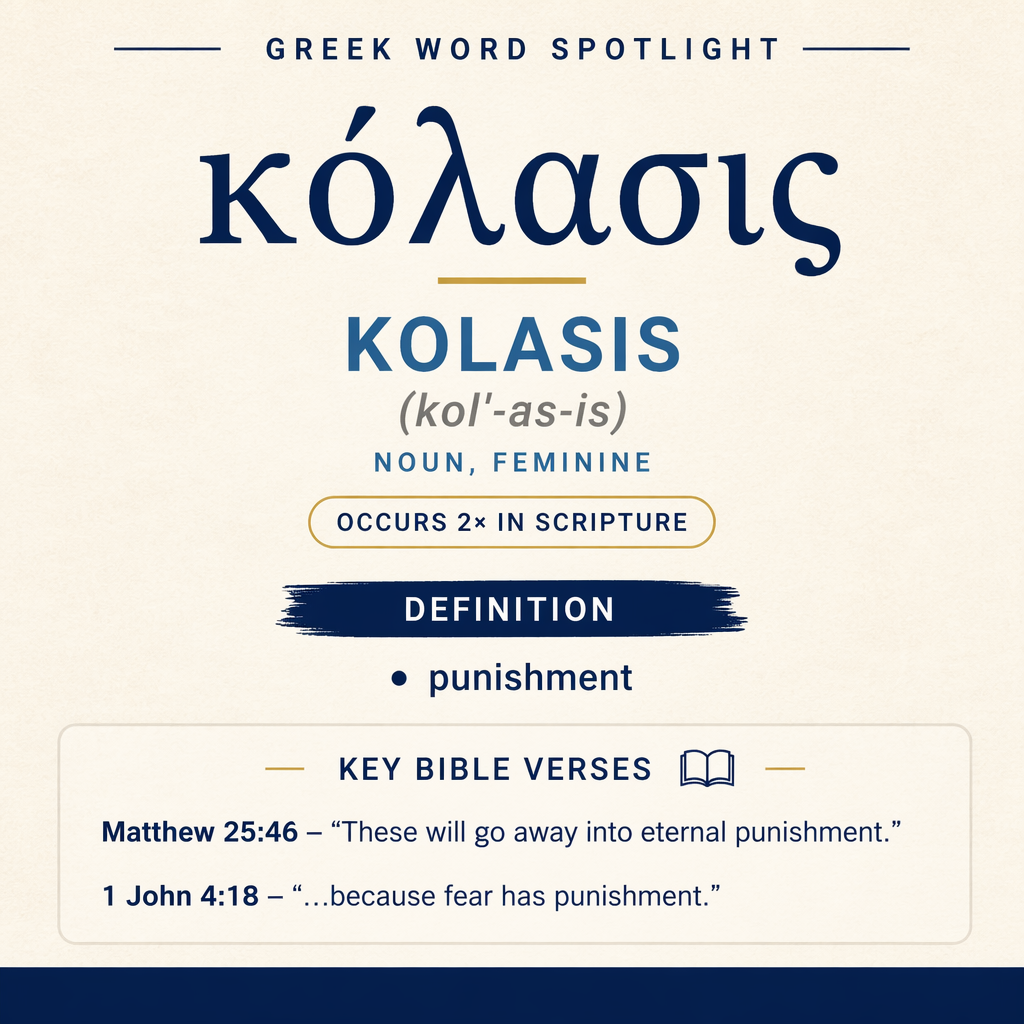
κόλασις (Kolasis) means “punishment” and appears twice in Scripture: Matthew 25:46 and 1 John 4:18.
Context Highlights
Matthew 25:46 speaks of “eternal punishment” contrasted with “eternal life.” 1 John 4:18 links fear with punishment and contrasts it with perfect love.
Learn More →κόλασις refers to punishment and appears twice in the New Testament: once in Jesus’ closing picture of final outcomes, and once in a pastoral argument about fear and love. In both settings it names an adverse consequence that stands in contrast to a desired state.
Root and Related Words
κόλασις is derived from the verb kolazo (κολάζω), “to punish” (Strong’s G2849). The noun expresses the result or reality designated by that verbal action.

Occurrences
“These will go away into eternal punishment, but the righteous into eternal life.” (Matthew 25:46)
Here κόλασις is placed in a direct parallel with “eternal life,” and the sentence sets two destinations side by side: “These will go away into eternal punishment, but the righteous into eternal life.” The word marks the negative outcome in a final separation, and it functions as a destination (“go away into”), not merely a feeling or a warning. Because it is paired with “eternal,” it is framed as enduring in the same way that “eternal life” is enduring; the adjective does not explain what punishment consists of, but it emphasizes its lasting character in the scene. In the logic of the line, κόλασις names what awaits the group referred to as “These,” while “the righteous” receive the contrasting outcome. The force of the term therefore lies in its role as the culminating consequence within a judgment scene: a fixed end-state to which some “go away.”

“There is no fear in love; but perfect love casts out fear, because fear has punishment. He who fears is not made perfect in love.” (1 John 4:18)
In this sentence κόλασις is linked, not to a final destination, but to an inner condition: “fear has punishment.” The statement treats punishment as something fear “has,” and this possession explains why “perfect love casts out fear.” The term thus supplies the rationale for the opposition between love and fear: fear is bound up with punishment, and therefore the presence of perfected love expels fear. The verse also uses the relationship between fear and punishment diagnostically: “He who fears is not made perfect in love.” In that reasoning, κόλασις is not presented as a separate theme to be explored, but as a defining feature attached to fear—something that makes fear incompatible with the maturity (“made perfect”) of love. The word’s contribution is to make fear more than mere emotion: fear is portrayed as carrying punitive weight, which love drives out.
Sense and Usage
Across these two occurrences κόλασις consistently denotes punishment, yet the surrounding syntax and contrasts show two complementary angles. In Matthew 25:46, the word is cast in spatial and temporal terms: people “go away into” it, and it is characterized as “eternal.” Punishment is therefore conceptualized as an objective outcome that one enters, and its endurance is stressed by the adjective placed on it. The contrast with “eternal life” also gives κόλασις a clear antithetical shape: it stands over against the life that is described as belonging to “the righteous.” The line’s structure makes the term part of a binary conclusion, highlighting punishment as one of two ultimate ends.
In 1 John 4:18, by contrast, κόλασις appears without an adjective and without a movement-into construction. Instead it is bound to an interior state: “fear has punishment.” This phrasing makes punishment function as what fear contains or brings with it, and it becomes the explanatory hinge for the claim that “perfect love casts out fear.” The verse does not explore punishment’s duration or its finality; it uses punishment to interpret fear’s character and to explain why fear and perfected love are mutually exclusive. The result is a practical, relational contrast: love is presented as expelling fear, and the presence of fear signals that love has not reached its intended maturity. κόλασις provides the reason that fear is something to be driven out: it is tied to punishment.
Taken together, these uses show that κόλασις can name both an ultimate outcome (“eternal punishment”) and the punitive dimension associated with fear (“fear has punishment”). The noun is flexible enough to operate as a destination in a judgment pronouncement and as a conceptual property that explains an emotional-spiritual condition. In both passages, the term gains its rhetorical force from sharp contrasts: in Matthew, punishment is contrasted with life; in 1 John, punishment is linked to fear and thereby contrasted with love that is “perfect.” The contexts do not define punishment by describing its mechanisms; rather, they deploy the word to clarify the seriousness of the alternatives (life versus punishment) and the moral-psychological dynamic at work (love versus fear tied to punishment).
Imagery in Context
Matthew 25:46 presents κόλασις with the imagery of departure and destination: people “go away into” it, as into a settled end. 1 John 4:18 uses less spatial imagery and more inner logic: punishment is pictured as something fear “has,” while love—when “perfect”—acts as a force that “casts out” fear, pushing away what is bound up with punishment.
Sources: Lexical data from Strong’s Exhaustive Concordance and the Translators Brief Lexicon of Extended Strongs for Greek (STEPBible, CC BY). Occurrence data from the Translators Amalgamated Greek New Testament (STEPBible, CC BY). Scripture quotations from the World English Bible (public domain).