Exploring the Meaning of Kolakeia in Greek
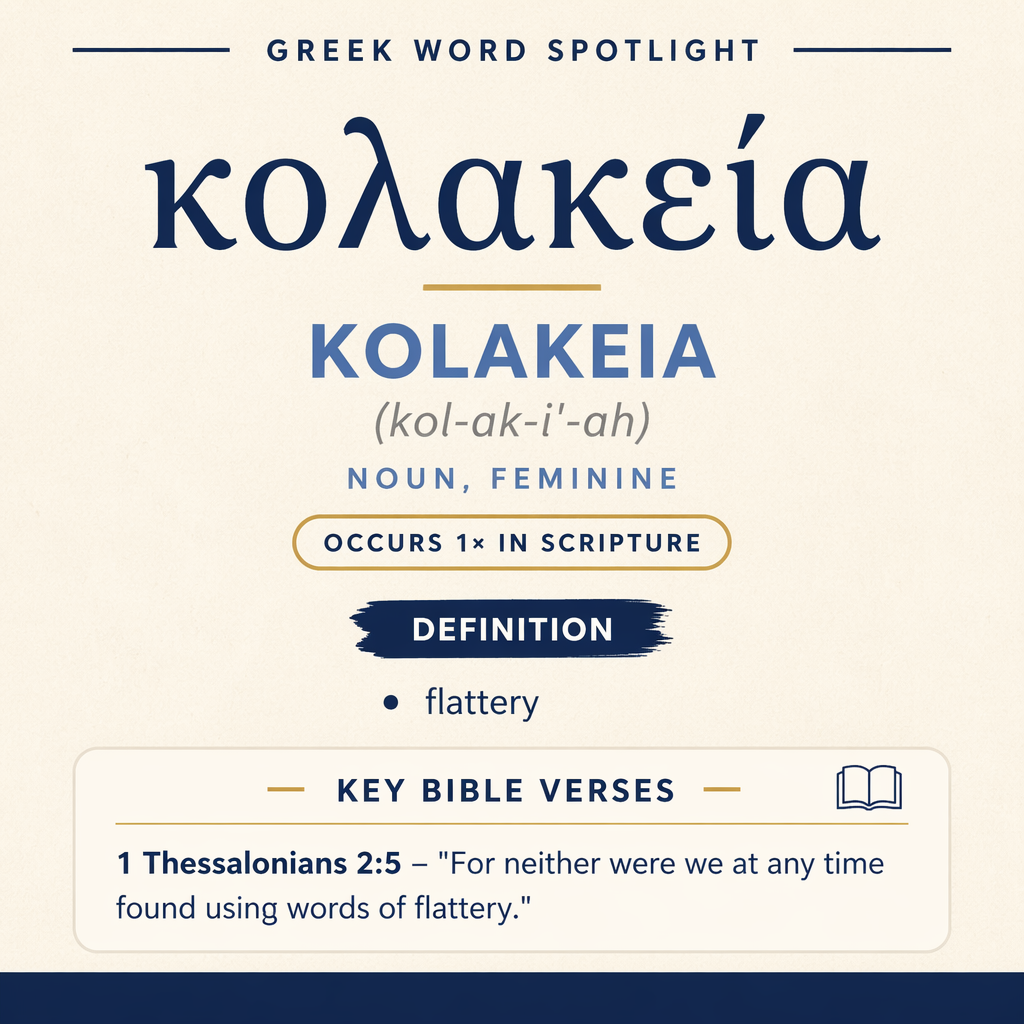
κολακεία means “flattery” and appears once in Scripture, in 1 Thessalonians 2:5.
Scripture Occurrence
It occurs 1 time in Scripture. The reference is 1 Thessalonians 2:5.
Learn More →Verse Context
In 1 Thessalonians 2:5, Paul says they were not found using “words of flattery.” The statement is set alongside “a cloak of covetousness” with “God is witness.”
Learn More →κολακεία means “flattery” and appears in the New Testament in Paul’s defense of his conduct toward the Thessalonian church. The term is used to deny a particular kind of speech and motive, set in contrast with plain integrity before both the congregation and God.
Occurrences
“For neither were we at any time found using words of flattery, as you know, nor a cloak of covetousness (God is witness),” (1 Thessalonians 2:5)
Here κολακεία is placed inside a carefully balanced denial: “neither… nor….” The phrase “words of flattery” frames flattery as something carried in speech—language chosen to affect the hearers—rather than merely a private attitude. Paul’s claim is not simply that he avoided harshness, but that he refused a mode of speaking that would have sought advantage by pleasing, soothing, or swaying the audience through flattering language. The verse anchors this denial in two kinds of accountability. First, it appeals to shared knowledge: “as you know,” which treats the Thessalonians as competent witnesses of what they actually heard and observed. Second, it invokes divine testimony: “God is witness,” which draws the question of flattery beyond public impression into the realm of motive and truthfulness before God.
The immediate pairing with “nor a cloak of covetousness” sharpens the function of κολακεία. Flattery is presented as one potential outward form that can conceal an inward aim—something like a “cloak,” a covering that masks what lies beneath. In this sentence, Paul denies both the flattering speech itself and the kind of covering that would hide covetous intent. The structure suggests a moral logic: flattering language can serve as an instrument of concealment, a way to present oneself acceptably while pursuing self-interest. Against that, the verse insists on transparency, placing speech (“words”) and intention (“covetousness”) side by side under witness.

Sense and Usage
In this passage, “flattery” is not treated as a harmless social courtesy, but as a serious ethical category. It is something that can be “found” in a person’s ministry—detectable in patterns of speech and behavior—so that the Thessalonians can recognize whether it was present. The wording implies that κολακεία is the kind of speech that leaves a trace: it can be heard, recalled, and evaluated. Paul’s defense assumes that the congregation is capable of discerning whether his speech carried that quality.
The collocation “words of flattery” narrows the focus to verbal expression. Flattery, as used here, is not an abstract label applied from a distance; it is embodied in “words,” in the actual phrasing and tone that people use when addressing others. The verse therefore situates κολακεία in the everyday arena of communication between a teacher and a church. It belongs to the practical ethics of how leaders speak, how they present themselves, and how they relate to the people they serve.
The semantic force of κολακεία in 1 Thessalonians 2:5 is also shaped by its rhetorical environment. Paul does not offer the term alone; he sets it in a courtroom-like frame of testimony and proof. “As you know” functions like a summons of human witnesses, while “God is witness” names the highest witness. In that setting, flattery is treated as a charge that could be brought against an apostolic messenger: an accusation that someone’s ministry depended on pleasing speech to gain acceptance or benefit. The denial is thus more than a preference for plain speaking; it is a claim about the integrity of the entire enterprise.
The parallel phrase “nor a cloak of covetousness” shows that κολακεία can be linked with hidden motives. A “cloak” is an image of concealment: something draped over a reality to hide it from sight. When flattery is placed next to that image, it suggests how flattering speech can become a covering—presenting devotion, affection, or admiration in order to veil self-serving desire. Paul’s statement rejects that pattern in both its outward form (“words of flattery”) and its inward aim (“covetousness”). In this way, κολακεία is portrayed as ethically suspect because it is associated with manipulation and disguise rather than straightforwardness.
The verse also provides a window into how κολακεία would have been perceived by the Thessalonians. Paul assumes they would recognize it if it had occurred. That assumption makes flattery a socially intelligible phenomenon: hearers can tell when speakers are using language designed to ingratiate. The passage does not define flattery in a technical way; instead, it relies on the community’s common sense and memory. Paul’s confidence—“neither were we at any time found”—portrays flattery as a recognizable pattern, not an isolated slip of phrasing.
Finally, κολακεία in this verse is tied to time and consistency. “At any time” broadens the denial across the full span of Paul’s presence and activity among them. The word therefore participates in a claim of sustained integrity: not only did the message avoid flattering speech on one occasion, but the ministry was not characterized by it at any point. In this usage, flattery is something that could have become a habitual tool; Paul denies ever adopting it as part of his approach.
Imagery and Texture
The imagery that frames κολακεία in 1 Thessalonians 2:5 is concrete and relational. Flattery appears as “words,” something spoken aloud in the hearing of others, and it is contrasted with the uncovering implied by “cloak.” The verse sets before the reader a scene of public speech examined under witness, with language either functioning as a plain vehicle for truth or as a covering that hides covetous intent. In that light, κολακεία carries the texture of speech that looks appealing on the surface while inviting scrutiny about what it may be meant to conceal.
Sources: Lexical data from Strong’s Exhaustive Concordance and the Translators Brief Lexicon of Extended Strongs for Greek (STEPBible, CC BY). Occurrence data from the Translators Amalgamated Greek New Testament (STEPBible, CC BY). Scripture quotations from the World English Bible (public domain).