Exploring the Meaning of Kleronomos in Greek
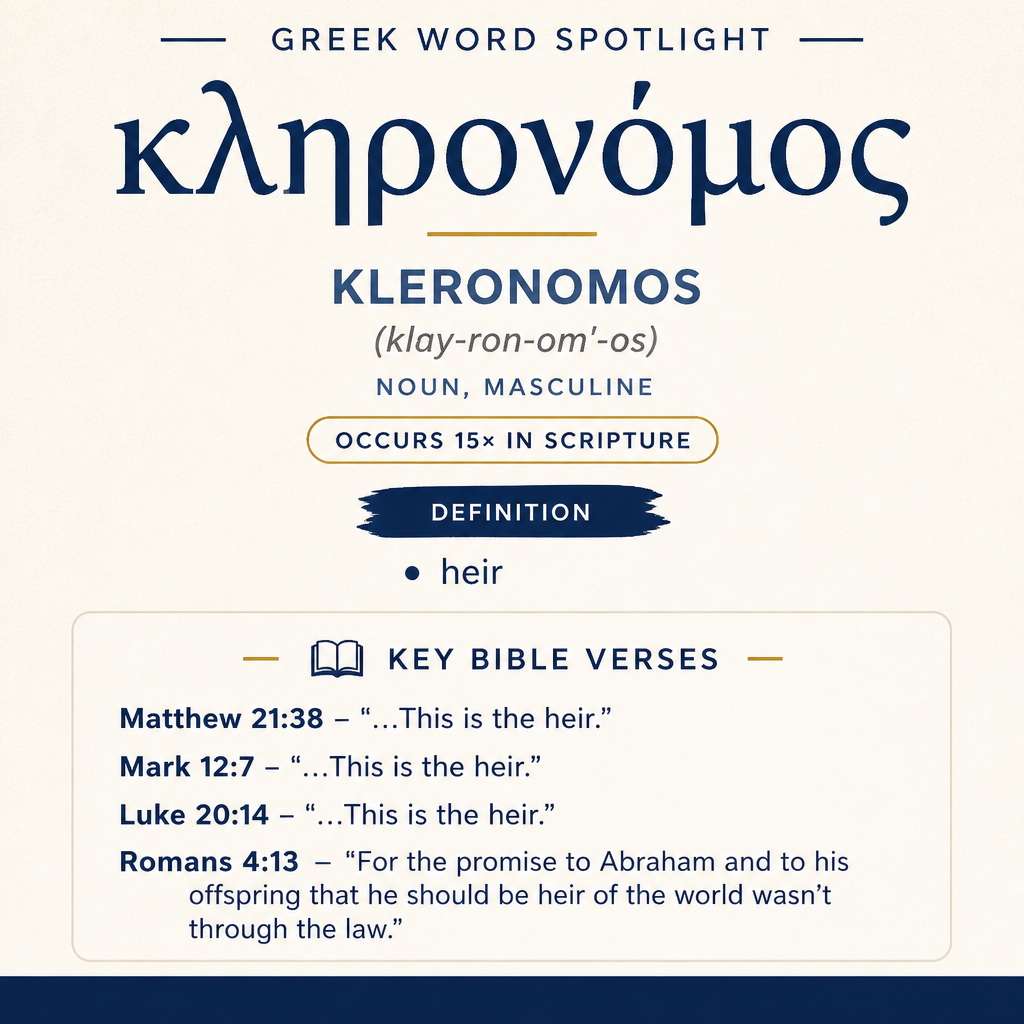
κληρονόμος means “heir” and occurs 15 times in Scripture, including Matthew 21:38 and Romans 8:17.
Core Meaning
κληρονόμος is defined as “heir.” It denotes one who receives an inheritance.
Learn More →Gospel Parables
In Matthew 21:38, Mark 12:7, and Luke 20:14, the farmers identify the son as “the heir.” They plot to kill him and seize the inheritance.
Learn More →Pauline Usage
Romans and Galatians use κληρονόμος for “heirs” in connection with promise and inheritance (Romans 4:13–14; Galatians 3:29; 4:1). Romans 8:17 speaks of being “heirs of God and joint heirs with Christ.”
Learn More →κληρονόμος is the term for an “heir,” someone designated to receive what belongs to another. Across its New Testament occurrences, it appears both in Jesus’ vineyard parables and in apostolic teaching that frames promise, sonship, and hope in inheritance language.
Occurrences
Matthew 21:38: “But the farmers, when they saw the son, said among themselves, ‘This is the heir. Come, let’s kill him, and seize his inheritance.’”
Here “the heir” is the identifying claim the farmers make about “the son.” The force of the word is practical and calculating: because he is the heir, they treat his death as a path to “seize his inheritance.” The heir is thus the one whose relationship to the property explains both his presence and the farmers’ violent strategy.
Mark 12:7: “But those farmers said among themselves, ‘This is the heir. Come, let’s kill him, and the inheritance will be ours.’”
Mark presents the same recognition in a compressed, blunt form. “Heir” is the pivot of their reasoning: once they label him the heir, they move immediately to murder, imagining that the inheritance, detached from its rightful heir, can be transferred to themselves—“the inheritance will be ours.”
Luke 20:14: ““But when the farmers saw him, they reasoned among themselves, saying, ‘This is the heir. Come, let’s kill him, that the inheritance may be ours.’”
Luke emphasizes the internal deliberation (“they reasoned among themselves”). The word “heir” again signals rightful claim, and the plot is explicitly framed as a way to redirect ownership: “that the inheritance may be ours.” In this setting, being the heir is not merely a family status; it is the legal and relational position that stands between the farmers and what they want.
Romans 4:13: “For the promise to Abraham and to his offspring that he should be heir of the world wasn’t through the law, but through the righteousness of faith.”
In Romans, “heir” anchors a statement about how a promise is received. Abraham is spoken of as “heir of the world,” and the verse sets “through the law” over against “through the righteousness of faith.” The term “heir” therefore carries the idea of receiving what is promised, and Paul uses it to argue that the means of reception is faith-righteousness rather than law.
Romans 4:14: “For if those who are of the law are heirs, faith is made void, and the promise is made of no effect.”
This verse turns the previous claim into a conditional warning. If “those who are of the law are heirs,” then two consequences follow: “faith is made void” and “the promise is made of no effect.” “Heirs” is the contested category—who properly stands to receive the promise. Paul’s reasoning treats heirship as bound up with the integrity of “faith” and “promise.”
Romans 8:17: “and if children, then heirs: heirs of God and joint heirs with Christ, if indeed we suffer with him, that we may also be glorified with him.”
Here “heirs” is derived from “children”: “if children, then heirs.” The word is expanded by two clarifying phrases: “heirs of God” and “joint heirs with Christ.” In the same sentence, the path of lived experience is linked—“if indeed we suffer with him”—and the outcome is paired—“that we may also be glorified with him.” “Heirs” thus names a belonging and a future receiving that is connected to shared suffering and shared glory.
Galatians 3:29: “If you are Christ’s, then you are Abraham’s offspring and heirs according to promise.”
In Galatians, heirship is tied to identity: “If you are Christ’s.” The verse places “offspring” alongside “heirs,” and it locates the basis in “promise.” The term “heirs” therefore functions as a status conferred within a defined relationship (“Christ’s”) and within a defined framework (“according to promise”).
Galatians 4:1: “But I say that so long as the heir is a child, he is no different from a bondservant, though he is lord of all,”
This occurrence explores the heir’s position in time. The heir can be “a child,” and in that stage “he is no different from a bondservant,” even while another truth stands: “though he is lord of all.” The word “heir” carries the future right, while the verse highlights that present experience may not yet reflect that right.
Galatians 4:7: “So you are no longer a bondservant, but a son; and if a son, then an heir of God through Christ.”
Galatians returns to the contrast with “bondservant.” The movement is relational and then legal: “no longer a bondservant, but a son; and if a son, then an heir.” “Heir of God through Christ” gives the heir’s reference point (God) and the mediating relationship (“through Christ”). The word marks the culminating status after the change from servitude to sonship.
Titus 3:7: “that being justified by his grace, we might be made heirs according to the hope of eternal life.”
In Titus, heirship is presented as an intended outcome of grace: “being justified by his grace, we might be made heirs.” The phrase “according to the hope of eternal life” attaches heirship to a forward-looking expectation. “Heirs” here is not merely a label for possession; it is a status aligned with “hope,” oriented to “eternal life.”
Hebrews 1:2: “has at the end of these days spoken to us by his Son, whom he appointed heir of all things, through whom also he made the worlds.”
Hebrews uses “heir” to describe the Son’s appointed role: “he appointed heir of all things.” The word underscores a comprehensive scope (“of all things”) and an intentional designation (“appointed”). In the same verse, the Son is also the agent “through whom also he made the worlds,” placing heirship alongside a cosmic work and a climactic act of divine speech.
Hebrews 6:17: “In this way God, being determined to show more abundantly to the heirs of the promise the immutability of his counsel, interposed with an oath,”
Here “heirs” is plural and communal: “the heirs of the promise.” The verse describes God’s purpose toward them—“determined to show more abundantly… the immutability of his counsel”—and the action taken—he “interposed with an oath.” The word “heirs” frames the audience of God’s confirmatory action: those positioned to receive the promise are the ones to whom God shows, abundantly, the unchanging character of his counsel.

Sense and Usage
Across these passages, κληρονόμος consistently functions as a relationship-term that points to receipt. In the vineyard parables (Matthew 21:38; Mark 12:7; Luke 20:14), the “heir” is singled out as the one whose connection to the inheritance is so direct that removing him is imagined to remove the obstacle to possession. The word therefore carries an implicit contrast between rightful recipient and wrongful taker: the farmers’ plan relies on recognizing the heir’s status while rejecting the heir himself.
In Paul’s letters, “heir” becomes a way to speak about promise and belonging. Romans 4:13–14 binds heirship to the logic of promise: who counts as heir determines whether “faith” remains meaningful and whether “the promise” remains effective. Galatians 3:29 similarly sets heirship “according to promise,” but it places that promise within the identity marker “Christ’s,” pairing “heirs” with “Abraham’s offspring.” In both letters, the word works as a shorthand for receiving what promise pledges, while the surrounding argument clarifies the basis and boundary of that receiving.
Romans 8:17 and Galatians 4:7 connect heirship to sonship: “if children, then heirs” and “if a son, then an heir of God through Christ.” In these lines, “heir” is not detached from relationship; it follows from being named a child or son. Yet the word is not purely present-tense. Galatians 4:1 can speak of an heir whose current experience resembles a “bondservant,” showing that heirship may be true even when its practical enjoyment is delayed. Romans 8:17 extends the horizon further by linking heirship with a shared path (“we suffer with him”) and a shared destination (“we may also be glorified with him”). Titus 3:7 adds the dimension of hoped-for fulfillment: being “made heirs” is aligned “according to the hope of eternal life.”
Hebrews uses κληρονόμος in two complementary directions. Hebrews 1:2 assigns heirship to the Son—“he appointed heir of all things”—establishing a singular, comprehensive heir. Hebrews 6:17 addresses “the heirs of the promise,” describing how God strengthens their confidence by an oath, so that they see more abundantly “the immutability of his counsel.” In Hebrews, then, the word can name both the appointed heir and the community who stand to receive what God has promised, with divine action aimed at confirming the certainty of that reception.
Imagery
The word’s imagery in these texts alternates between field and household, between contested property and assured promise. In the parables, the heir walks into a vineyard already claimed by others, and the title “heir” becomes the spark of conflict over an inheritance. In the epistles, the same term shifts into the language of family—children, sons, and joint heirs—and into the language of steadfast promise, where heirship is anchored in what God appoints, promises, and confirms by oath.
Sources: Lexical data from Strong’s Exhaustive Concordance and the Translators Brief Lexicon of Extended Strongs for Greek (STEPBible, CC BY). Occurrence data from the Translators Amalgamated Greek New Testament (STEPBible, CC BY). Scripture quotations from the World English Bible (public domain).