
Exploring the Meaning of Kleronomia in Greek
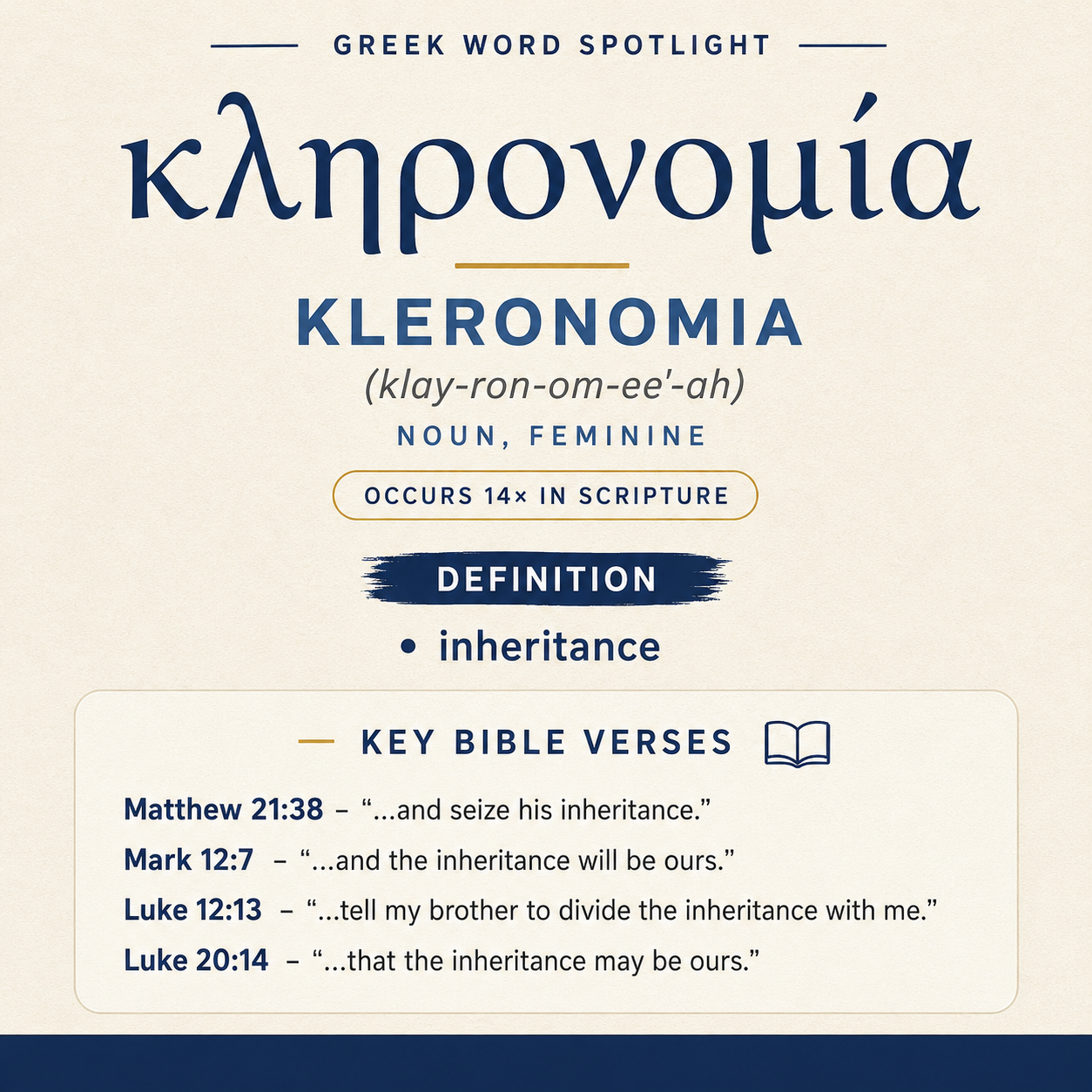
κληρονομία means “inheritance” in Greek and appears 14 times in Scripture, including Matthew 21:38, Mark 12:7, and Luke 12:13.
Gospel Contexts
In Matthew 21:38 and Mark 12:7 it appears in statements about seizing an inheritance. In Luke 12:13 it concerns dividing an inheritance.
Learn More →Acts and Epistles
Acts 7:5 uses it for Abraham receiving no inheritance in the land. Ephesians 1:14 speaks of an inheritance connected with redemption and God’s possession.
Learn More →κληρονομία refers to an “inheritance,” a received possession or share that belongs to an heir. In the passages where it appears, the word moves between ordinary family property, contested claims in parables, and the promised share God gives to those set apart to him.
Occurrences
“But the farmers, when they saw the son, said among themselves, ‘This is the heir. Come, let’s kill him, and seize his inheritance.’” (Matthew 21:38)
Here κληρονομία is the object the farmers want to take. The word sits in a violent plan: recognizing “the son” as “the heir,” they speak of “seiz[ing]” what properly belongs to him. The inheritance is treated as a transferable asset that can be grasped if the heir is removed.

“But those farmers said among themselves, ‘This is the heir. Come, let’s kill him, and the inheritance will be ours.’” (Mark 12:7)
In Mark’s telling the farmers imagine an outcome: if the heir is killed, “the inheritance will be ours.” κληρονομία functions as the prize that motivates the plot, highlighting a logic of wrongful possession—ownership claimed by force rather than by rightful standing.
“One of the multitude said to him, “Teacher, tell my brother to divide the inheritance with me.”” (Luke 12:13)
In this scene κληρονομία is a family estate expected to be “divide[d].” The speaker’s request frames inheritance as a concrete share that can be apportioned between siblings and therefore becomes a matter for adjudication.
“But when the farmers saw him, they reasoned among themselves, saying, ‘This is the heir. Come, let’s kill him, that the inheritance may be ours.’” (Luke 20:14)
Luke again places κληρονομία in the mouth of plotting farmers. The phrasing “that the inheritance may be ours” presents inheritance as something that, in their reasoning, can be redirected to themselves—an anticipated gain produced by eliminating the rightful recipient.
“He gave him no inheritance in it, no, not so much as to set his foot on. He promised that he would give it to him for a possession, and to his offspring after him, when he still had no child.” (Acts 7:5)
Here κληρονομία is explicitly denied in the present (“no inheritance in it”), even to the extent of lacking “so much as to set his foot on.” The verse then contrasts present non-possession with promise: what is not yet held is still spoken of as something that would be “give[n]” as “a possession” to him and to “his offspring after him.” κληρονομία therefore carries the tension between immediate lack and future grant.
“Now, brothers, I entrust you to God and to the word of his grace, which is able to build up, and to give you the inheritance among all those who are sanctified.” (Acts 20:32)
In Paul’s charge, κληρονομία is something God gives, tied to “the word of his grace” that is “able to build up.” The inheritance is also corporate: it is received “among all those who are sanctified,” placing it within a community set apart to God rather than as a private family asset.
“For if the inheritance is of the law, it is no more of promise; but God has granted it to Abraham by promise.” (Galatians 3:18)
This usage places κληρονομία within an argument about how it is received. The verse sets “of the law” against “of promise,” concluding that God “has granted it…by promise.” In this sentence κληρονομία is the granted share whose mode of reception (promise rather than law) is the focus.
“who is a pledge of our inheritance, to the redemption of God’s own possession, to the praise of his glory.” (Ephesians 1:14)
Here κληρονομία is something believers can speak of as “our inheritance,” and it is linked with assurance: “a pledge of our inheritance.” The verse also places the inheritance in a larger trajectory “to the redemption of God’s own possession,” so κληρονομία is not merely a distant idea but a promised reality with a present guarantee.
“having the eyes of your hearts enlightened, that you may know what is the hope of his calling, and what are the riches of the glory of his inheritance in the saints,” (Ephesians 1:18)
κληρονομία here is described with layered language: “the riches,” “the glory,” and “his inheritance in the saints.” The word’s contribution is to name something belonging to God (“his inheritance”) located “in the saints,” and it is something meant to be known through enlightened understanding.
“Know this for sure, that no sexually immoral person, nor unclean person, nor covetous man, who is an idolater, has any inheritance in the Kingdom of Christ and God.” (Ephesians 5:5)
In this warning κληρονομία marks a share “in the Kingdom of Christ and God.” The emphasis falls on exclusion: certain patterns of life are incompatible with “any inheritance” there. The word functions as a boundary-marker—an allotted participation that is not automatically possessed.
“knowing that from the Lord you will receive the reward of the inheritance; for you serve the Lord Christ.” (Colossians 3:24)
Here κληρονομία is framed as something “you will receive…from the Lord,” and it is called “the reward of the inheritance.” The word contributes the idea of a granted share connected with service—“for you serve the Lord Christ”—and therefore presented as something bestowed by the Lord rather than secured by human claim.
“For this reason he is the mediator of a new covenant, since a death has occurred for the redemption of the transgressions that were under the first covenant, that those who have been called may receive the promise of the eternal inheritance.” (Hebrews 9:15)
In Hebrews, κληρονομία is “the eternal inheritance,” and it is explicitly something to be “receive[d]” as “the promise.” The sentence ties this reception to mediation and covenant language: “mediator of a new covenant,” “a death has occurred,” and “redemption of the transgressions.” κληρονομία thus stands as the promised share granted to “those who have been called,” anchored in the covenantal sequence described in the verse.

Sense and Usage
Across these occurrences κληρονομία consistently names a received share that properly belongs to an heir or to designated recipients. In the vineyard-parable settings (Matthew 21:38; Mark 12:7; Luke 20:14), inheritance is envisioned as the owner’s wealth passing to “the son,” and the drama turns on a counterfeit transfer: the farmers speak as though killing the heir can convert what belongs to him into something that “will be ours.” In that setting, κληρονομία highlights the moral contrast between rightful inheritance and attempted seizure, using the language of inheritance to expose the farmers’ presumption.
In everyday social life (Luke 12:13), κληρονομία denotes an estate to be divided, the kind of possession that generates disputes over fairness and allocation. This domestic sense supplies a concrete baseline for the word: inheritance is a definable share that can be apportioned, argued over, and requested.
Acts 7:5 and Galatians 3:18 draw κληρονομία into the realm of promise and grant. Stephen’s wording joins physical and legal imagery (“no…not so much as to set his foot on”) with a forward-looking pledge of possession to offspring, while Paul’s statement turns on the basis by which the inheritance is granted—“by promise.” In these contexts κληρονομία is not seized or divided but bestowed, and the emphasis falls on the giver’s commitment and the future-oriented certainty embedded in promise.
The later epistolary uses develop κληρονομία as a communal and spiritual share. Acts 20:32 frames inheritance as something given “among all those who are sanctified,” embedding it in a sanctified people rather than in a single family line. Ephesians brings a thick set of associations: inheritance is pledged (Ephesians 1:14), contemplated as something whose “riches” and “glory” are to be known (Ephesians 1:18), and treated as an allotted participation within a kingdom (Ephesians 5:5). Colossians 3:24 describes it as something received “from the Lord,” calling it “the reward of the inheritance” in a setting that underscores service to Christ. Hebrews 9:15 intensifies the time-horizon by calling it “eternal,” while still keeping the basic inheritance framework: those who are called “receive the promise” of it, grounded in the mediating work described in the verse.
Imagery
These passages repeatedly picture inheritance as something that can be possessed, withheld, promised, pledged, or seized. The vineyard scenes cast κληρονομία in stark physical terms—an estate that violent tenants believe can become theirs—while Acts and the letters use the same inheritance language to describe a share given by God, associated with sanctification, the kingdom, and the surety of promise and pledge (Acts 20:32; Ephesians 1:14; Hebrews 9:15).
Sources: Lexical data from Strong’s Exhaustive Concordance and the Translators Brief Lexicon of Extended Strongs for Greek (STEPBible, CC BY). Occurrence data from the Translators Amalgamated Greek New Testament (STEPBible, CC BY). Scripture quotations from the World English Bible (public domain).




