Exploring the Meaning of Keramikos in Greek
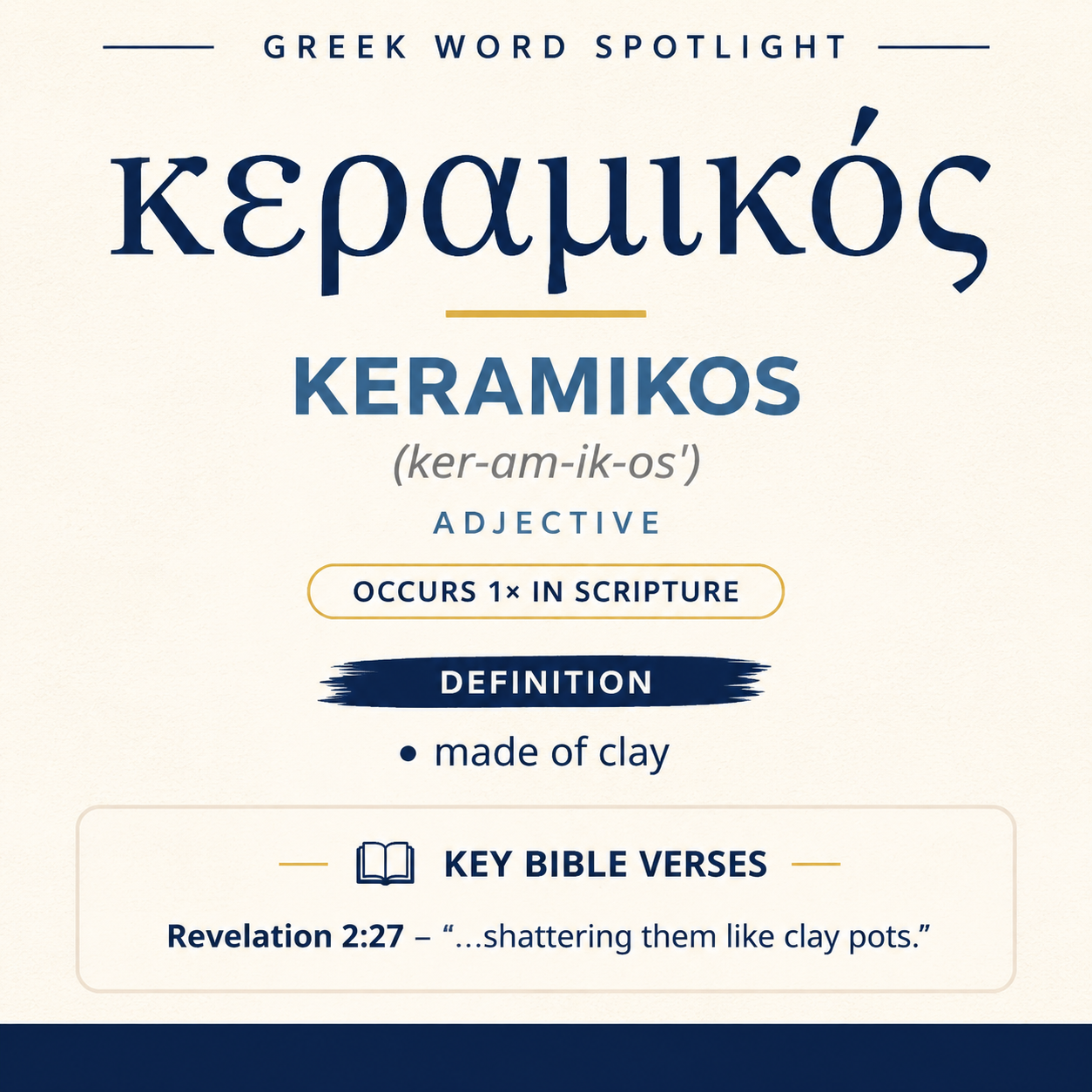
κεραμικός means “made of clay” and appears once in Scripture, in Revelation 2:27.
Verse Context
Revelation 2:27 describes shattering “like clay pots” under a rod of iron.
Learn More →κεραμικός means “made of clay” and appears once in the New Testament, in Revelation 2:27. In that verse it belongs to an image of forceful rule and complete breakage.
Root and Related Words
κεραμικός derives from keramos (κέραμος), “clay roof tile” (Strong’s G2766). The relationship places the adjective in the world of shaped, fired clay as a familiar material object, connecting the term to everyday ceramic items rather than to metals or stone.
Occurrences
“He will rule them with a rod of iron, shattering them like clay pots; as I also have received of my Father:” (Revelation 2:27)
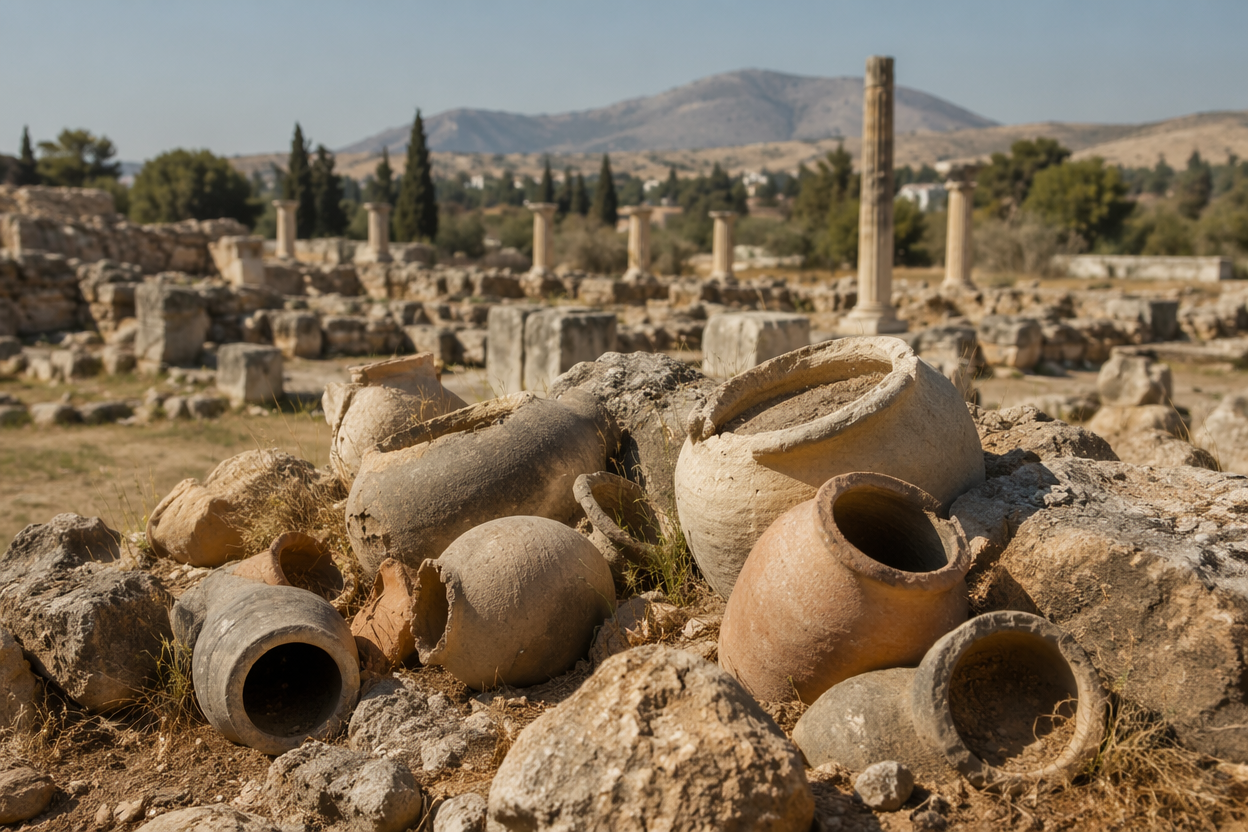
In Revelation 2:27, κεραμικός contributes the material quality of the objects being smashed: they are “clay pots,” items characterized by being made of clay. The verse sets up a stark contrast between the instrument and what it strikes: “a rod of iron” on the one hand, and pots defined by clay on the other. Within the imagery, the adjective does not merely name an object; it foregrounds what the object is made from, and that in turn supports the picture of “shattering.” The action described is not bending, denting, or bruising, but breaking into pieces. The phrase “like clay pots” depends on the ordinary expectations a reader has about pottery: clay vessels are real, solid, and useful, yet they break decisively under sufficient force. The adjective thus helps the line communicate that the described rule has the power to reduce opposition to fragments, not simply to restrain it.
The second half of the sentence, “as I also have received of my Father,” frames the action as delegated authority. Within that frame, the clay-made quality of the pots intensifies the sense of inevitability: the same authority that wields “a rod of iron” is portrayed as fully capable of producing the outcome likened to shattered clayware. The comparison works because the material is common and recognizable; it is not an exotic substance but a basic one, and so the picture is immediate and concrete.
Sense and Usage
The sense “made of clay” is straightforward and physical, marking composition rather than shape, size, color, or function. In Revelation 2:27 the adjective is deployed where material composition matters: clay is the relevant feature because it naturally fits the verb “shattering” in the simile. The line does not aim to describe pottery in a neutral, craft-focused way; it employs clayness as a rhetorical cue for breakability when confronted with superior force. In this usage, being clay-made is not praised or admired; it serves the comparison by highlighting the outcome of impact.
Because the verse already supplies “rod of iron,” the adjective’s contribution can be seen in the way it helps structure the contrast: iron suggests hardness and strength, while clay suggests a formed object that can be broken. The adjective therefore functions as a compact way to bring the sensory world of ceramics into the sentence—something shaped from earth, used as a vessel, and liable to be shattered. The effect is not abstract; it is tactile and audible, inviting the reader to imagine the brittle crack and the scattering fragments implied by “shattering.”
At the same time, κεραμικός remains an adjective of composition, not a verb of breaking and not a noun for the pot itself. Its role is to qualify the “pots” in a way that makes the comparison work. The simile does not need many details; “clay pots” provides enough to carry the force of the image. The adjective thus exemplifies how a single material descriptor can bear a significant part of a verse’s emotional and rhetorical weight, anchoring a claim about rule and judgment in a simple, physical reality.
Imagery
Revelation 2:27 sets a scene in which the soundness of “iron” and the clay-made nature of the “pots” collide. By specifying that the pots are made of clay, κεραμικός helps the verse evoke a decisive, irreversible kind of breaking—an image of authority that does not merely press down but shatters what is struck.
Sources: Lexical data from Strong’s Exhaustive Concordance and the Translators Brief Lexicon of Extended Strongs for Greek (STEPBible, CC BY). Occurrence data from the Translators Amalgamated Greek New Testament (STEPBible, CC BY). Scripture quotations from the World English Bible (public domain).