Exploring the Meaning of Kerameus in Greek
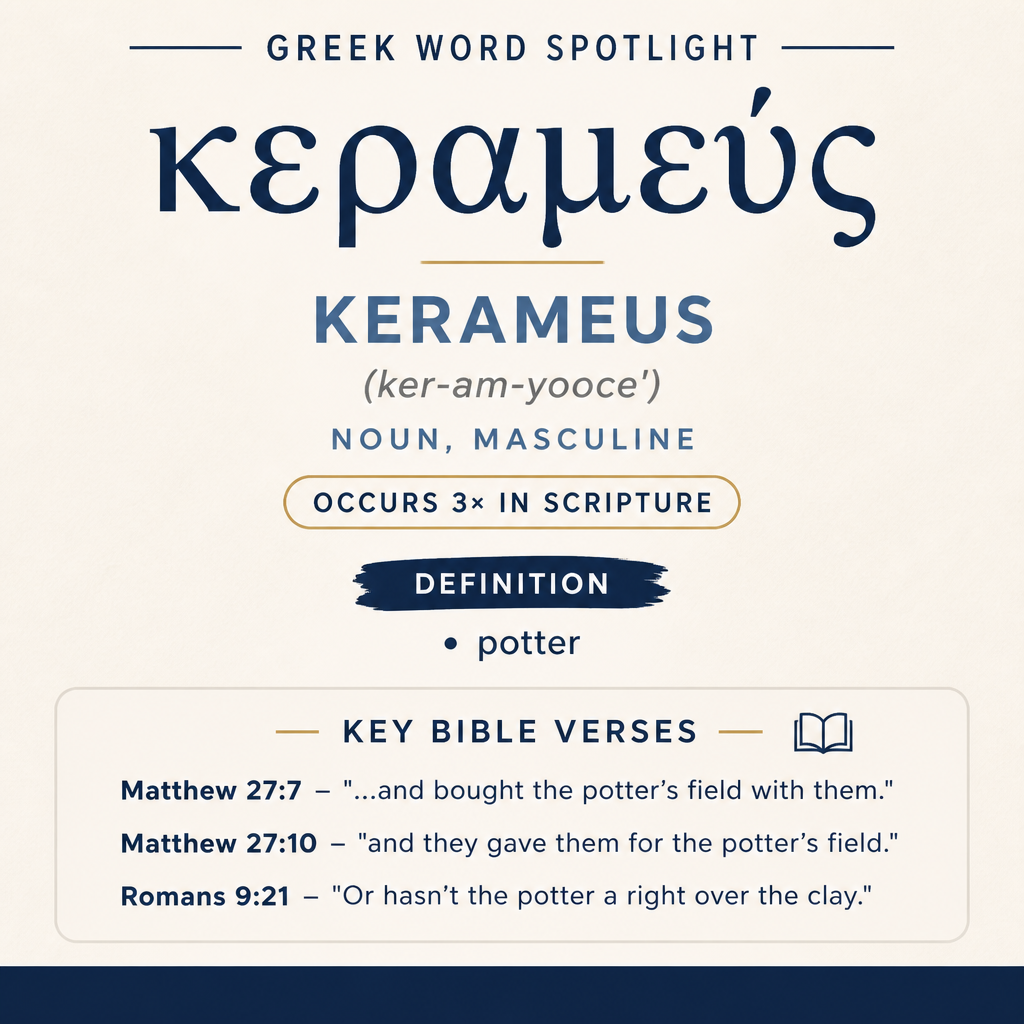
κεραμεύς means “potter” and appears three times in Scripture: Matthew 27:7, Matthew 27:10, and Romans 9:21.
Gospel Context
In Matthew 27:7 and 27:10, it appears in the phrase “the potter’s field.”
Learn More →Pauline Usage
In Romans 9:21, the potter is described as having a right over the clay to make different vessels.
Learn More →κεραμεύς refers to a “potter,” and in the New Testament it appears in two closely linked lines in Matthew’s account of a purchased burial field and once in Paul’s illustration about shaping clay into different kinds of vessels. Across these passages the word points either to a specific plot of land associated with a potter or to the familiar craftsperson whose hands and rights over clay make the illustration work.
Root and Related Words
κεραμεύς is connected with keramos (κέραμος), “clay roof tile” (Strong’s G2766). The related term anchors the word in the world of baked clay and the work that produces and handles it.
Occurrences
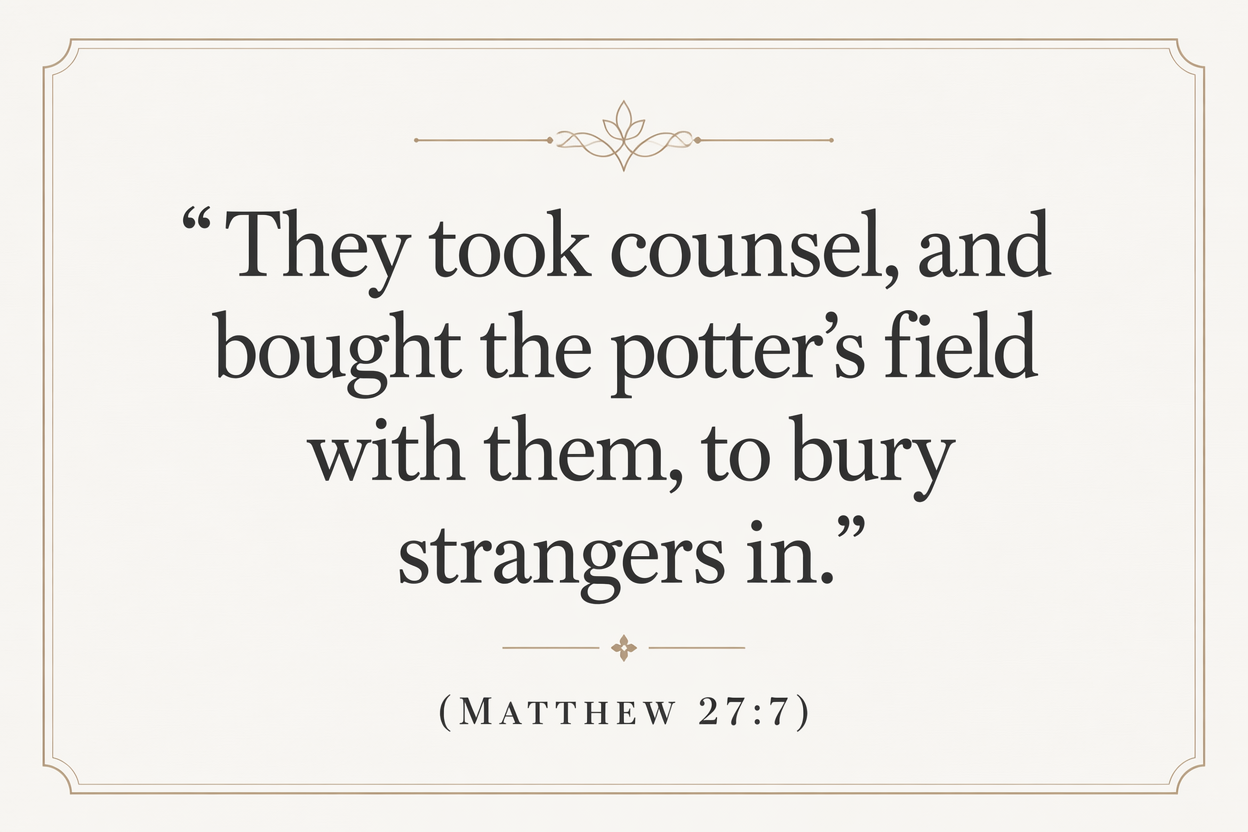
“They took counsel, and bought the potter’s field with them, to bury strangers in.” (Matthew 27:7)
Here κεραμεύς functions as a descriptive marker for a particular location: “the potter’s field.” The verse itself sets the scene in a decision made after deliberation (“They took counsel”) and carried out in a purchase (“bought”). By attaching the field to “the potter,” the word helps the reader identify the field not merely as any tract of land but as one known by its association with a potter—either by ownership, prior use, or public designation embedded in the name. In this sentence the point is not the craft of making pottery but the way the potter’s association names a place that becomes the solution to a specific need: “to bury strangers in.” The word thus grounds the action in a concrete, ordinary setting (a field tied to a common trade) while the purpose of the purchase frames the field as a space set aside for those who do not otherwise belong within the community’s usual burial arrangements.
“and they gave them for the potter’s field, as the Lord commanded me.” (Matthew 27:10)
Matthew repeats the phrase “the potter’s field,” and κεραμεύς again works as the identifying adjective that fixes the destination of the money: “they gave them for the potter’s field.” The verse is brief but loaded with direction and intention: the funds are not simply spent, but “gave … for” a defined end, the field already marked out by its association with a potter. In the logic of the sentence, the phrase is the focal point that gathers up the action—money moving to a place—and connects it with a sense of obligation: “as the Lord commanded me.” Within this line, “the potter” is not a character in the scene, speaking or acting; the term is a label that makes the transaction specific and reportable. The effect is to keep the reader’s attention on the concrete endpoint of the giving: a particular field, known by that trade-based designation, standing as the tangible result of the decision and the giving.
“Or hasn’t the potter a right over the clay, from the same lump to make one part a vessel for honor, and another for dishonor?” (Romans 9:21)
In Romans 9:21, κεραμεύς shifts from a place-name association to a craftsman in an argument. Paul frames a rhetorical question around the potter’s “right over the clay,” and the word supplies the human agent whose expertise and authority make the illustration intelligible. The imagery depends on the basic situation the sentence sketches: there is “the clay,” there is “the same lump,” and there is the potter who “make[s]” from it. The potter’s action is presented as purposeful division—“one part … and another”—with the outcome described in terms of resulting vessels. In this verse the potter is the one who decides what each portion becomes, and the word carries the weight of a recognized craft in which shaping and producing vessels from clay is normal, skillful, and intentional. The contrast between “a vessel for honor” and “another for dishonor” is not explained in technical pottery terms; instead the potter’s role in producing divergent outcomes from one lump supplies the analogy’s force. κεραμεύς is therefore essential to the picture: without the potter, “clay,” “lump,” and “vessel” would lack the decisive agent whose right and making bring the image to life.
Sense and Usage
Across these three occurrences, κεραμεύς stays close to the plain sense of a potter, yet it is used in two distinct ways that show how a straightforward trade term can carry narrative and argumentative weight.
In Matthew, the word is embedded in a fixed phrase—“the potter’s field”—and the potter’s significance is indirect. The story’s action revolves around counsel, purchase, and the designation of a burial place for “strangers,” while the potter is present only through the field’s identifying label. Even so, the label accomplishes several things within the narrative economy of a single sentence: it distinguishes this field from other fields, ties the purchase to a known location, and anchors the outcome of the deliberation in a named place with a recognizable association. The potter’s trade, implicit in the title, makes the field sound ordinary and local—exactly the sort of place that can be bought and repurposed for a practical end. The word therefore contributes specificity and concreteness: a burial arrangement is not left abstract but attached to a particular plot of land remembered by its connection to a potter.
In Romans, by contrast, the potter is not a background label but the central actor. The sentence leans on the everyday logic of craft: someone who works with clay has “a right over the clay,” and the same raw material can be formed into differing results. κεραμεύς names the figure whose hands, judgment, and control are assumed by the illustration, and the vocabulary around it (“clay,” “same lump,” “make,” “vessel”) frames the potter’s work as both authoritative and deliberate. The potter is presented not merely as someone who produces pottery, but as the one whose rightful agency explains the diversity of outcomes. The definition “potter” is therefore not only a job title here; it is the key that unlocks the analogy’s internal coherence, because the rhetorical question expects the reader to grant the potter’s prerogative as self-evident.
Placed side by side, these uses show how κεραμεύς can point either to a person directly (Romans) or to an associative marker that names something else (Matthew). In both settings the word keeps its footing in ordinary life: a potter’s field is a real location that can be purchased, and a potter working clay is a familiar image of skilled making. The passages employ that ordinariness differently—Matthew to ground a transaction in a known place, and Romans to frame a question about rights, formation, and the contrasting status of finished vessels.
Imagery
The three texts evoke two complementary pictures. Matthew presents a field known by its link to a potter, a piece of land whose identity is so settled that it can be referenced without further explanation: “the potter’s field” (Matthew 27:7; Matthew 27:10). Romans presents the workshop image itself: “the potter” facing “the clay,” dividing “the same lump,” and producing distinct “vessel[s]” (Romans 9:21). Together these scenes keep κεραμεύς rooted in tangible realities—land, clay, and crafted vessels—so that the word’s everyday referent can support both narrative specificity and a tightly drawn illustration.
Sources: Lexical data from Strong’s Exhaustive Concordance and the Translators Brief Lexicon of Extended Strongs for Greek (STEPBible, CC BY). Occurrence data from the Translators Amalgamated Greek New Testament (STEPBible, CC BY). Scripture quotations from the World English Bible (public domain).