Exploring the Meaning of Kenos in Greek
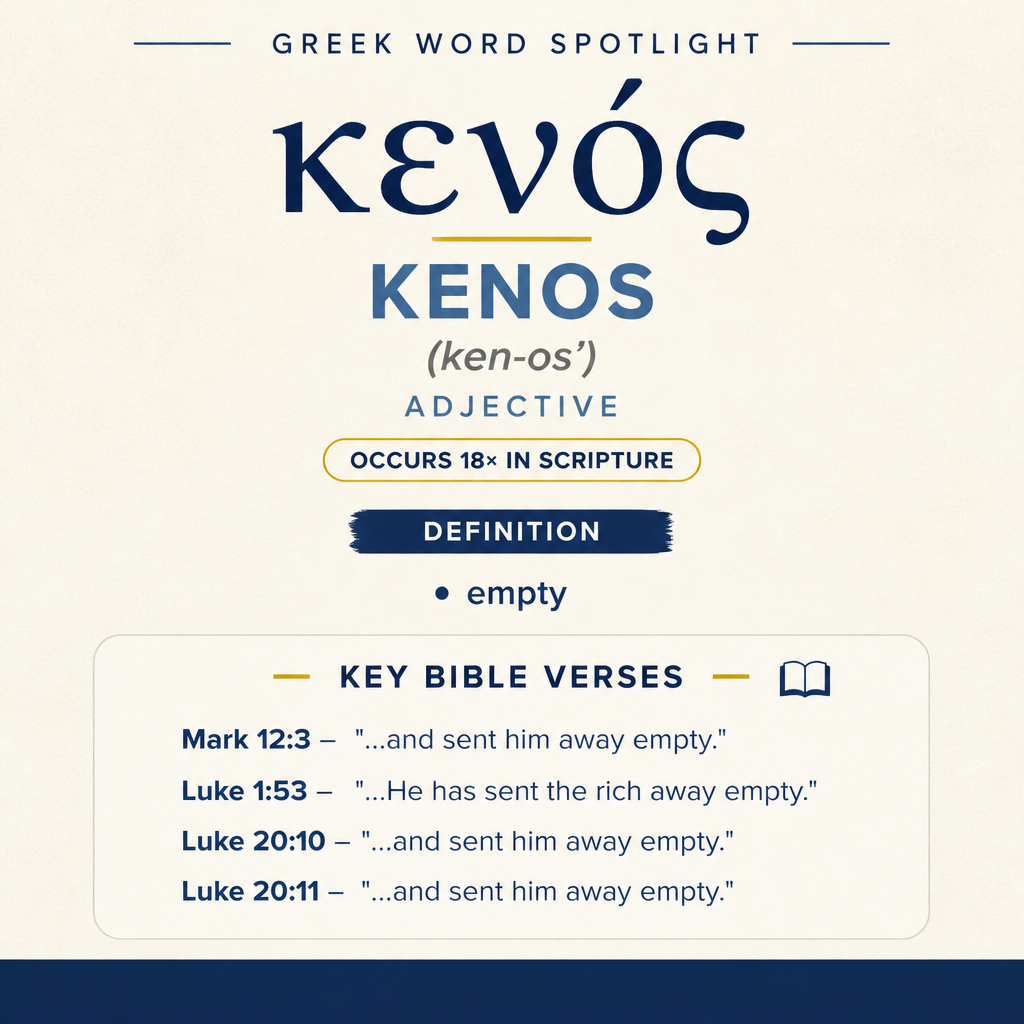
κενός (Kenos) means “empty” and appears 18 times in Scripture, including Mark 12:3, Luke 1:53, Luke 20:11, Acts 4:25, and 1 Corinthians 15.
Core Meaning
κενός is defined as “empty.” In Mark 12:3 and Luke 1:53, people are sent away empty.
Learn More →Narrative Examples
In Luke 20:11, a servant is beaten, treated shamefully, and sent away empty. Acts 4:25 uses it for a “vain thing” plotted by the peoples.
Learn More →Paul’s Contrast
In 1 Corinthians 15:10, Paul says God’s grace to him was not futile. In 1 Corinthians 15:14, without Christ’s resurrection, preaching and faith are in vain.
Learn More →κενός carries the sense “empty,” and it appears in narrative scenes of sending someone away without gain as well as in argumentative and exhortative passages that speak of what proves empty when it lacks a real outcome. The occurrences below show the word applied to hands, words, plans, preaching, faith, labor, grace received, and even an apostle’s life-course when measured by its result.
Occurrences
Mark 12:3: “They took him, beat him, and sent him away empty.”
In the parable setting, κενός marks the servant’s return as a return with nothing to show for the mission. The servant is not merely rejected; the sending ends in an emptied outcome—no collected fruit, no delivered share—paired with violence (“beat him”). The word sharpens the injustice: the servant’s departure is as barren as his treatment is harsh.
Luke 1:53: “He has filled the hungry with good things. He has sent the rich away empty.”
Here κενός stands in deliberate contrast with “filled.” The hungry receive “good things,” while “the rich” are dismissed with an emptiness that answers to their status: they go away without the “good things” just mentioned. The line frames emptiness as the condition of those who are sent away lacking what others are given, making the word function as the opposite pole to being filled.
Luke 20:10: “At the proper season, he sent a servant to the farmers to collect his share of the fruit of the vineyard. But the farmers beat him, and sent him away empty.”
κενός again describes the servant’s dismissal, now in a vineyard collection scene. The mission has a concrete goal (“collect his share of the fruit”), and “empty” states that the servant departs without any portion at all. The word underscores the refusal to render what is due; the emptiness is the farmers’ chosen result for the owner’s representative.
Luke 20:11: “He sent yet another servant, and they also beat him, and treated him shamefully, and sent him away empty.”
The repetition intensifies the pattern: another sending, another beating, another empty return. κενός functions almost like a refrain that marks the persistent denial of fruit. Joined to “treated him shamefully,” the word depicts not only lack of produce but also the humiliation of a messenger whose work is nullified by the farmers’ actions.
Acts 4:25: “who by the mouth of your servant, David, said, ‘Why do the nations rage, and the peoples plot a vain thing?”
In this prayerful quotation, κενός characterizes what “the peoples plot” as something empty in substance. The scene sets “rage” alongside plotting; κενός assesses the plot’s content as lacking what would make it weighty or effective. The word thereby casts the nations’ opposition as having the character of emptiness even while it is energetically pursued.
1 Corinthians 15:10: “But by the grace of God I am what I am. His grace which was given to me was not futile, but I worked more than all of them; yet not I, but the grace of God which was with me.”
Here κενός is used to deny emptiness: grace “was not futile.” The statement links emptiness to a life or ministry that would lack true effect, and it contrasts that with vigorous labor (“I worked more than all of them”) while still grounding the outcome in “the grace of God.” κενός thus marks the opposite of grace that produces real work and result.
1 Corinthians 15:14: “If Christ has not been raised, then our preaching is in vain, and your faith also is in vain.”
κενός evaluates two central realities—“preaching” and “faith”—as empty if the stated condition holds. The word functions as a verdict on content and outcome: preaching would be an empty proclamation, and faith would be an empty reliance, should the resurrection not be true. The sentence shows κενός applied to the core of Christian message and response, not to objects in the hand but to what gives those activities substance.
1 Corinthians 15:58: “Therefore, my beloved brothers, be steadfast, immovable, always abounding in the Lord’s work, because you know that your labor is not in vain in the Lord.”
Against the possibility of emptiness, κενός is again negated: “your labor is not in vain in the Lord.” The exhortations (“steadfast, immovable, always abounding”) assume labor that could be questioned for its payoff; κενός names that feared outcome and then denies it. The phrase “in the Lord” places the labor within a sphere where emptiness does not have the last word.
2 Corinthians 6:1: “Working together, we entreat also that you do not receive the grace of God in vain,”
κενός is used to warn against grace received in an empty manner—received without the fullness of response that would make the reception meaningful. The speaker’s posture (“we entreat”) and the collaborative frame (“Working together”) treat the danger as serious: grace can be present as a gift and yet be rendered empty in the way it is received.
Galatians 2:2: “I went up by revelation, and I laid before them the Good News which I preach among the Gentiles, but privately before those who were respected, for fear that I might be running, or had run, in vain.”
Here κενός qualifies “running” as the metaphor for apostolic effort over time. The fear is not of exertion itself but of exertion culminating in emptiness—work expended without the kind of outcome that would confirm its course. The word lends weight to the private laying out of the message: it is an action taken so that the long run would not end up empty.
Ephesians 5:6: “Let no one deceive you with empty words. For because of these things, the wrath of God comes on the children of disobedience.”
κενός describes “words” that are empty in the service of deception. The term does not merely call the words unhelpful; it frames them as lacking substance while still having power to mislead (“deceive you”). The follow-on warning about wrath and “children of disobedience” sets “empty words” in a morally charged context: emptiness here is linked with speech that tries to hollow out truth and dull accountability.
Philippians 2:16: “holding up the word of life, that I may have something to boast in the day of Christ, that I didn’t run in vain nor labor in vain.”
In this pastoral aim, κενός is used twice for the feared alternative to a fruitful ministry: running empty and laboring empty. The instruction “holding up the word of life” is tied to the apostle’s hope of having “something to boast in the day of Christ,” and κενός names what would erase that hope—effort that ends with nothing to show for it.

Sense and Usage
Across these passages κενός consistently marks emptiness as a deficit of outcome, substance, or content. In the parabolic narratives (Mark 12:3; Luke 20:10–11), the word is concrete and situational: a servant is sent for fruit and returns with empty hands, the emptiness functioning as evidence of rejection and wrongdoing. Luke 1:53 broadens the same idea into a reversal motif: one group is “filled,” another is sent away empty, so emptiness becomes a social and spiritual condition described in terms of lack.
In Acts 4:25, emptiness attaches to a plotted “thing,” bringing κενός into the realm of plans and intentions. The word assesses the plot as empty even while it is energetically pursued, showing that κενός can evaluate not only what is possessed but also what is proposed.
In the Pauline texts, κενός repeatedly appears as a test of what counts as real. It can describe the hypothetical collapse of foundational realities (“our preaching is in vain, and your faith also is in vain,” 1 Corinthians 15:14), and it can be denied of grace and labor when those are shown to have true effect (1 Corinthians 15:10; 15:58). The term also warns that something genuinely given—“the grace of God”—can be received in a way that results in emptiness (2 Corinthians 6:1). Galatians 2:2 and Philippians 2:16 apply κενός to a long course of ministry pictured as running and laboring: emptiness is not mere tiredness but the horror of expended effort emptied of lasting result.
Ephesians 5:6 uses κενός for speech: “empty words” are language without substance that nevertheless seeks to deceive. This use shows emptiness not as neutral lack but as a quality that can be weaponized—hollow talk that attempts to persuade without truth.
Imagery and Force
κενός carries a vivid picture of dismissal with nothing gained: servants walking away empty after being beaten (Mark 12:3; Luke 20:10–11), and the rich sent away empty in contrast to the hungry being filled (Luke 1:53). In the letters, the same emptiness becomes a measuring line for message, faith, grace, speech, and lifelong effort: what is empty is what ends without substance, without fitting response, or without a result that can stand.
Sources: Lexical data from Strong’s Exhaustive Concordance and the Translators Brief Lexicon of Extended Strongs for Greek (STEPBible, CC BY). Occurrence data from the Translators Amalgamated Greek New Testament (STEPBible, CC BY). Scripture quotations from the World English Bible (public domain).