
Exploring the Meaning of Kenophonia in Greek
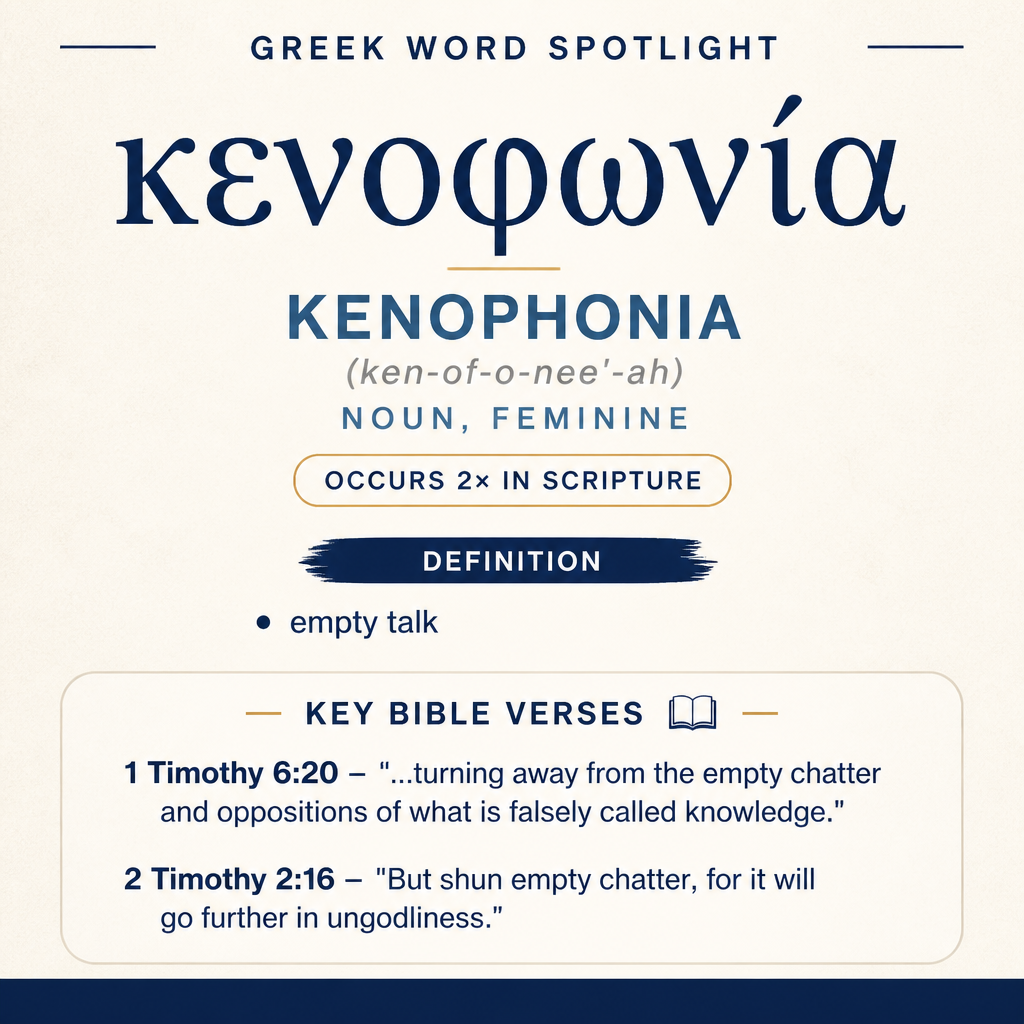
κενοφωνία means “empty talk” and appears twice in Scripture: 1 Timothy 6:20 and 2 Timothy 2:16.
Scripture Occurrences
It occurs 2 times in Scripture, in 1 Timothy 6:20 and 2 Timothy 2:16.
Learn More →Biblical Context
In 1 Timothy 6:20 and 2 Timothy 2:16 it is linked with “empty chatter” to be avoided.
Learn More →κενοφωνία means “empty talk,” and it appears in two Pastoral Epistle warnings about speech that must be avoided. In both places it is set over against faithful safeguarding of what has been entrusted and against a life ordered toward godliness.
Root and Related Words
Kenophonia is formed from kenos (κενός), “empty,” and phone (φωνή), “voice/sound: voice.”

Occurrences
“Timothy, guard that which is committed to you, turning away from the empty chatter and oppositions of what is falsely called knowledge,” (1 Timothy 6:20)
Here kenophonia stands within a direct pastoral charge: “guard that which is committed to you.” The command does not treat speech as a minor side issue; it places this “turning away” alongside the central task of guarding what has been entrusted. The “empty chatter” is portrayed as something Timothy must actively refuse—speech he must not entertain, repeat, or allow to occupy space in the stewardship he has received.
The verse also frames this talk as argumentative: “empty chatter and oppositions.” Kenophonia is not only useless noise; it is paired with “oppositions,” verbal resistance that sets itself against the entrusted deposit. The line “of what is falsely called knowledge” further locates this chatter within a claim to insight or learning. Within this single sentence, empty talk is linked with a posture that sounds intellectual (“knowledge”) while being fundamentally misleading (“falsely called”). Thus kenophonia functions as a label for speech that presents itself as significant but does not deserve Timothy’s attention because it pulls him away from the work of guarding what is truly committed to him.
“But shun empty chatter, for it will go further in ungodliness,” (2 Timothy 2:16)
In this second occurrence, kenophonia again appears as something to refuse: “shun empty chatter.” The command is short and forceful, emphasizing separation rather than engagement. Unlike a call to refute, the verb “shun” assumes that there are kinds of talk best handled by avoidance, not by ongoing participation.
The reason given is an effect on conduct: “for it will go further in ungodliness.” Kenophonia is depicted as speech with momentum. It does not remain contained at the level of conversation; it spreads, “go[ing] further,” and its direction is toward “ungodliness.” The talk is “empty,” yet it is not harmless; it is empty in content or worth while still being potent in consequence. In this verse, the word marks a kind of speech that, once welcomed, tends to expand its influence and carry people along into patterns that oppose godliness.
Sense and Usage
Across these two settings, kenophonia describes talk evaluated as empty, but the emptiness is shown in two complementary ways. In 1 Timothy 6:20, it is empty because it distracts from guarding what has been entrusted and because it is bound up with “oppositions” and the prestige of “what is falsely called knowledge.” The emptiness is exposed by contrast: it is not the solid substance to be guarded, but the chatter to be turned away from. In 2 Timothy 2:16, the emptiness is exposed by outcome: it does not produce godliness but advances “ungodliness.”
The verses also show that kenophonia is recognized not merely by its sound but by its relational and moral setting. It stands near conflict (“oppositions”) and misnaming (“falsely called knowledge”) in one passage, and near moral decline (“ungodliness”) in the other. This anchors the word in real pastoral discernment: empty talk is identified as speech that consumes attention and generates friction while lacking the substance that belongs to faithful stewardship and godly life.
The repeated commands—“turning away” and “shun”—give kenophonia a practical contour. The word does not invite curiosity or debate; it is treated as a category of talk that must be refused for the sake of protection and purity. The first passage highlights protection of a trust (“guard that which is committed to you”), suggesting that empty talk can function like a breach in a guarded boundary. The second highlights moral trajectory (“will go further in ungodliness”), suggesting that empty talk acts like a path that keeps extending in the wrong direction. In both, the emptiness is not a neutral description; it is a warning label.
Because kenophonia is built from terms for “empty” and “voice,” it naturally fits these passages’ emphasis on audible, social speech—what is said, traded, and circulated. The problem is not that words are spoken, but that this particular kind of speaking lacks worthy substance while still making claims (“knowledge”) and exerting pressure (“oppositions”), and while still producing real spiritual damage (“ungodliness”). The verses therefore treat kenophonia as speech that sounds active and even sophisticated, but proves hollow where it matters: it neither safeguards the entrusted charge nor supports a godly life.
Imagery
The imagery carried by kenophonia in these warnings is of talk that fills the air without filling the soul. In 1 Timothy 6:20 it crowds near the guarded trust, like noise at the edge of something precious that must be protected. In 2 Timothy 2:16 it is pictured as speech that keeps moving—“go[ing] further”—as though empty words can still travel and take people with them into “ungodliness.”
Sources: Lexical data from Strong’s Exhaustive Concordance and the Translators Brief Lexicon of Extended Strongs for Greek (STEPBible, CC BY). Occurrence data from the Translators Amalgamated Greek New Testament (STEPBible, CC BY). Scripture quotations from the World English Bible (public domain).





