Exploring the Meaning of Katecho in Greek
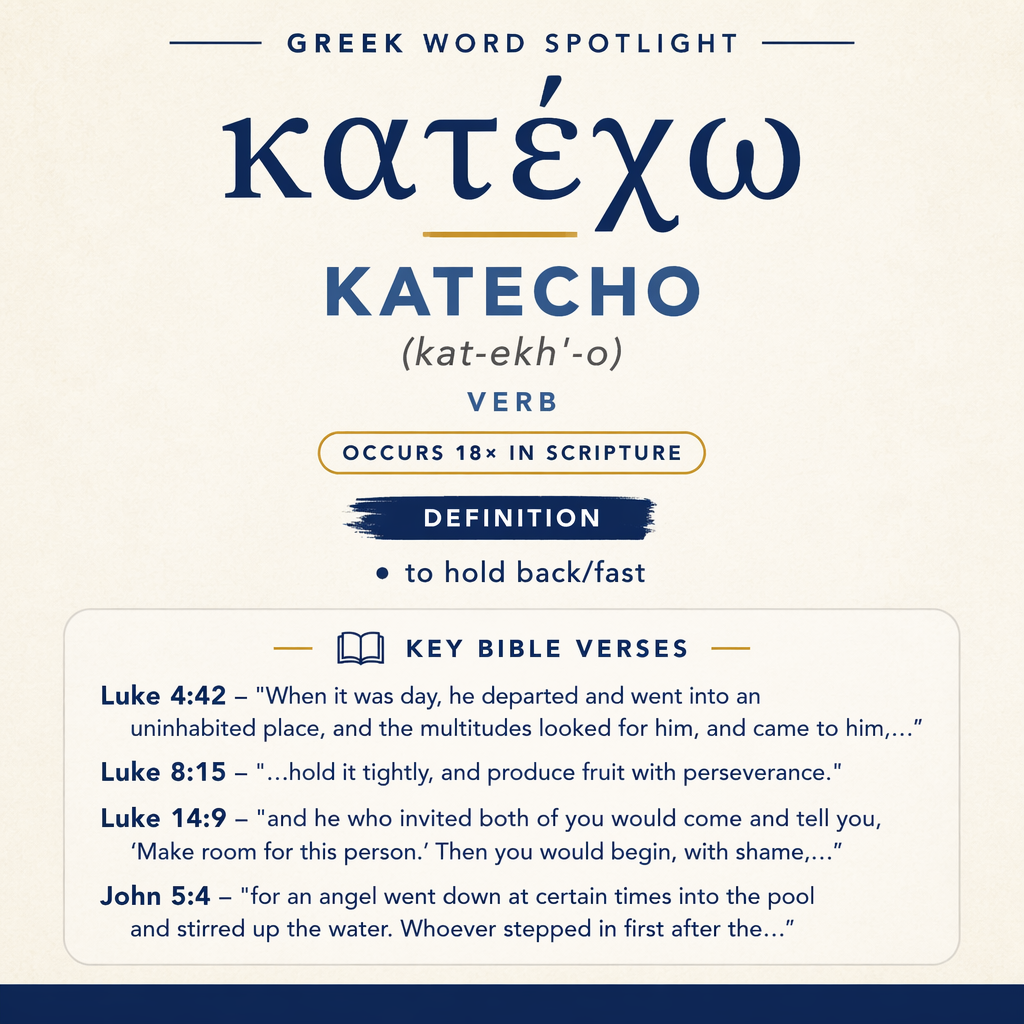
κατέχω (Katecho) means “to hold back/fast” and occurs 18 times in Scripture, including Luke, John, Acts, Romans, and 1 Corinthians.
Core Meaning
κατέχω means “to hold back/fast.” In Luke 8:15 it is used of holding the word tightly.
Learn More →Where It Appears
This verb occurs 18 times in Scripture. Listed occurrences include Luke 4:42; Luke 8:15; Luke 14:9; John 5:4; Acts 27:40; Romans 1:18; Romans 7:6; and 1 Corinthians 7:30.
Learn More →Usage Examples
In Romans 1:18 it refers to suppressing the truth. In Romans 7:6 it describes being held under something from which believers are discharged.
Learn More →κατέχω expresses the act of holding fast or holding back, whether that involves clinging to a person, retaining a message, restraining something, or being kept under a binding condition. In the passages where it appears, it ranges from physical grasping and nautical action to moral and doctrinal steadfastness.
Occurrences
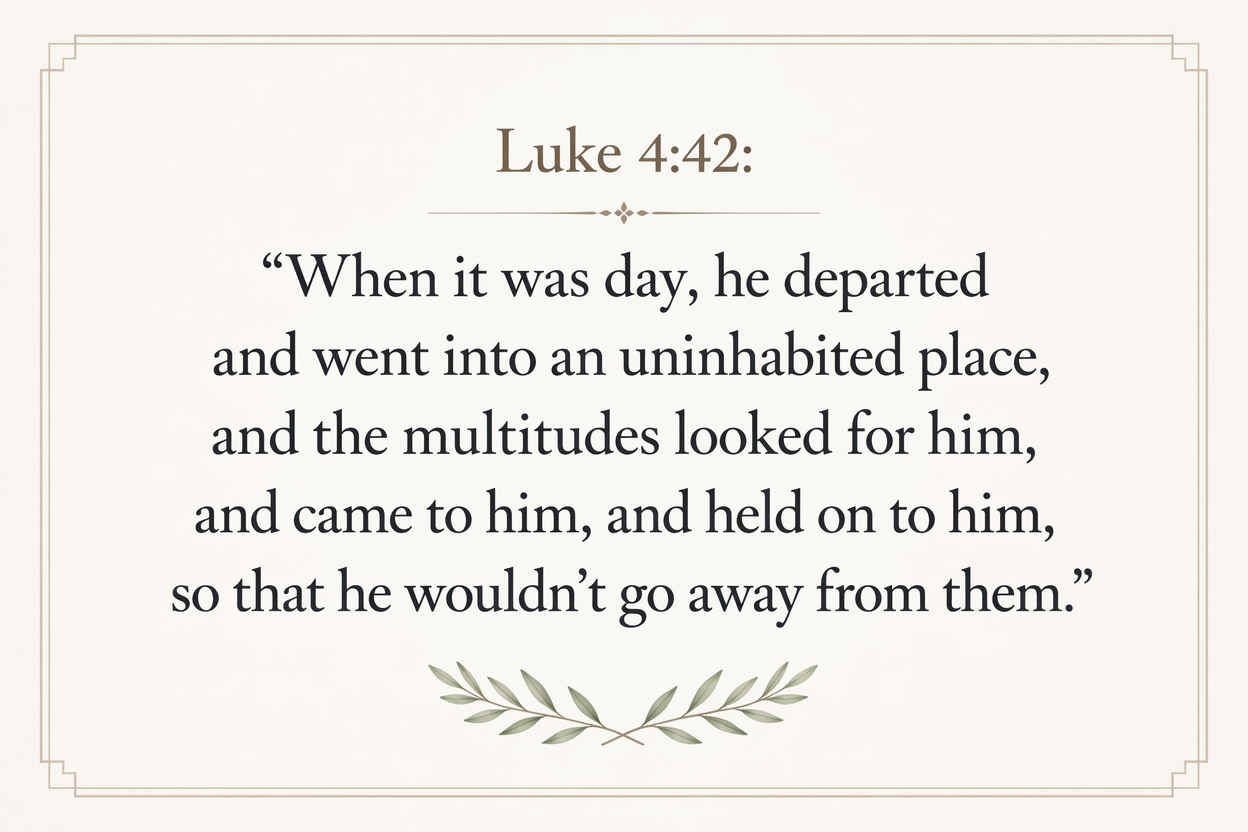
Luke 4:42: “When it was day, he departed and went into an uninhabited place, and the multitudes looked for him, and came to him, and held on to him, so that he wouldn’t go away from them.”
Here the verb is embodied and immediate: the crowd “held on to him” with the practical aim “so that he wouldn’t go away from them.” The holding is a kind of restraint—an attempt to keep Jesus present by preventing departure. In this scene, κατέχω has the texture of physical insistence: the multitude seeks to retain access to him by holding him back from leaving.
Luke 8:15: “Those in the good ground, these are those who with an honest and good heart, having heard the word, hold it tightly, and produce fruit with perseverance.”
The holding shifts from grasping a person to retaining “the word.” The phrase “hold it tightly” places the emphasis on firm retention after hearing, and the result is long-term: “produce fruit with perseverance.” The verb thus supports an image of sustained adherence—keeping hold of what has been received so that it remains effective over time rather than slipping away.
Luke 14:9: “and he who invited both of you would come and tell you, ‘Make room for this person.’ Then you would begin, with shame, to take the lowest place.”
In this setting of social seating and honor, the action described (“to take the lowest place”) uses the verb in the sense of taking hold of a position—grasping or occupying a place when forced to yield a higher one. The movement is downward and reluctant, framed by “shame,” so the holding is not celebratory possession but the compelled taking of what remains.
John 5:4: “for an angel went down at certain times into the pool and stirred up the water. Whoever stepped in first after the stirring of the water was healed of whatever disease he had.”
The verse narrates a sequence of movement and timing: descent, agitation of water, then the first to enter is healed. Within that competitive moment, κατέχω contributes the idea of holding back—an implied restraint that delays until the “certain times” and until after “the stirring of the water.” The focus is not on the one who holds, but on conditions that restrain action until the decisive moment.
Acts 27:40: “Casting off the anchors, they left them in the sea, at the same time untying the rudder ropes. Hoisting up the foresail to the wind, they made for the beach.”
On the ship, the narrative is full of controlled release. The sailors “Casting off the anchors” and “untying the rudder ropes” depict the letting go of what had held the vessel in place or held parts in a fixed state. Against that backdrop, κατέχω belongs to the world of restraint and its removal: what is held back is intentionally released so forward motion becomes possible—“they made for the beach.”
Romans 1:18: “For the wrath of God is revealed from heaven against all ungodliness and unrighteousness of men who suppress the truth in unrighteousness,”
Here κατέχω is applied to “the truth,” not as something cherished but as something “suppress[ed] … in unrighteousness.” The verb conveys an active holding-down: the truth is restrained, kept from free course, in a moral posture that the sentence identifies as “ungodliness and unrighteousness.” The holding is thus not neutral; it functions as obstruction.
Romans 7:6: “But now we have been discharged from the law, having died to that in which we were held; so that we serve in newness of the spirit, and not in oldness of the letter.”
The verb describes a former condition: “that in which we were held.” The image is of being kept in a binding frame—held within something that constrained service. The contrast clarifies the kind of holding in view: being held is linked with “oldness of the letter,” while release enables “newness of the spirit.” κατέχω here conveys constraint experienced as a state one can be discharged from.
1 Corinthians 7:30: “and those who weep, as though they didn’t weep; and those who rejoice, as though they didn’t rejoice; and those who buy, as though they didn’t possess;”
The clause “those who buy, as though they didn’t possess” uses the verb to express having a hold on something—possession as a kind of grasp. Yet the exhortation is to live “as though” that hold were not ultimate. In this context, κατέχω points to ordinary holding/possessing, while the surrounding phrasing relativizes it: the buyer’s grip is treated as something one must not cling to as defining reality.
1 Corinthians 11:2: “Now I praise you, brothers, that you remember me in all things, and hold firm the traditions, even as I delivered them to you.”
The verb frames the community’s faithful continuity: “hold firm the traditions” exactly “as I delivered them to you.” The holding is careful and conserving, guarding what has been handed over. In this scene, κατέχω highlights steadfast maintenance—retaining an entrusted pattern rather than letting it loosen, drift, or be replaced.
1 Corinthians 15:2: “by which also you are saved, if you hold firmly the word which I preached to you—unless you believed in vain.”
Again the object is “the word,” and the holding is decisive: “you are saved, if you hold firmly.” The verb marks the continuing grip that corresponds to a faith that does not empty out into “vain” belief. The scene is not about the initial hearing but about persevering retention—keeping the preached word held fast as the ongoing posture of belief.
2 Corinthians 6:10: “as sorrowful, yet always rejoicing; as poor, yet making many rich; as having nothing, and yet possessing all things.”
The closing paradox uses the language of possession: “having nothing, and yet possessing all things.” κατέχω contributes to the idea of holding or having, but here in a strikingly expansive way. The line sets ordinary lack (“having nothing”) alongside a counterintuitive holding (“possessing all things”), so the verb participates in the rhetoric of contrast—what can be held is not limited to visible assets.
1 Thessalonians 5:21: “Test all things, and hold firmly that which is good.”
This imperative ties discernment to retention. After “Test all things,” the proper outcome is to “hold firmly that which is good.” κατέχω here is selective and evaluative: one does not hold everything indiscriminately, but clings to what has been recognized as good, maintaining it against pressure, decay, or distraction.

Sense and Usage
Across these passages, κατέχω consistently depicts a strong grip—either exercised upon something or experienced as a state of being kept. In narrative scenes, that grip can be concrete: the crowd restrains Jesus’ movement by holding on to him (Luke 4:42), and maritime restraints are released so the ship can move toward shore (Acts 27:40). Even when the action is not explicitly physical, the verb still carries the force of constraint: people can restrain the truth by holding it down (Romans 1:18), and a former regime can hold persons within a binding condition from which they are later discharged (Romans 7:6).
When the object is a message or pattern—“the word” (Luke 8:15; 1 Corinthians 15:2) or “the traditions” (1 Corinthians 11:2)—κατέχω portrays persistence. The holding is not momentary but sustained, with consequences that stretch over time: fruit “with perseverance” grows from holding the word tightly (Luke 8:15), and saving continuance is linked to holding firmly the preached word (1 Corinthians 15:2). The verb thus suits contexts where continuity matters: the core issue is not merely receiving but keeping hold.
The word also flexes naturally into the sphere of possession. Buying can result in “possess[ing]” (1 Corinthians 7:30), yet that possession is treated lightly within a larger call to live without being dominated by present states. In a related but heightened contrast, one can be described as “having nothing, and yet possessing all things” (2 Corinthians 6:10). In these lines, κατέχω expresses holding as “having,” while the surrounding rhetoric qualifies what counts as real or ultimate possession.
Finally, several occurrences show that holding can be either commendable or blameworthy depending on what is held and why. Holding the good firmly follows testing (1 Thessalonians 5:21), and holding traditions is praised when they remain as delivered (1 Corinthians 11:2). Conversely, “suppress[ing] the truth in unrighteousness” (Romans 1:18) uses the same fundamental idea—holding fast/holding down—but now as obstruction. The verb’s range, within these verses, therefore turns not on a change in basic action but on the object and moral direction of the grip.
Imagery
The passages place κατέχω in vivid contrasts of movement and restraint: a crowd trying to keep someone from leaving (Luke 4:42), ropes and anchors being released for a final run to shore (Acts 27:40), and truth either pressed down (Romans 1:18) or clung to with endurance until it bears fruit (Luke 8:15). The word repeatedly evokes hands that either cling in faithfulness or clamp down in suppression, and the difference is revealed by what is being held and what that holding produces.
Sources: Lexical data from Strong’s Exhaustive Concordance and the Translators Brief Lexicon of Extended Strongs for Greek (STEPBible, CC BY). Occurrence data from the Translators Amalgamated Greek New Testament (STEPBible, CC BY). Scripture quotations from the World English Bible (public domain).