
Exploring the Meaning of Katesthio in Greek
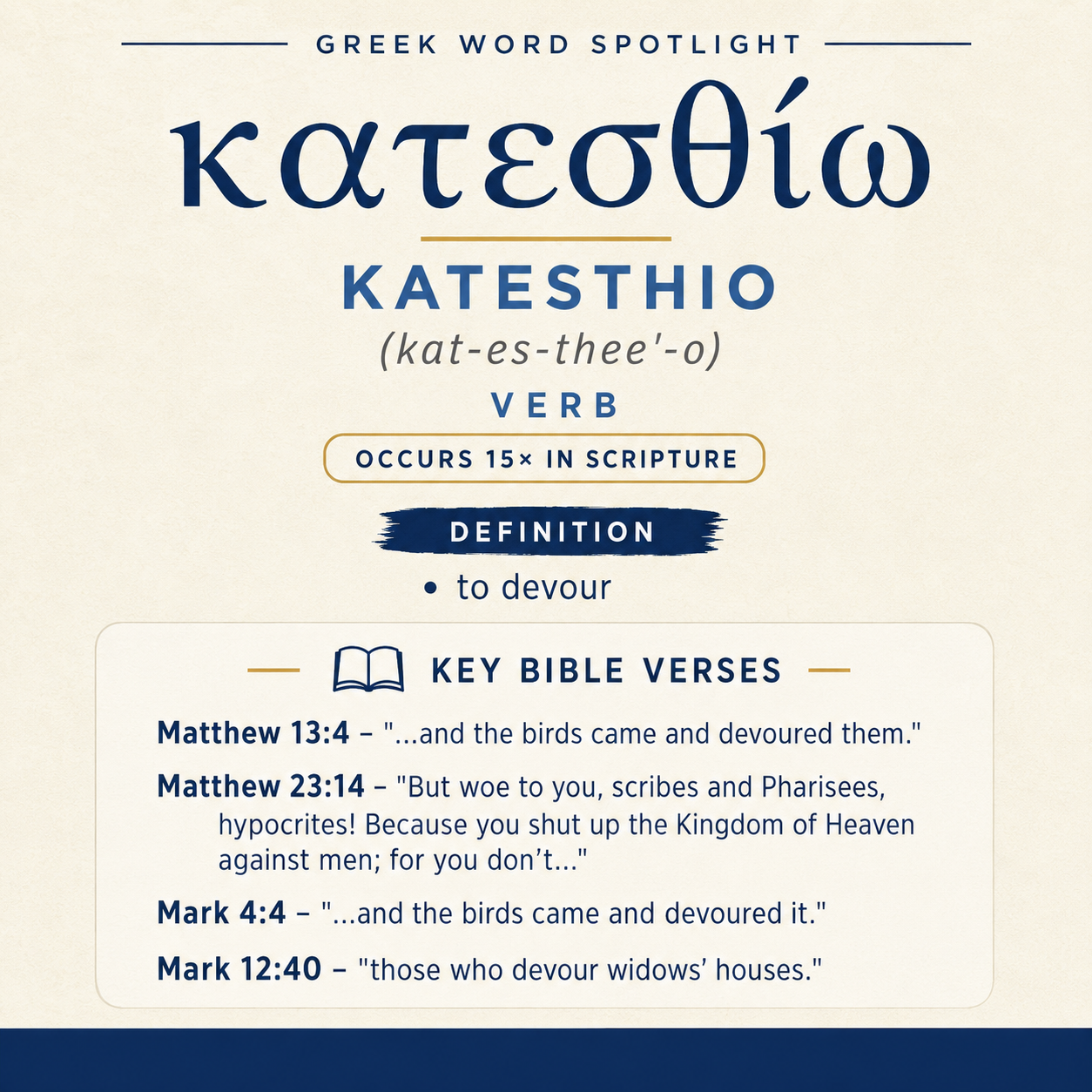
κατεσθίω means “to devour,” occurring 15 times in Scripture, including Matthew 13:4, Mark 4:4, Luke 15:30, and John 2:17.
Core Meaning
κατεσθίω is defined as “to devour.” In John 2:17 it appears as “eat me up.”
Learn More →Parable Contexts
In Matthew 13:4 and Mark 4:4, birds come and devour seed that fell by the road. Luke 8:5 presents the same setting with seed along the road.
Learn More →Moral Warnings
In Mark 12:40 and Luke 20:47 it describes those who “devour widows’ houses.” In Luke 15:30 it describes a son who “has devoured your living.”
Learn More →κατεσθίω expresses the act of devouring, a vivid verb used for birds consuming seed, for people consuming resources, and for a striking act of “eating” that communicates intense inner effect. It appears in Gospel parables and polemical sayings, in apostolic rebuke, and in Revelation’s symbolic eating of a book.
Occurrences
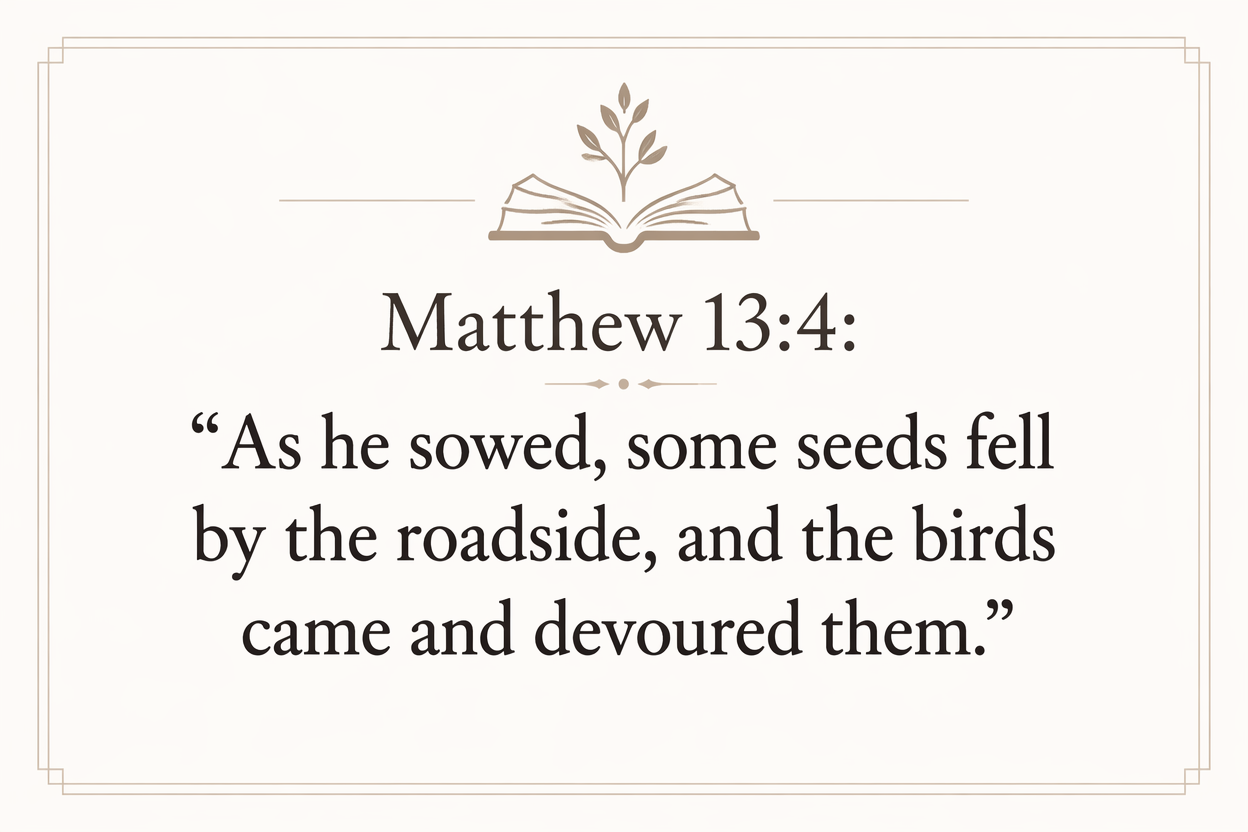
Matthew 13:4: “As he sowed, some seeds fell by the roadside, and the birds came and devoured them.”
Here the verb supplies the parable’s first loss: the seed does not merely lie exposed but is actively taken and consumed by birds. The roadside setting highlights vulnerability; devouring is the decisive action that removes what was sown before it can progress to any later stage.
Matthew 23:14: ““But woe to you, scribes and Pharisees, hypocrites! Because you shut up the Kingdom of Heaven against men; for you don’t enter in yourselves, neither do you allow those who are entering in to enter.”
In this saying the focus is the shutting of access and the blocking of others. The verse frames a setting of exclusion and harm, which elsewhere in similar denunciations is paired with the imagery of consuming what belongs to the vulnerable; the scene’s emphasis is on active wrongdoing that deprives others.
Mark 4:4: “and as he sowed, some seed fell by the road, and the birds came and devoured it.”
Mark’s wording makes the devouring abrupt: seed falls, birds come, and consumption follows. The verb adds a concrete picture of total removal—what was intended for growth becomes food for something else.
Mark 12:40: “those who devour widows’ houses, and for a pretense make long prayers. These will receive greater condemnation.”
Devouring is applied to “widows’ houses,” extending the verb from literal eating to a consuming action directed at someone’s household and security. The surrounding clause, “for a pretense make long prayers,” places the devouring alongside hypocrisy: outward piety masks inward taking, and the consequence named is “greater condemnation.”
Luke 8:5: ““The farmer went out to sow his seed. As he sowed, some fell along the road, and it was trampled under foot, and the birds of the sky devoured it.”
Luke combines two destructive actions: trampling and devouring. The verb depicts the finality of the birds’ action after the seed has already been damaged underfoot; devouring completes the loss, leaving nothing to sprout.
Luke 15:30: “But when this your son came, who has devoured your living with prostitutes, you killed the fattened calf for him.’”
In the older brother’s protest, devouring describes the wasteful consumption of “your living.” The verb conveys more than spending in the abstract: it frames the son’s behavior as consuming a finite supply that belonged to the household, intensifying the sense of injury and resentment that fuels the complaint.
Luke 20:47: “who devour widows’ houses, and for a pretense make long prayers: these will receive greater condemnation.”
This matches the charge found in Mark: devouring targets “widows’ houses” and is coupled with religious pretense. The repeated pairing of devouring with “long prayers” sharpens the moral contrast—consumption hidden beneath respectable display—and again the verdict is “greater condemnation.”
John 2:17: “His disciples remembered that it was written, “Zeal for your house will eat me up.””
“Eat me up” presents devouring as what zeal does to the person characterized by it. The verb communicates an internal intensity that consumes the subject—zeal is not mild enthusiasm but something that takes hold with the force of eating.
2 Corinthians 11:20: “For you bear with a man if he brings you into bondage, if he devours you, if he takes you captive, if he exalts himself, or if he strikes you on the face.”
Devouring is placed among a list of abuses: bondage, captivity, self-exaltation, and physical assault. The verb therefore functions as a strong image for an exploitative relationship—being “devoured” stands as one form of being harmed and used, set beside other actions that diminish and dominate.
Galatians 5:15: “But if you bite and devour one another, be careful that you don’t consume one another.”
Here devouring describes community infighting as predatory behavior. Paired with “bite,” the verb evokes escalating harm: hostility that begins in smaller acts can move toward mutual consumption. The warning that follows—“be careful that you don’t consume one another”—keeps the image in view as a threat to the group’s survival and unity.
Revelation 10:9: “I went to the angel, telling him to give me the little book. He said to me, “Take it, and eat it. It will make your stomach bitter, but in your mouth it will be as sweet as honey.””
Devouring becomes an acted command: “Take it, and eat it.” The verb anchors a physical gesture toward “the little book,” and the verse interprets the experience with sensory consequences: sweetness “in your mouth” and bitterness in the stomach. Eating is the means by which the book’s message becomes inwardly experienced.
Revelation 10:10: “I took the little book out of the angel’s hand, and ate it. It was as sweet as honey in my mouth. When I had eaten it, my stomach was made bitter.”
The narrator obeys, repeating the mouth-and-stomach contrast. The verb “ate” marks the completion of the act, and the aftermath—“my stomach was made bitter”—shows devouring as an intake with effects that unfold after the initial sweetness.

Sense and Usage
Across these passages κατεσθίω consistently conveys devouring as a consuming action that removes what is available to be taken. In the sowing scenes (Matthew 13:4; Mark 4:4; Luke 8:5), the verb is concrete and observable: birds devour seed lying exposed on the road. Devouring there is swift, opportunistic, and final; it turns something meant for planting into immediate consumption.
In the accusations against religious leaders (Mark 12:40; Luke 20:47), devouring is aimed not at food but at “widows’ houses.” The verb’s force intensifies the charge: what is taken is pictured as being consumed, leaving the vulnerable depleted. The accompanying mention of “a pretense” and “long prayers” places devouring in a moral frame, where consumption is carried out under cover of public religiosity and is judged with “greater condemnation.”
Luke 15:30 applies devouring to family resources—“your living”—in a setting of conflict over honor and generosity. The older brother’s wording depicts the returning son’s past as consumption that empties the father’s substance, strengthening the sense of disproportion between what was lost and what is now celebrated.
John 2:17 turns the verb inward: zeal “will eat me up.” Devouring functions as an image for being consumed by a driving commitment. The sentence is not about food or theft but about the self being taken over by an intense impulse oriented toward “your house.”
Paul’s rebuke in 2 Corinthians 11:20 shows devouring as one mode of interpersonal abuse within a pattern of domination. The surrounding verbs (“brings you into bondage,” “takes you captive,” “exalts himself,” “strikes you on the face”) depict control and harm; “devours you” fits as an image of being exploited until diminished. Galatians 5:15, by contrast, pictures devouring as mutual: “bite and devour one another.” Here the danger is reciprocal destruction, where conflict within the group threatens to escalate into a consuming cycle.
Revelation 10:9–10 presents devouring as an enacted reception of a “little book.” The act is literal eating within the vision, but the text itself interprets it through taste and bodily consequence—sweetness in the mouth, bitterness in the stomach. Devouring thus becomes a way of describing internalization that is initially pleasant yet ultimately troubling in its aftereffects.
Imagery
The word’s imagery moves from the roadside—birds stripping away unprotected seed—to social and spiritual settings where people or communities can be “devoured” through exploitation or internal hostility. It can also depict an inner consuming force (“Zeal for your house will eat me up,” John 2:17) and a prophetic intake that is sweet at first yet bitter afterward (Revelation 10:9–10). In every setting, devouring communicates consumption with palpable impact: what is devoured is diminished, taken inside, or worn down.
Sources: Lexical data from Strong’s Exhaustive Concordance and the Translators Brief Lexicon of Extended Strongs for Greek (STEPBible, CC BY). Occurrence data from the Translators Amalgamated Greek New Testament (STEPBible, CC BY). Scripture quotations from the World English Bible (public domain).





