
Exploring the Meaning of Katastole in Greek
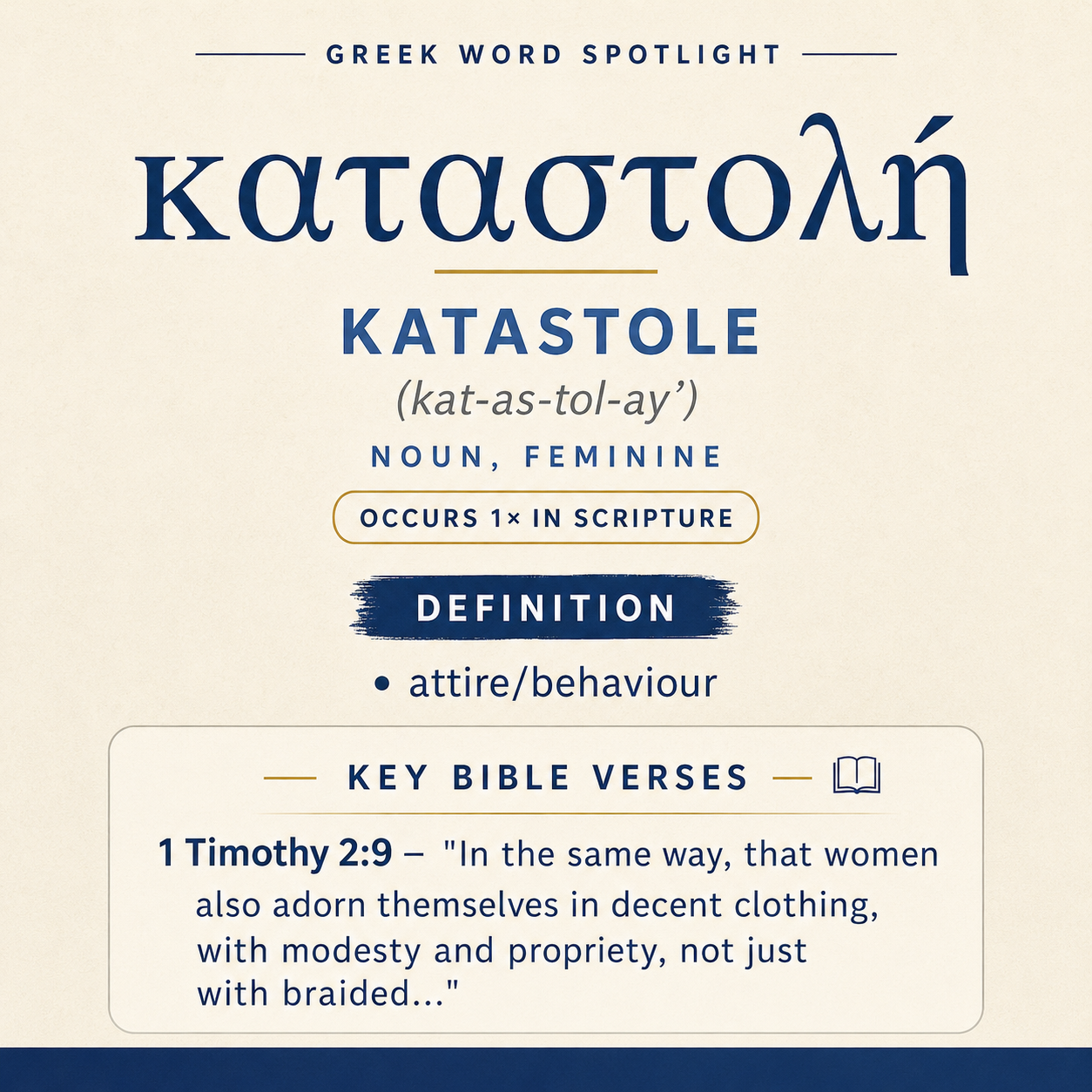
καταστολή means attire/behaviour and appears once in Scripture, in 1 Timothy 2:9.
Verse Context
In 1 Timothy 2:9 it is used in the instruction for women to adorn themselves in decent clothing with modesty and propriety.
Learn More →καταστολή describes a person’s “attire/behaviour” in a way that ties outward presentation to inward decorum. It appears once, in a pastoral instruction about how women are to adorn themselves in gathered Christian life.
Root and Related Words
καταστολή is connected with the verb katastellō (καταστέλλω), “to quiet” (Strong’s G2687). The relationship naturally suggests a link between what is worn or displayed and a settled, restrained manner.

Occurrences
“In the same way, that women also adorn themselves in decent clothing, with modesty and propriety, not just with braided hair, gold, pearls, or expensive clothing,” (1 Timothy 2:9)
Here καταστολή stands in the immediate context of “adorn themselves” and is framed by three paired ideas: (1) what is “decent,” (2) the accompanying qualities of “modesty and propriety,” and (3) a contrast with forms of adornment that draw attention through visible expense (“braided hair, gold, pearls, or expensive clothing”). In this sentence, the word functions as the term that gathers the whole presentation of a woman—both what she wears and how she carries herself—under a standard shaped by decency rather than display.

The verse sets up a clear focus on deliberate self-presentation: the women are to “adorn themselves,” implying intentional choices about appearance. Within that action, καταστολή is qualified by “decent,” so the word does not point to clothing in isolation but to clothing as evaluated according to a public standard of appropriateness. The pairing “with modesty and propriety” further indicates that the external appearance is meant to harmonize with a composed way of acting. The instruction is not presented as mere avoidance; it is a positive call to a kind of adornment that matches the virtues named in the verse.
The negative contrast—“not just with braided hair, gold, pearls, or expensive clothing”—places καταστολή in the realm of visible markers of status and taste, while relativizing them (“not just”) in favor of a more fitting overall presentation. The list of items is concrete and visual; it evokes carefully arranged hair and costly accessories. Against that background, καταστολή draws attention to a different kind of adornment: one where attire and behaviour are coordinated to reflect “modesty and propriety” rather than to project wealth or social standing.
Sense and Usage
Because καταστολή carries the combined sense “attire/behaviour,” it serves as a bridge-word between what can be seen immediately (clothing, grooming, adornment) and what is expressed through conduct (modesty, propriety). In 1 Timothy 2:9, this bridging role is crucial: the verse does not treat appearance as morally neutral or irrelevant, nor does it reduce the issue to a dress code detached from character. Instead, the instruction presents external adornment as meaningful precisely because it communicates and reinforces a manner of life.
Within the verse, the semantic weight of the word is shaped by the adjectives and accompanying phrases surrounding it. “Decent” places the focus on suitability—what fits the setting and the community’s values. “Modesty and propriety” indicates that the outward presentation should be consistent with an inward disposition that does not seek attention or push boundaries of what is fitting. The word’s reach across both attire and behaviour helps the sentence hold these threads together: the visible choices (hair, jewelry, clothing) are not discussed as detached objects but as expressions of how one chooses to appear and act among others.
The contrast with luxurious adornment also clarifies what the word is doing. The verse does not portray braided hair or jewelry as the only possible forms of adornment; rather, it cautions against making these the defining elements of one’s self-presentation. In that setting, καταστολή contributes a broader category that includes clothing and bearing, so that decency, modesty, and propriety are not restricted to the absence of certain accessories. They become the shaping principles for the whole outward life as it meets the eyes of the community.
The related verb katastellō (καταστέλλω), “to quiet,” aligns well with how the verse frames this topic: what is urged is a composed, settled mode of presentation. The point is not an aggressive rejection of beauty, but an ordering of priorities so that outward adornment corresponds to a quieted, self-governed demeanour. In this single occurrence, the word therefore supports a vision of adornment that is socially intelligible (“decent”), ethically marked (“modesty and propriety”), and resistant to being defined by conspicuous expense.
Imagery
The imagery evoked by καταστολή in 1 Timothy 2:9 is that of a person preparing to be seen—choosing clothing and arranging appearance—yet doing so under the guiding aim of decency. The verse sets two pictures side by side: one of careful, costly display (“braided hair, gold, pearls, or expensive clothing”), and one of a restrained, appropriate presentation “with modesty and propriety.” In that contrast, the word gathers the visible and the behavioural into a single, coherent portrait of how a woman’s outward life is to look in public worship and community.
Sources: Lexical data from Strong’s Exhaustive Concordance and the Translators Brief Lexicon of Extended Strongs for Greek (STEPBible, CC BY). Occurrence data from the Translators Amalgamated Greek New Testament (STEPBible, CC BY). Scripture quotations from the World English Bible (public domain).





