Exploring the Meaning of Katastema in Greek
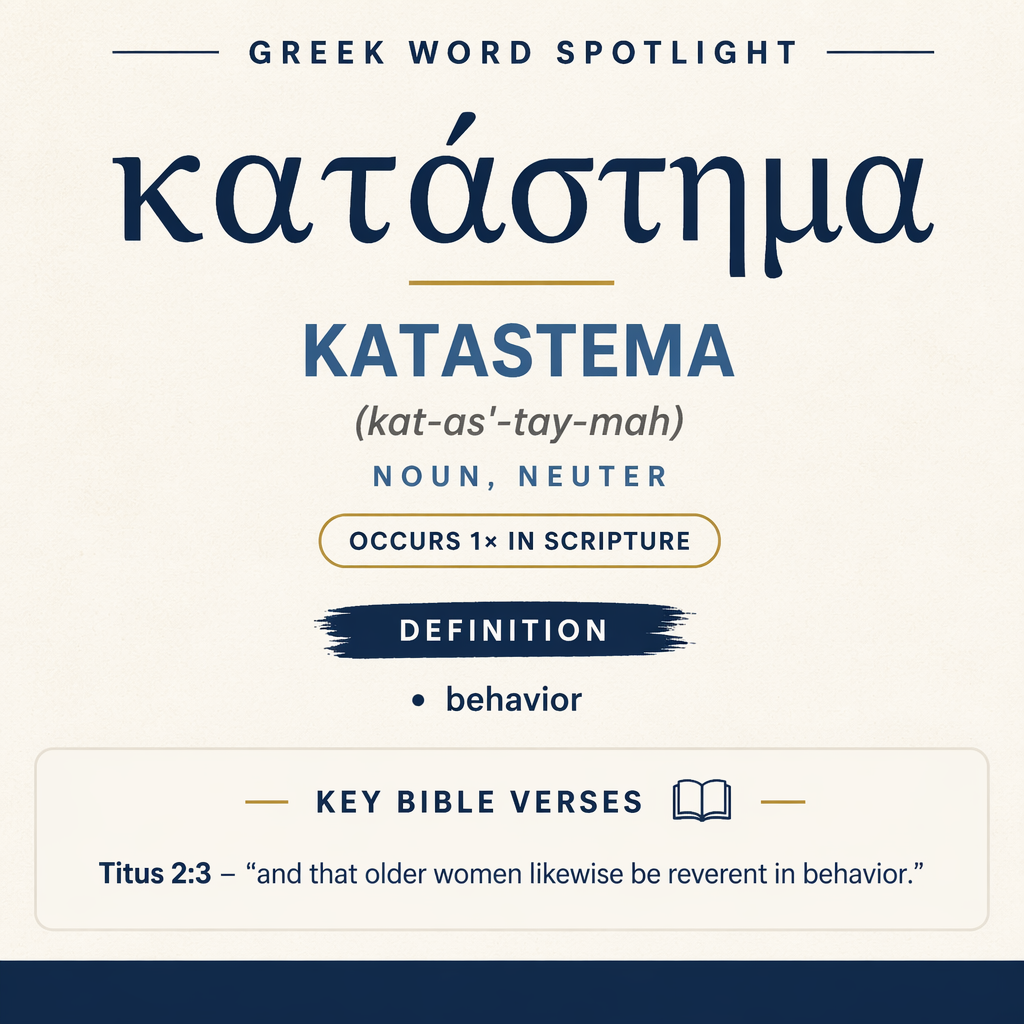
κατάστημα means “behavior” and appears once in Scripture in Titus 2:3.
Context in Titus
In Titus 2:3, older women are instructed to be reverent in behavior.
Learn More →κατάστημα refers to “behavior,” and it appears in a single New Testament instruction about the conduct expected of older women. In its lone context, the word functions as the observable pattern of life that fits a reverent manner.
Root and Related Words
κατάστημα derives from the verb kathistēmi (καθίστημι), “to appoint/conduct” (Strong’s G2525). In Titus 2:3 the noun form gathers the idea of one’s conducted life into a single, speakable category: a person can be described by what their conduct has become.

Occurrences
Titus 2:3 — “and that older women likewise be reverent in behavior, not slanderers nor enslaved to much wine, teachers of that which is good,”
Here κατάστημα names the sphere in which “reverent” is to be seen: not merely in private intention, but in the outwardly recognizable shape of life. The sentence places “reverent in behavior” first and then immediately supplies contrasts and companion traits—“not slanderers nor enslaved to much wine” and “teachers of that which is good.” This arrangement shows behavior as something that includes speech (“not slanderers”), habits and self-mastery (“nor enslaved to much wine”), and positive influence on others (“teachers of that which is good”). The word therefore supports an integrated picture: conduct that can be evaluated by what it avoids and by what it actively produces.
The placement of “likewise” connects this instruction to a wider pattern of ethical exhortation in the immediate discourse, but within this line itself the force is specific: reverence is to characterize an older woman’s ordinary conduct in a way that others can observe and learn from. The expression “teachers of that which is good” also implies that behavior is not silent; it becomes instructive, either directly through teaching or indirectly because a consistent life lends weight to what is taught. In this scene, κατάστημα functions as the practical setting in which reverence becomes concrete.
Sense and Usage
With the definition “behavior,” κατάστημα denotes a person’s lived manner of life as it presents itself in daily patterns. Titus 2:3 frames this behavior as capable of being qualified (“reverent”), bounded (“not slanderers nor enslaved to much wine”), and directed toward the good of others (“teachers of that which is good”). The word is broad enough in this context to cover multiple kinds of conduct without needing separate terms: what one says, what one is controlled by, and what one passes on to others are treated as parts of a single behavioral whole.
The verse also portrays behavior as something that can be shaped into a stable quality. “Reverent in behavior” reads like a settled disposition expressed in consistent practice, rather than a momentary act. By coupling the positive descriptor with two negatives and a positive role, the line suggests that behavior is recognized by patterns: the repeated absence of slander, the refusal to live under the mastery of much wine, and the steady presence of good teaching. Thus κατάστημα here carries the sense of an identifiable mode of life—one that can be either fitting for reverence or compromised by destructive speech and enslavement to a habit.
Because the verse places behavior alongside teaching, it also implies that conduct has communicative power. The instruction does not separate character from public influence; instead, it sets behavior as the ground from which “that which is good” may be taught credibly. In this usage, κατάστημα is not a technical term for a single action but a summary word for the observable course of living in which reverence is displayed.
Imagery
The imagery suggested by this passage is domestic and ordinary: a life seen over time in speech, habits, and instruction. κατάστημα evokes the plain visibility of conduct—what a community hears someone say, sees someone refuse, and learns as someone teaches “that which is good” (Titus 2:3).
Sources: Lexical data from Strong’s Exhaustive Concordance and the Translators Brief Lexicon of Extended Strongs for Greek (STEPBible, CC BY). Occurrence data from the Translators Amalgamated Greek New Testament (STEPBible, CC BY). Scripture quotations from the World English Bible (public domain).