Exploring the Meaning of Katara in Greek
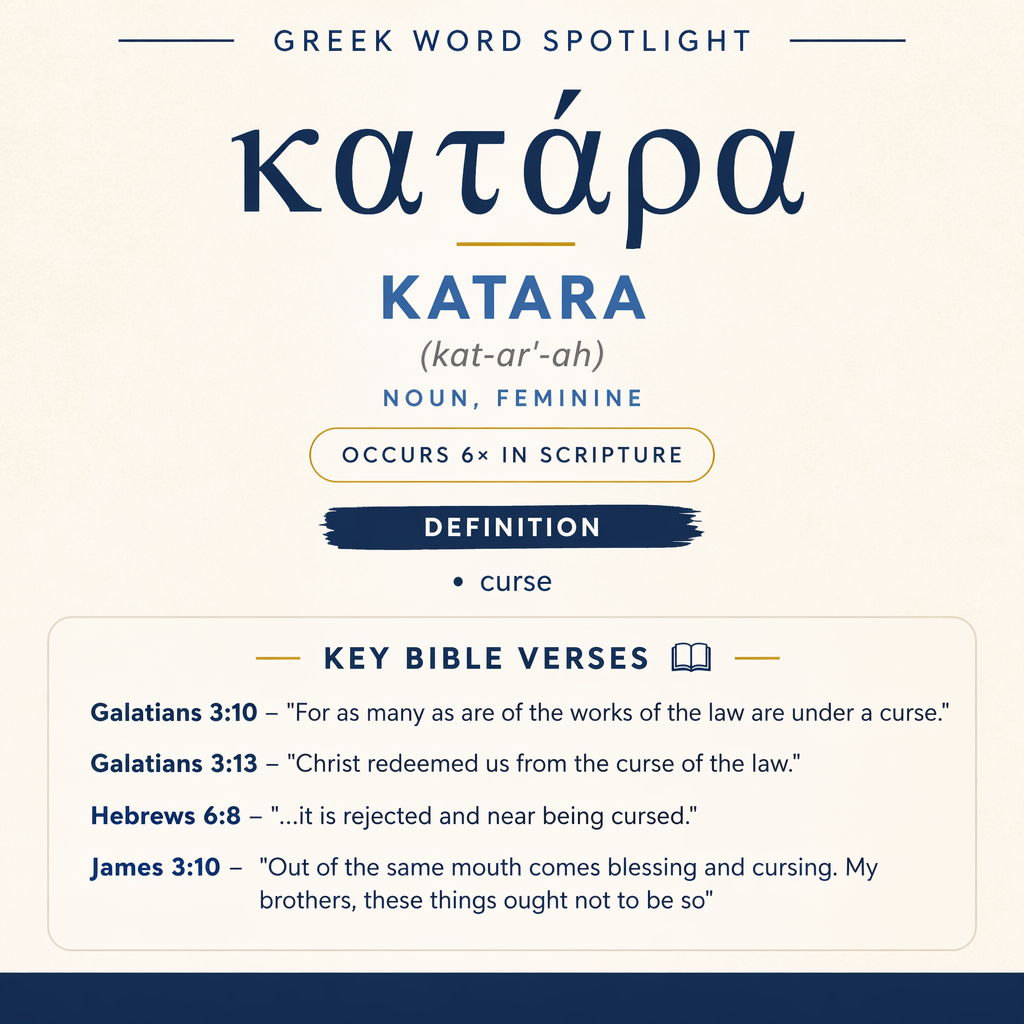
κατάρα means “curse” and occurs six times in Scripture, including Galatians 3:10, Galatians 3:13, Hebrews 6:8, James 3:10, and 2 Peter 2:14.
Key Occurrences
It appears in Galatians 3:10 and 3:13 in connection with “the curse of the law.”
Learn More →Context Snapshots
Hebrews 6:8 uses it for land “near being cursed,” and James 3:10 contrasts “blessing and cursing.”
Learn More →κατάρα names a “curse” as a real condition resting on someone, a spoken act that comes from the mouth, and a looming verdict described with vivid agricultural and judicial imagery. It appears in Galatians, Hebrews, James, and 2 Peter in settings that range from argument about “the law” to warnings about speech and character.
Occurrences
Galatians 3:10 — “For as many as are of the works of the law are under a curse. For it is written, “Cursed is everyone who doesn’t continue in all things that are written in the book of the law, to do them.””
Here κατάρα is something one can be “under,” describing a burdensome standing that hangs over “as many as are of the works of the law.” The verse itself frames this curse in relation to comprehensive obligation: failure to “continue in all things” written “in the book of the law” brings the declared condition “Cursed.” In this scene, the word marks not merely disapproval but a decisive, stated outcome attached to noncontinuance in “all things,” casting the issue in absolute rather than partial terms.
Galatians 3:13 — “Christ redeemed us from the curse of the law, having become a curse for us. For it is written, “Cursed is everyone who hangs on a tree,””
In this verse κατάρα is twice used to describe, first, what “the law” holds over people (“the curse of the law”) and, second, what Christ “became … for us.” The first use speaks of a curse as something from which one needs “redeem[ing],” a deliverance term that treats the curse as a binding condition. The second use intensifies the idea by presenting the curse as something taken on personally and representatively: Christ “having become a curse for us.” The quoted line “Cursed is everyone who hangs on a tree” ties κατάρα to a publicly visible circumstance (“hangs on a tree”), so that the curse is portrayed as a recognizable status connected to a particular kind of exposure.
Hebrews 6:8 — “but if it bears thorns and thistles, it is rejected and near being cursed, whose end is to be burned.”
κατάρα appears here in an agricultural evaluation: what “bears thorns and thistles” is judged negatively. The phrase “near being cursed” places the curse on the horizon as an impending verdict, not a distant abstraction. The surrounding language (“rejected … end … to be burned”) shows how κατάρα functions as part of a chain of assessment moving toward destruction; the curse is aligned with rejection and an “end” described in burning, giving the term a concrete, consequential force in the imagery.
James 3:10 — “Out of the same mouth comes blessing and cursing. My brothers, these things ought not to be so.”
In James κατάρα is rendered in the paired expression “blessing and cursing,” explicitly located “out of the same mouth.” The verse treats cursing as speech-act: something produced verbally, contrasted with “blessing,” and judged as an inconsistency that “ought not” characterize the community addressed as “My brothers.” Here the word’s contribution is ethical and relational; the focus is not on an external legal standing but on what one’s mouth produces and how incompatible outputs—blessing and κατάρα—can proceed from a single source.
2 Peter 2:14 — “having eyes full of adultery, and who can’t cease from sin; enticing unsettled souls; having a heart trained in greed; children of cursing;”
κατάρα is used in a character description structured as a series of traits: “eyes full of adultery,” inability to stop sinning, enticement of “unsettled souls,” and a “heart trained in greed.” The concluding label “children of cursing” makes the curse more than a momentary utterance; it becomes a defining association, a familial-style descriptor that portrays these persons as belonging to cursing as their moral lineage. In this scene, κατάρα is linked with patterns of predatory and greedy behavior, functioning as a summary designation that gathers the preceding vices under a dark identity marker.

Sense and Usage
Across these passages κατάρα (“curse”) operates in two main arenas: as an objective condition with binding weight, and as a spoken act that reveals and shapes a person’s moral posture. Galatians supplies the clearest example of curse as a condition one can be “under” and from which one must be “redeemed.” The language of being “under a curse” (Galatians 3:10) gives the word a spatial metaphor: the curse stands over someone as a covering authority. When the verse then quotes “Cursed is everyone who doesn’t continue in all things that are written in the book of the law, to do them,” κατάρα is tethered to comprehensive failure—“all things”—so that the curse functions as an all-or-nothing outcome in that argument.
Galatians 3:13 presses further by presenting the curse as transferable in a representative sense: Christ “having become a curse for us.” In that sentence κατάρα is not merely an impersonal state; it is something a person can “become,” so that the term can describe a status borne by an individual. The accompanying quotation, “Cursed is everyone who hangs on a tree,” gives the curse a public-facing, visible frame: the status is tied to an observable condition (“hangs on a tree”), which in turn supports the argument’s insistence that redemption from the curse involved a concrete, costly assumption of that status.
Hebrews 6:8 shows κατάρα as a verdict language bound to fruitfulness imagery. “Thorns and thistles” are not neutral; they function as evidence within an evaluative process that results in “rejected and near being cursed.” The phrase “near being cursed” is especially forceful: it portrays the curse not only as a label but as an approaching judicial outcome, standing close at hand once the evidence (harmful growth) is present. The concluding “whose end is to be burned” reinforces that κατάρα, in this context, is linked with finality and destructive consequence. The curse is thus not treated as a mere emotional outburst but as an assessment with an “end.”
James 3:10 shifts the focus from verdict to speech. By pairing “blessing and cursing,” the verse frames κατάρα as the negative counterpart to blessing, both emerging from the same speaker. This usage highlights that cursing is not accidental noise; it is meaningful output issuing from “the mouth.” James also supplies a communal and moral evaluation—“these things ought not to be so”—so that κατάρα becomes a marker of discordant speech life, incompatible with the expected pattern among “My brothers.” In this passage the curse is less a legal condition and more a contradictory practice that undermines integrity.
2 Peter 2:14 brings together both dimensions—speech and moral identity—by using κατάρα in the phrase “children of cursing.” The form of the expression makes cursing sound generative and habitual: it is something that can characterize people as though it were their parentage. Set at the end of a list of entrenched vices—persistent sin, enticement of vulnerable souls, and greed described as trained—κατάρα functions as a culminating designation. It does not stand alone but resonates with the portrait of settled corruption: cursing belongs with eyes “full of adultery” and a heart “trained in greed,” implying that the curse is consistent with, and expressive of, a life bent toward harm.
Taken together, these occurrences show κατάρα as more than a sharp word. It can denote a comprehensive adverse standing (“under a curse”), a condition bound up with “the law” and requiring “redeem[ing]” (Galatians 3:13), a near-imminent verdict following evident unfruitfulness (Hebrews 6:8), an act of speech that should not coexist with blessing in the same mouth (James 3:10), and an identity-marker attached to predatory, greedy persons (2 Peter 2:14). The word therefore moves between courtroom-like assessment and mouth-level utterance, yet in every setting it carries moral seriousness: whether pronounced, impending, assumed, or habitual, κατάρα signifies a weighty negative reality rather than a casual insult.
Imagery
The passages attach vivid pictures to κατάρα. In Galatians the curse is linked with the stark image of one who “hangs on a tree” (Galatians 3:13), making the status of being “cursed” concrete and exposed. In Hebrews the curse stands near a plot that “bears thorns and thistles,” moving toward an “end … to be burned” (Hebrews 6:8), so that the word evokes a field judged by its produce. James places the imagery in the body—“Out of the same mouth comes blessing and cursing” (James 3:10)—while 2 Peter speaks of “children of cursing” (2 Peter 2:14), turning the word into a stark descriptor of belonging and character.
Sources: Lexical data from Strong’s Exhaustive Concordance and the Translators Brief Lexicon of Extended Strongs for Greek (STEPBible, CC BY). Occurrence data from the Translators Amalgamated Greek New Testament (STEPBible, CC BY). Scripture quotations from the World English Bible (public domain).