
Exploring the Meaning of Katadeo in Greek
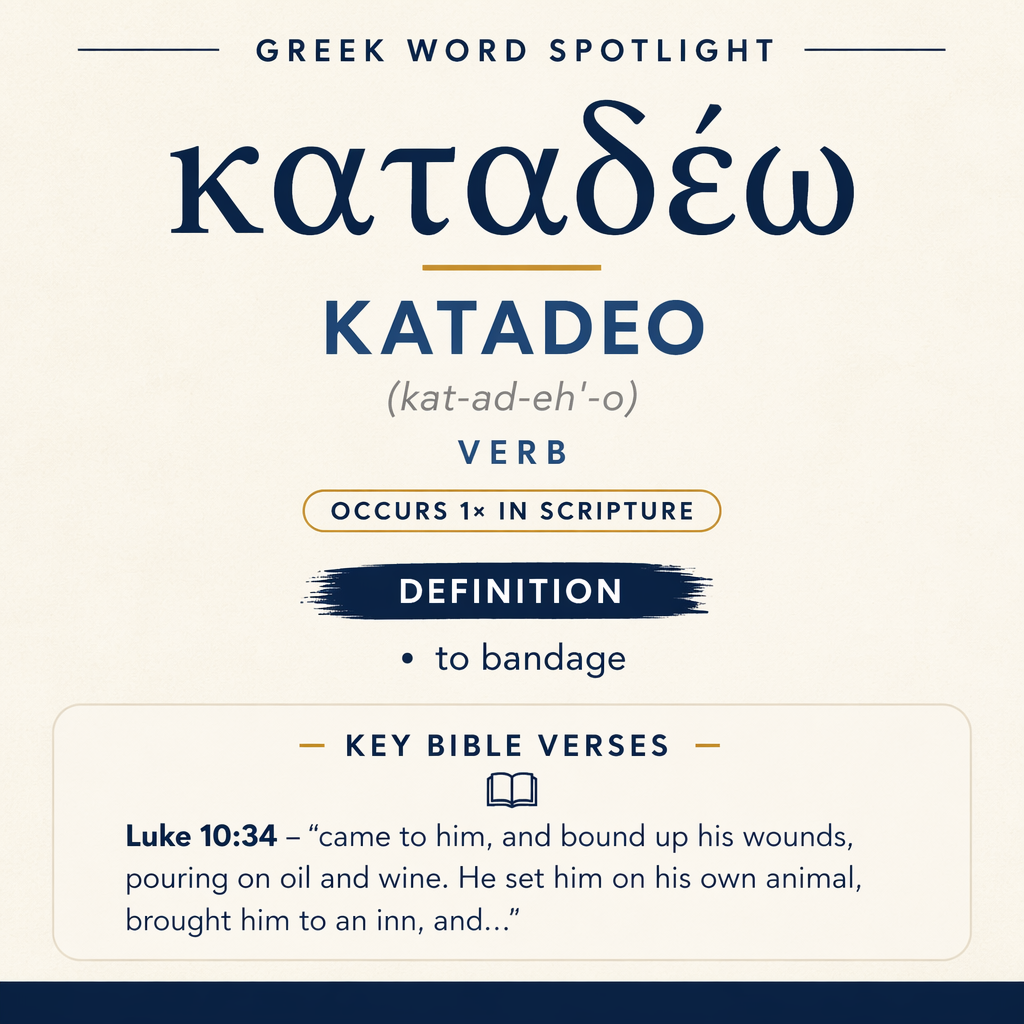
καταδέω means “to bandage” and appears once in Scripture in Luke 10:34.
Verse Context
In Luke 10:34, it describes binding up wounds while pouring on oil and wine.
Learn More →καταδέω means “to bandage” and appears in the account of the Samaritan’s care for an injured man. In its lone New Testament occurrence, it describes hands-on first aid applied to visible wounds.
Root and Related Words
καταδέω is built from two elements named in Scripture-word study: δέω (deo), “to bind” (Strong’s G1210), and κατά (kata), “according to” (Strong’s G2596). Together they form a verb used of binding in a concrete, medical-action setting.

Occurrences
“came to him, and bound up his wounds, pouring on oil and wine. He set him on his own animal, brought him to an inn, and took care of him.” (Luke 10:34)
Here καταδέω names the decisive movement from seeing injury to addressing it. The clause places the action in a sequence of care: he “came to him,” then “bound up his wounds,” then treated them further by “pouring on oil and wine.” The word therefore contributes the image of wrapping and securing what is torn or bleeding—an act that implies direct contact, attention to the injured places (“his wounds”), and a concern to stabilize the man’s condition before travel. Because the text immediately mentions pouring oil and wine, the bandaging is not an isolated gesture but part of a coordinated response: binding the wounds and then applying soothing or cleansing liquids, followed by relocating the man (“He set him on his own animal”) and arranging continued care (“brought him to an inn, and took care of him”). In this narrative flow, καταδέω marks the practical, embodied beginning of restoration: the injuries are not merely acknowledged but treated in a way that prepares the victim to be carried and cared for over time.
Sense and Usage
The sense “to bandage” fits the physical specificity of Luke 10:34: the direct object is “his wounds,” and the surrounding verbs keep the reader at the level of concrete action—approaching, binding, pouring, lifting, bringing, and caring. The bandaging is presented as purposeful restraint and protection of damaged flesh. By choosing a term of bandaging rather than a more general word for helping, the narrative foregrounds the tangible means by which compassion operates: care begins with what can be done immediately at the site of injury, using available materials and deliberate touch.
The word’s placement also shows that bandaging is neither the final step nor the only remedy. It stands at the hinge between emergency intervention and longer-term support. First, the wounds are bound; then substances are poured on them; then the injured man is transported; then he is placed somewhere that care can continue. In other words, καταδέω contributes an early-stage medical response that makes the later steps feasible. Bandaging here is not a dramatic flourish but the quiet competence of attending to injuries in a way consistent with continued responsibility.
Because this is the only attested New Testament use in the passage cited, the word’s usage is concentrated: it operates with a clear, concrete object (wounds) and a clear, compassionate agent (the one who stops to help). The meaning remains anchored in the visible world of injury and treatment, expressing care that is practical and ordered rather than abstract.
Imagery
Luke 10:34 ties the imagery of bandaging to movement toward safety. The scene begins on the road with an injured body and ends with shelter and ongoing attention: “He set him on his own animal, brought him to an inn, and took care of him.” In that progression, καταδέω supplies the picture of wounds gathered, covered, and secured—injury met with skilled hands—so that the suffering man can be carried forward into continued care.
Sources: Lexical data from Strong’s Exhaustive Concordance and the Translators Brief Lexicon of Extended Strongs for Greek (STEPBible, CC BY). Occurrence data from the Translators Amalgamated Greek New Testament (STEPBible, CC BY). Scripture quotations from the World English Bible (public domain).




