
Exploring the Meaning of Hupotrecho in Greek
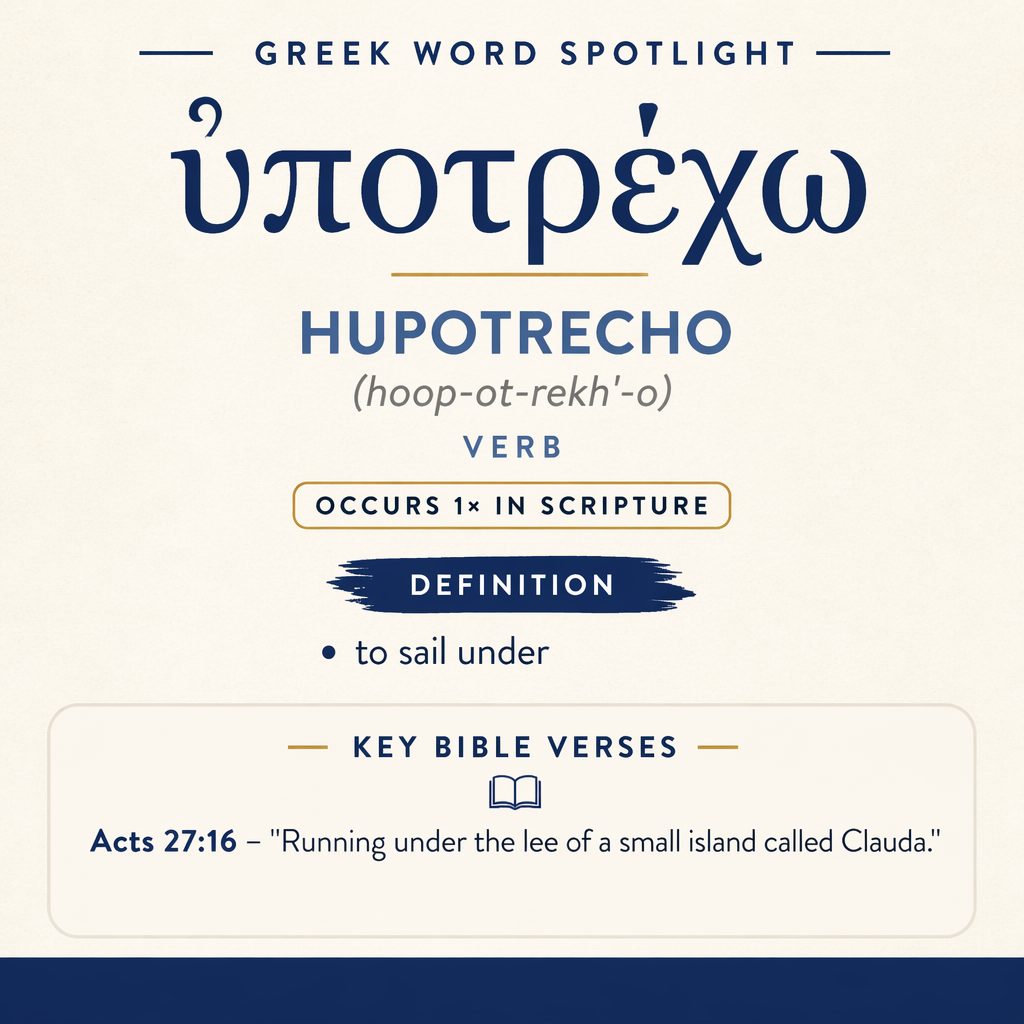
ὑποτρέχω means “to sail under” and appears once in Scripture in Acts 27:16.
Scripture Occurrence
This verb occurs 1 time in Scripture. Its single occurrence is in Acts 27:16.
Learn More →Acts Narrative
In Acts 27:16, it describes running under the lee of the small island called Clauda. This helped them, with difficulty, secure the boat.
Learn More →ὑποτρέχω expresses the idea of sailing under something, and it appears in a single narrative moment in Paul’s voyage to Rome. In Acts 27:16 it describes a ship’s tactical movement in relation to land, portrayed as a difficult but necessary maneuver.
Root and Related Words
ὑποτρέχω (Hupotrechō) is formed from ὑπό (hypo), “by/under” (Strong’s G5259), and τρέχω (trechō), “to run” (Strong’s G5143). The combination creates a vivid motion-verb: running in a direction characterized by being “under,” with the maritime setting supplying the concrete frame for that movement.

Occurrences
“Running under the lee of a small island called Clauda, we were able, with difficulty, to secure the boat.” (Acts 27:16)
In this scene the voyage narrative is driven by practical seamanship. The phrase “Running under the lee of a small island called Clauda” places the ship in immediate relation to the island’s sheltering side (“lee”), and ὑποτρέχω supplies the directional action: the vessel moves “under” the protection afforded by the landform. The following clause, “we were able, with difficulty, to secure the boat,” shows the purpose and outcome of this maneuver. The movement described is not leisurely travel but a pressured adjustment made so that a task—securing the boat—can be accomplished at all. The adverbial feel of the wording (“running under…”) underscores urgency and controlled speed, and the mention of “difficulty” anchors the verb’s action in hazardous conditions where gaining partial shelter makes the difference between failure and success.
The geographical note, “a small island called Clauda,” is not mere color: it clarifies what “under” means in practice. The ship is positioned relative to a specific feature in the seascape, using the island as a buffer. ὑποτρέχω therefore contributes more than motion; it marks a deliberate choice of route that depends on the presence of the island and the possibility of moving into its lee. The narrative voice (“we were able…”) ties the action to the experience of those on board, so the verb functions as a compact report of a critical navigational decision made amid strain.
Sense and Usage
The sense “to sail under” fits Acts 27:16 as a concrete description of seamovement in relation to an object that can be “over” the ship in some relevant way—here, the island as a protective barrier. The verse itself interprets the maneuver by pairing it with “under the lee,” which explains the practical advantage: the ship is brought into a position where the island stands between the vessel and the elements, allowing work on deck (“to secure the boat”) that would be far harder in open exposure.
Because the narrative links the movement directly to a problem and a solution, ὑποτρέχω carries an implication of purposefulness: sailing under is not presented as an incidental path but as a means to achieve a necessary end. The action is also bounded by constraint—“with difficulty”—so the verb’s imagery is compatible with a setting where control is contested by weather and sea. Even without naming the forces involved, the text frames the ship’s “running under” as a response to pressure, the kind of response that seeks any available advantage in the environment.
Formally, the components ὑπό (“under”) and τρέχω (“run”) invite the reader to picture a swift, directed movement that is nevertheless defined by position relative to cover. In maritime terms, the verb compresses what might otherwise require several words: the ship does not merely pass by an island; it takes a line that places the vessel under the island’s lee. The result is a tight coupling of motion and location: movement expressed in a way that encodes where the ship is moving with respect to shelter.
Imagery
Acts 27:16 frames ὑποτρέχω with the visual of a vessel tucked into the lee of “a small island,” working to “secure the boat” despite “difficulty.” The word’s imagery is therefore not abstract but spatial and practical: a ship running along a safer side of land, seeking cover that turns a dangerous situation into one where urgent work can be done.
Sources: Lexical data from Strong’s Exhaustive Concordance and the Translators Brief Lexicon of Extended Strongs for Greek (STEPBible, CC BY). Occurrence data from the Translators Amalgamated Greek New Testament (STEPBible, CC BY). Scripture quotations from the World English Bible (public domain).




