
Exploring the Meaning of Trecho in Greek
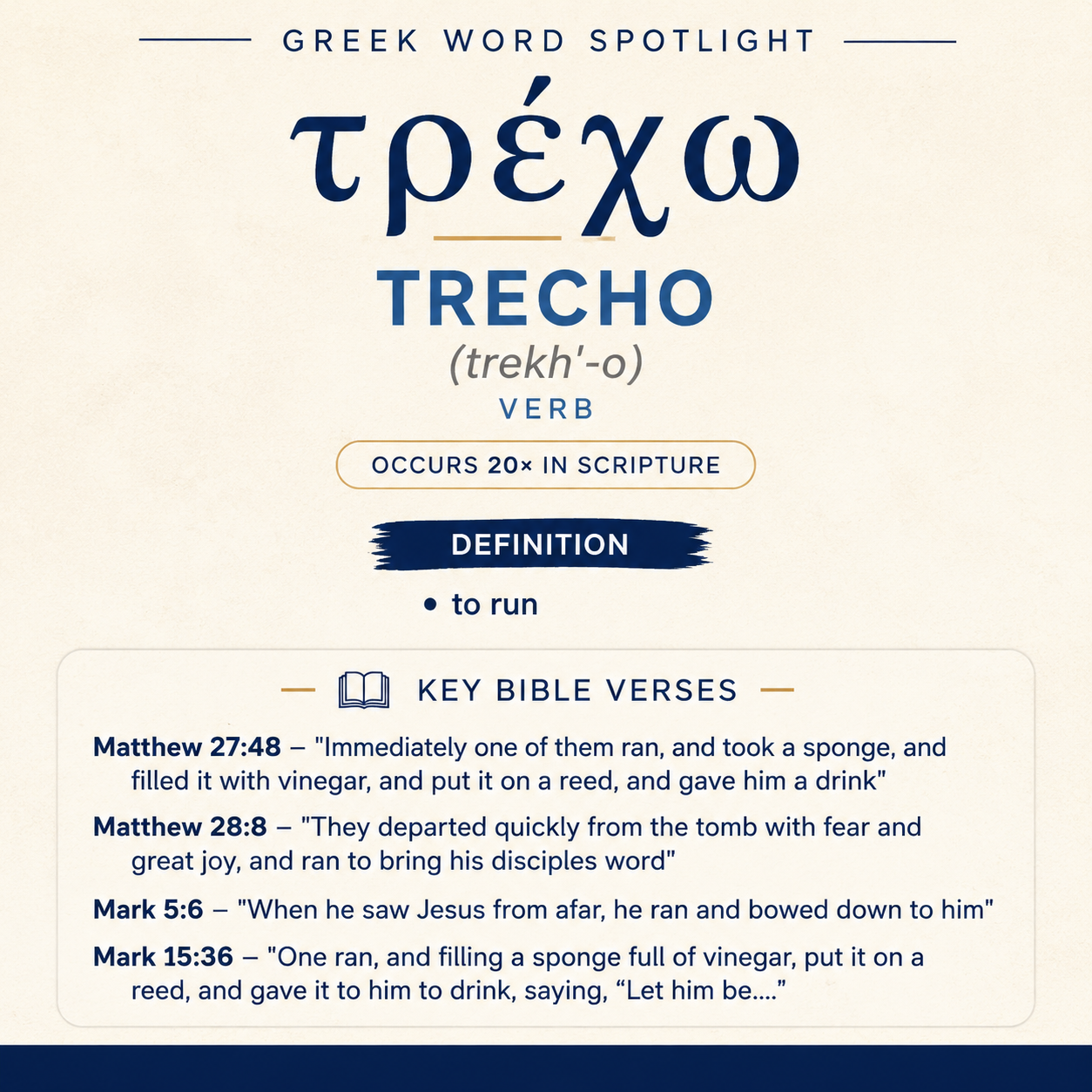
τρέχω means “to run” and appears 20 times in Scripture, including in Matthew, Mark, Luke, and John.
Gospel Scenes
In Matthew 27:48 and Mark 15:36, someone ran to bring vinegar on a sponge to Jesus. In Matthew 28:8 and John 20:2, people ran to bring news about the empty tomb.
Learn More →Notable Examples
In Mark 5:6, a man ran and bowed down to Jesus. In Luke 24:12 and John 20:4, Peter and another disciple ran to the tomb.
Learn More →τρέχω describes the physical act of running, whether in urgency, in pursuit, or as a chosen manner of action. Across the Gospels it often marks swift movement in charged moments, and in Paul it becomes a ready image for human effort and purpose.
Occurrences
“Immediately one of them ran, and took a sponge, and filled it with vinegar, and put it on a reed, and gave him a drink.” (Matthew 27:48)
Here τρέχω signals quick, decisive movement in response to what is happening at the crucifixion. The running compresses the sequence of actions—taking a sponge, filling it with vinegar, placing it on a reed, offering a drink—into an immediate, almost reflexive attempt to act.

“They departed quickly from the tomb with fear and great joy, and ran to bring his disciples word.” (Matthew 28:8)
The verb captures the women’s urgent mission as they leave the tomb. Their running matches the verse’s paired emotions (“fear and great joy”) and gives bodily shape to the need to communicate: they do not merely go; they run “to bring his disciples word.”
“When he saw Jesus from afar, he ran and bowed down to him,” (Mark 5:6)
Running here is the first movement toward encounter. The man’s action bridges distance (“from afar”) and leads directly into a posture of submission (“bowed down to him”), so τρέχω functions as the rapid approach that precedes an act of reverence.
“One ran, and filling a sponge full of vinegar, put it on a reed, and gave it to him to drink, saying, “Let him be. Let’s see whether Elijah comes to take him down.”” (Mark 15:36)
As in Matthew’s crucifixion scene, running introduces immediate involvement. The runner’s quick motion initiates the offering of vinegar on a reed, while the spoken line frames the action as part of a tense watchfulness—an act performed quickly, then interpreted aloud within the crowd’s expectation.
“He arose, and came to his father. But while he was still far off, his father saw him, and was moved with compassion, and ran, and fell on his neck, and kissed him.” (Luke 15:20)
τρέχω portrays the father’s compassion as energetic and outward-moving. The son is “still far off,” yet the father closes the distance by running, and that run flows straight into embrace and affection (“fell on his neck, and kissed him”), making the running the turning point from separation to reunion.
“But Peter got up and ran to the tomb. Stooping and looking in, he saw the strips of linen lying by themselves, and he departed to his home, wondering what had happened.” (Luke 24:12)
Peter’s running marks urgency and personal engagement with the report of the empty tomb. The verb sets up the careful actions that follow—stooping, looking in, seeing—and contrasts swift arrival with lingering uncertainty as he leaves “wondering what had happened.”
“Therefore she ran and came to Simon Peter and to the other disciple whom Jesus loved, and said to them, “They have taken away the Lord out of the tomb, and we don’t know where they have laid him!”” (John 20:2)
Running here serves communication under distress. Her movement is not toward the tomb but away from it and toward others, and τρέχω underscores the urgency in her message: the rapid approach to Peter and the other disciple matches the alarm and confusion in what she says.
“They both ran together. The other disciple outran Peter, and came to the tomb first.” (John 20:4)
John’s narration uses running to depict a shared urgency and also a comparison in speed. The doubled running (“both ran together… outran”) highlights competitive pace within a common purpose, and the detail of arriving first makes τρέχω a concrete marker of sequence in the unfolding discovery.
“So then it is not of him who wills, nor of him who runs, but of God who has mercy.” (Romans 9:16)
Here τρέχω is paired with willing as a representative human activity—something a person does, exerting effort and direction. The verse sets such exertion in contrast with God’s mercy, using “runs” as an image of striving that does not determine the outcome in view.
“Don’t you know that those who run in a race all run, but one receives the prize? Run like that, that you may win.” (1 Corinthians 9:24)
Running appears first as an observable fact of competition (“those who run in a race all run”), then as a pointed exhortation (“Run like that”). The verb carries the image of committed participation in a contest where effort is real and the aim is definite: the manner of running is shaped by the desire to win.
“I therefore run like that, not aimlessly. I fight like that, not beating the air,” (1 Corinthians 9:26)
Paul speaks of his own “running” as purposeful rather than random. The verb functions as a metaphor for directed action, clarified by the contrast “not aimlessly” and reinforced by the parallel image of fighting with real targets rather than empty motion.
“I went up by revelation, and I laid before them the Good News which I preach among the Gentiles, but privately before those who were respected, for fear that I might be running, or had run, in vain.” (Galatians 2:2)
Here τρέχω frames Paul’s concern about wasted effort. The verb expresses ongoing and past exertion (“might be running, or had run”) and places his private meeting in the context of safeguarding the value and outcome of his labors, so that his running would not prove “in vain.”

Sense and Usage
In narrative scenes, τρέχω regularly compresses time. The runner’s movement in Matthew 27:48 and Mark 15:36 makes the offering of vinegar feel instantaneous, a swift chain of actions that begins with a burst of motion. In resurrection contexts (Matthew 28:8; Luke 24:12; John 20:2; John 20:4), running conveys urgency driven by startling news. The verb repeatedly connects bodily speed with the need to verify, report, or reach others quickly, and John 20:4 even uses the act of running to establish who arrives first, making speed itself part of the story’s sequencing.
τρέχω also carries relational and emotional weight. In Luke 15:20 the father’s run is prompted by seeing the son from a distance and being “moved with compassion.” The running is not mere travel; it is compassion translated into immediate approach, leading directly to embrace and kisses. In Mark 5:6, the run becomes an approach that ends in bowing down; the physical rush forward sets the stage for the posture of submission.
In Paul’s letters the verb shifts from literal movement to an established image of exertion toward a goal. Romans 9:16 places “him who runs” alongside “him who wills,” treating running as a recognizable emblem of human effort and initiative. In 1 Corinthians 9:24–26, running is explicitly shaped by the logic of competition: runners run with a prize in view, and Paul’s own running is characterized by the absence of aimlessness. Galatians 2:2 extends the image across time (“running… had run”) and evaluates it by outcome (“in vain”), presenting running as sustained labor whose value depends on whether it truly reaches its intended end.
Imagery
The passages build a cluster of vivid pictures around running: a sudden dash to fetch something (Matthew 27:48; Mark 15:36), an urgent sprint to deliver news (Matthew 28:8; John 20:2), a rush toward a decisive encounter (Mark 5:6), and a compassionate run that collapses distance to restore relationship (Luke 15:20). Alongside these, Paul’s race language and his insistence on not running “aimlessly” (1 Corinthians 9:26) keep the physical image in view even when the focus is on purposeful exertion and its outcome.
Sources: Lexical data from Strong’s Exhaustive Concordance and the Translators Brief Lexicon of Extended Strongs for Greek (STEPBible, CC BY). Occurrence data from the Translators Amalgamated Greek New Testament (STEPBible, CC BY). Scripture quotations from the World English Bible (public domain).




