
Exploring the Meaning of Huperballo in Greek
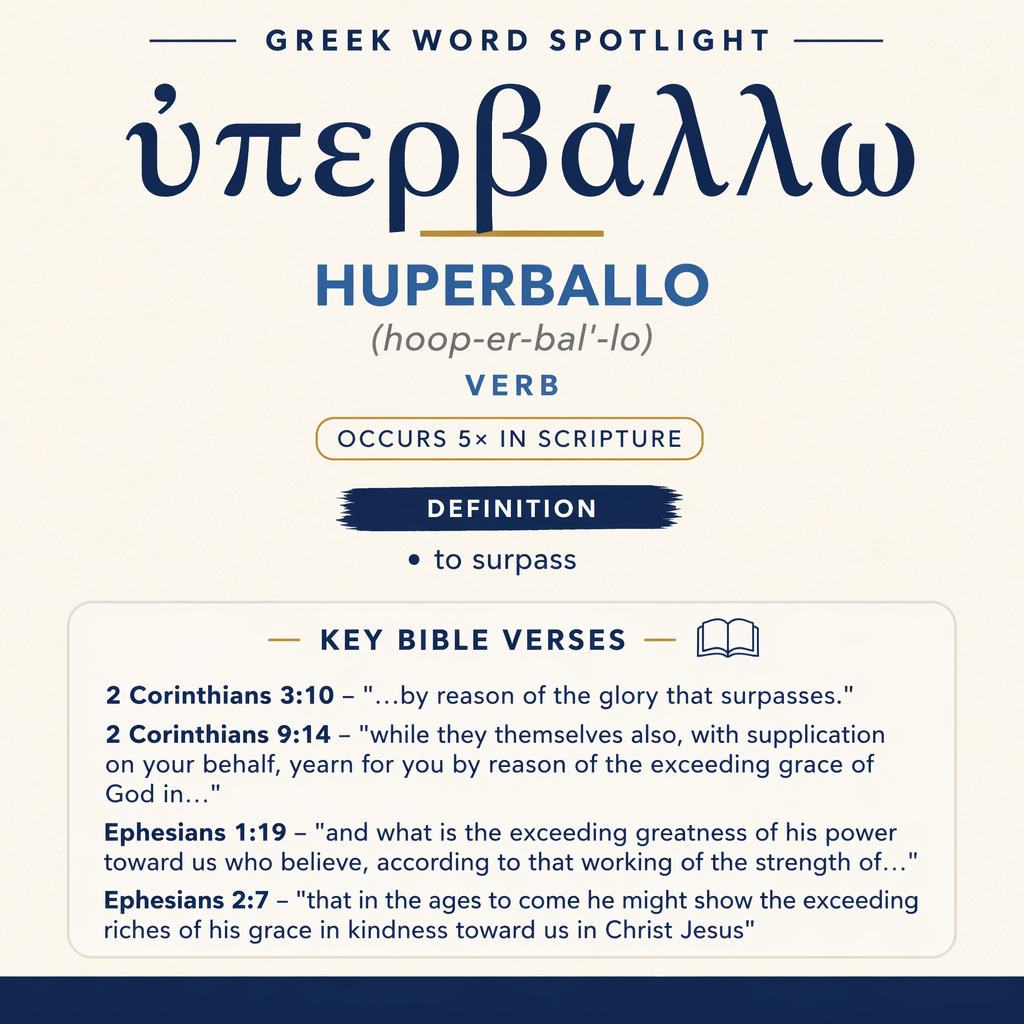
ὑπερβάλλω (Huperballo) means “to surpass” and occurs five times in Scripture: 2 Corinthians 3:10; 9:14; Ephesians 1:19; 2:7; 3:19.
Core Meaning
ὑπερβάλλω means “to surpass.” In these passages it expresses what exceeds or goes beyond.
Learn More →Where It Appears
This verb appears 5 times in Scripture. Its occurrences are in 2 Corinthians 3:10; 2 Corinthians 9:14; Ephesians 1:19; Ephesians 2:7; and Ephesians 3:19.
Learn More →How It’s Used
It describes “exceeding” grace (2 Corinthians 9:14), the “exceeding” greatness of God’s power (Ephesians 1:19), and Christ’s love that “surpasses” knowledge (Ephesians 3:19).
Learn More →ὑπερβάλλω expresses the idea of surpassing, marking something as outstripping a comparison point. In the New Testament it appears in Paul’s letters (2 Corinthians and Ephesians), where it characterizes glory, grace, power, riches, and Christ’s love as exceeding what might otherwise be measured or expected.
Root and Related Words
ὑπερβάλλω (Huperballo) is related to the preposition ὑπέρ (hyper), “above/for” (Strong’s G5228), and the verb βάλλω (ballo), “to throw: throw” (Strong’s G906). Together these related forms supply the imagery behind the verb’s force in context, where the surpassing described is portrayed as going beyond a stated standard or frame of reference.

Occurrences
For most certainly that which has been made glorious has not been made glorious in this respect, by reason of the glory that surpasses. (2 Corinthians 3:10)
Here ὑπερβάλλω qualifies “the glory” as surpassing, and it does so within an explicit comparison: one “glorious” thing is said, “in this respect,” to lack glory when set beside another glory. The verb supplies the reason clause—“by reason of the glory that surpasses”—so the point turns on the relative weight of glory. Surpassing is not abstract in this line; it functions as the decisive factor that re-frames the evaluation of what counts as glorious when a greater glory is present.

while they themselves also, with supplication on your behalf, yearn for you by reason of the exceeding grace of God in you. (2 Corinthians 9:14)
In this sentence the surpassing is attached to “the … grace of God,” and its effect is relational: it becomes the stated reason that others “yearn for you.” The verb’s contribution is causal and motivational—“by reason of the exceeding grace”—so surpassing describes grace as so abundant or pronounced that it produces longing and prayer (“supplication on your behalf”). The focus stays on what is “in you,” locating this surpassing grace as something discernible in the recipients’ situation rather than merely a theological label.
and what is the exceeding greatness of his power toward us who believe, according to that working of the strength of his might (Ephesians 1:19)
ὑπερβάλλω shapes a layered description: “the exceeding greatness” of God’s “power,” further set “toward us who believe,” and aligned “according to that working of the strength of his might.” The verb strengthens the superlative feel of the phrase by pressing “greatness” beyond ordinary magnitude. In the logic of the line, surpassing does not stand alone; it is coordinated with “working,” “strength,” and “might,” so the surpassing quality of power is not static but active and effective toward believers.
that in the ages to come he might show the exceeding riches of his grace in kindness toward us in Christ Jesus; (Ephesians 2:7)
In this forward-looking statement, surpassing modifies “the … riches of his grace,” and the setting is temporal and demonstrative: “in the ages to come he might show” them. The verb thus contributes a sense of grace as exceeding what can be exhausted or fully displayed at once; it is the kind of richness that can be “shown” across coming ages. The phrase “in kindness toward us in Christ Jesus” indicates how these surpassing riches are expressed—through kindness directed “toward us”—so surpassing is tied to a lived outworking, not merely an internal attribute.
and to know Christ’s love which surpasses knowledge, that you may be filled with all the fullness of God. (Ephesians 3:19)
Here surpassing is framed as a paradox: “to know Christ’s love” even though it “surpasses knowledge.” ὑπερβάλλω sharpens the contrast between the act of knowing and the limits of knowledge. The verb places Christ’s love beyond the capacity of knowledge to contain it, while the sentence still urges knowledge of that love, aiming at a result—“that you may be filled with all the fullness of God.” In this line, surpassing signals transcendence over an intellectual boundary, yet remains connected to experiential fullness.
Sense and Usage
Across these passages, “to surpass” regularly operates with an explicit or implied standard: glory compared with glory (2 Corinthians 3:10), grace that provokes yearning (2 Corinthians 9:14), power described as exceeding in greatness (Ephesians 1:19), riches of grace displayed through ages (Ephesians 2:7), and love set beyond the reach of knowledge (Ephesians 3:19). The verb’s role is to push the described reality beyond what the surrounding terms already convey—beyond “glorious,” beyond “grace,” beyond “greatness,” beyond “riches,” and beyond “knowledge.”
The surpassing in these uses also tends to be functional rather than merely comparative. In 2 Corinthians 3:10, surpassing explains why something once called glorious is eclipsed “in this respect.” In 2 Corinthians 9:14, surpassing grace becomes the reason for prayer and longing. In Ephesians 1:19, surpassing greatness belongs to power that is “toward us who believe,” linked to divine “working.” In Ephesians 2:7, surpassing riches are not merely possessed but “shown” in kindness over time. In Ephesians 3:19, surpassing presses past cognitive boundaries in order to ground a prayerful aim: fullness.
Another consistent feature is that ὑπερβάλλω intensifies without changing the category of the noun it modifies: it does not replace “glory” with something else, but marks one glory as exceeding another; it does not replace “knowledge,” but marks love as outstripping knowledge’s capacity. This allows Paul to speak comparatively while keeping continuity with common categories of evaluation—glory can be weighed, grace can be recognized in a community, power can be measured by its working, riches can be displayed, and knowledge can be tested by its limits.
Imagery in Context
Although the contexts are theological, the verb carries concrete comparative force. In 2 Corinthians 3:10, surpassing casts glory in the language of brightness and relative splendor, where the greater glory renders the lesser effectively unglorious “in this respect.” In Ephesians, surpassing contributes to a sense of abundance and overflow: greatness that exceeds, riches that exceed, and love that exceeds knowledge—each portrayed as pressing beyond normal measurement while still acting “toward us,” shown “in kindness,” and sought in order to be “filled.”
Sources: Lexical data from Strong’s Exhaustive Concordance and the Translators Brief Lexicon of Extended Strongs for Greek (STEPBible, CC BY). Occurrence data from the Translators Amalgamated Greek New Testament (STEPBible, CC BY). Scripture quotations from the World English Bible (public domain).




