
Exploring the Meaning of Hupandros in Greek
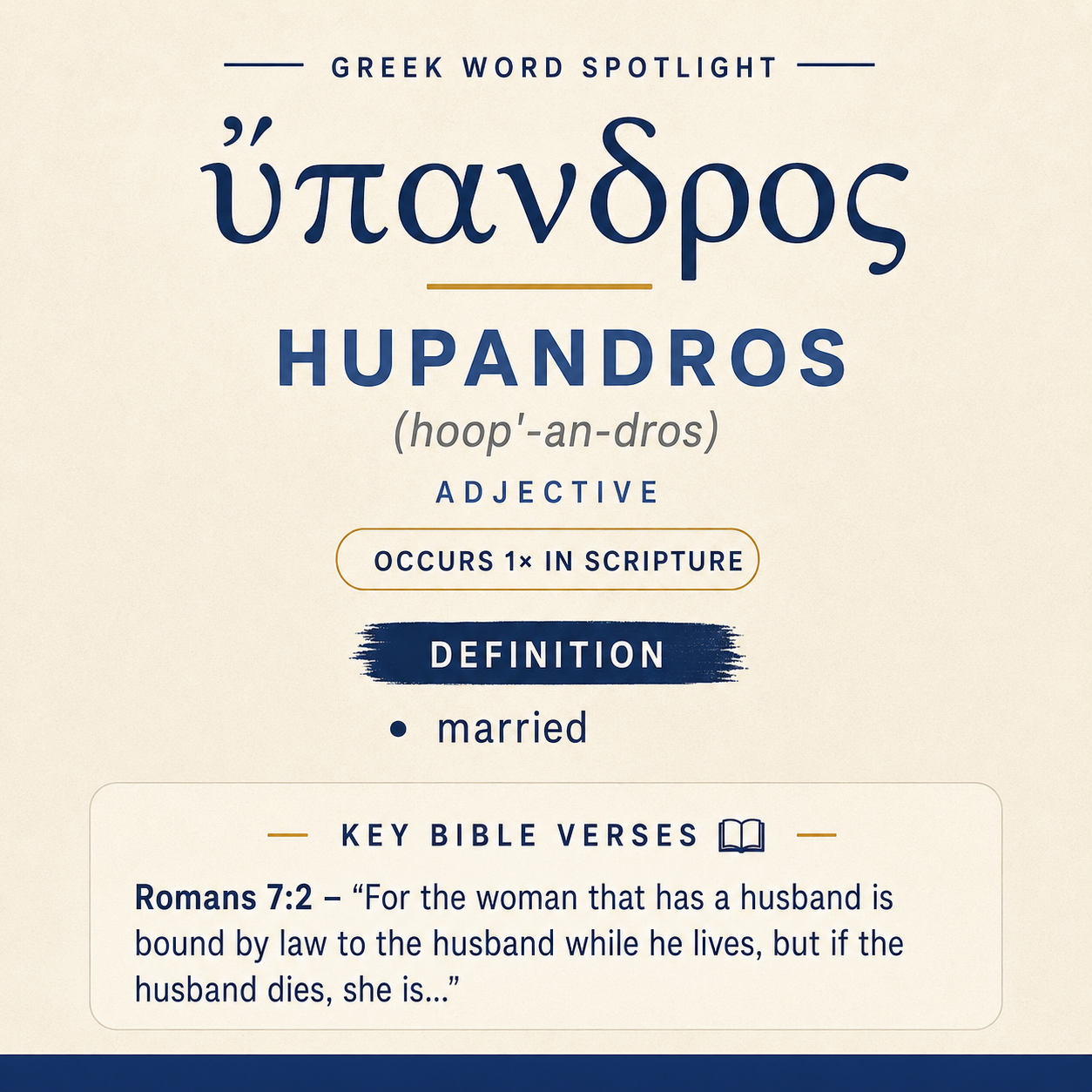
ὕπανδρος means “married” and appears once in Scripture, in Romans 7:2.
Verse Context
In Romans 7:2, it describes a woman who has a husband and is bound by law to him while he lives.
Learn More →ὕπανδρος means “married” and appears in Paul’s legal illustration about a woman’s binding to her husband in Romans 7:2. In that setting it serves as a precise social-and-legal descriptor that frames the question of obligation while the husband lives and release when he dies.
Root and Related Words
ὕπανδρος (Hupandros) is related to ἀνήρ (aner), “man” (Strong’s G435), and to ὑπό (hypo), “by/under: by” (Strong’s G5259). The combination of these related elements supports the word’s role as a compact descriptor of a woman’s marital status in relation to her husband.

Occurrences
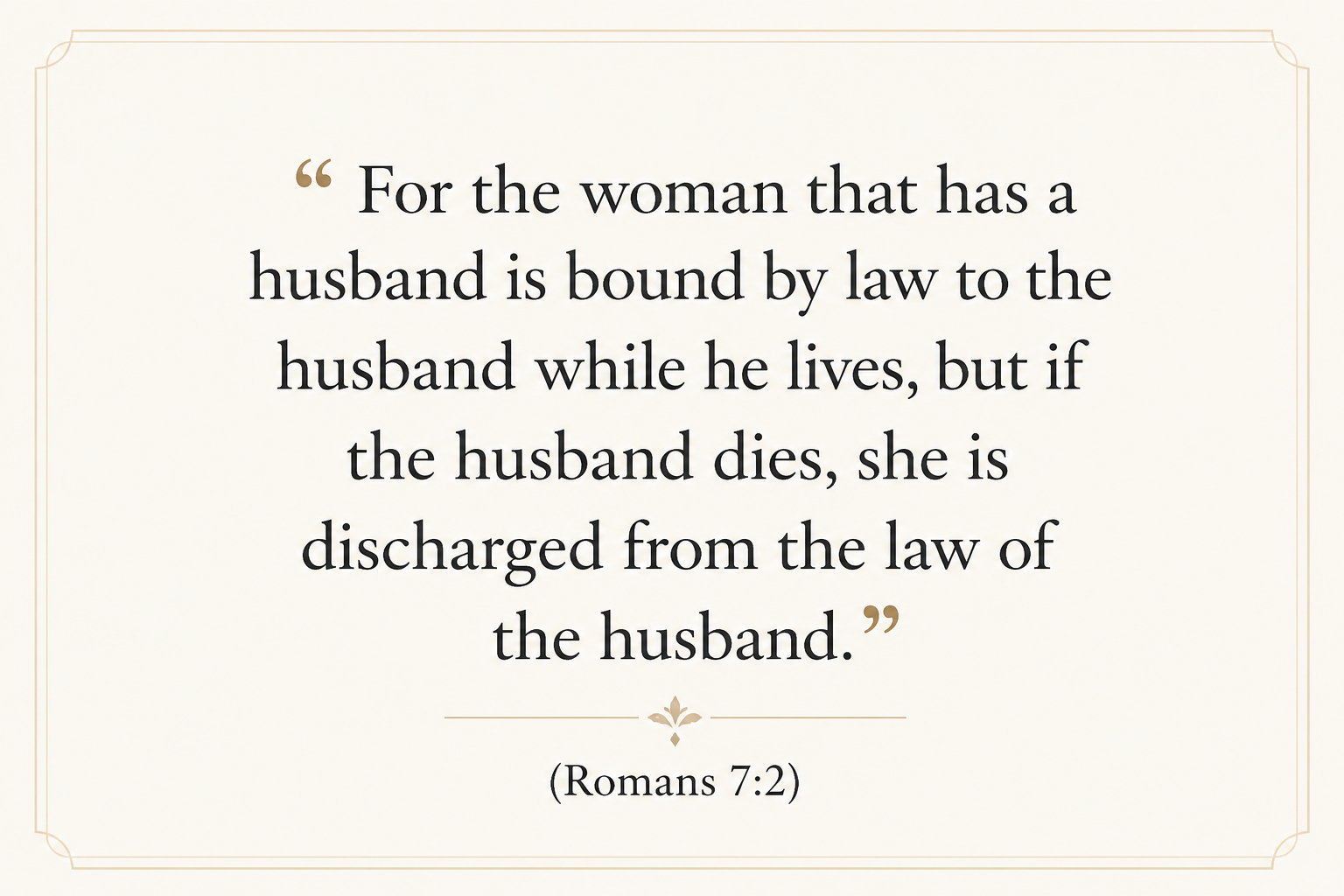
“For the woman that has a husband is bound by law to the husband while he lives, but if the husband dies, she is discharged from the law of the husband.” (Romans 7:2)
In Romans 7:2, ὕπανδρος marks the woman as one who “has a husband,” setting the scene for the legal principle Paul draws on: she “is bound by law to the husband while he lives.” The term does not merely note that a man exists in her life; it places her within a recognized status that carries defined obligations. The verse then turns on a clear temporal boundary—“while he lives”—and a decisive change in condition—“if the husband dies.” Against that contrast, ὕπανδρος helps the reader feel the weight of the initial condition: the woman’s standing as married is the circumstance in which the “law” binds her to her husband. When the husband’s death occurs, she “is discharged from the law of the husband,” and the legal tie described in the first half of the verse is presented as no longer in force.
The wording “bound by law” and “discharged” shows why a single adjective is useful here. By classifying the woman as married, ὕπανδρος provides the relational context that makes “the law of the husband” intelligible as a real, operative claim during the husband’s lifetime. It also allows the verse to speak with a general, illustrative force: the reader can follow the argument without needing any personal detail about the couple. The emphasis stays on status and its consequences—being married corresponds, in this illustration, to being under a binding legal relationship to the husband, and the husband’s death corresponds to release from that binding relationship.
Sense and Usage
Because ὕπανδρος appears only in this legal illustration, its sense is seen in a tightly focused way: it identifies a woman as married in the sense relevant to obligation and release. Romans 7:2 places marriage in the sphere of law (“bound by law”), not merely affection or custom. The adjective therefore functions as a status term—one that establishes which set of constraints applies (“to the husband while he lives”) and under what condition those constraints end (“if the husband dies”).
In this verse, the idea of being married is not treated as an abstract label but as a living condition with a duration (“while he lives”). That duration matters: Paul’s illustration depends on the fact that the binding holds during the husband’s life. The adjective fits that logic by letting the reader hold together two realities in a single frame: (1) a relationship (“has a husband … to the husband”) and (2) a legal consequence (“bound by law … discharged”). The verse then makes a clean distinction between the married condition and its cessation, not by redefining marriage, but by introducing a change that ends the marriage’s legal binding as presented here—death.
Within the flow of Romans 7:2 itself, ὕπανδρος also helps avoid ambiguity about whose obligation is in view. The verse speaks of “the woman that has a husband” and then repeatedly specifies “the husband,” including “the law of the husband.” The adjective, tied to the woman, anchors the relationship from her side: she is the one described by her marital condition, and the binding described is her binding “to the husband.” In that way the term supports the verse’s orderly movement from status (married) to binding (by law) to termination of binding (discharged upon death).
The verse’s language implies that marriage, as invoked here, is recognized in a way that can be spoken of as a legal bond. ὕπανδρος serves that purpose by being a concise marital descriptor that can carry the legal entailment the sentence immediately states. Thus, the word’s use in Romans 7:2 is practical and argumentative: it supplies the premise for a general rule about binding and release, stated in the clear, symmetrical clauses of the verse.
Imagery
Romans 7:2 frames ὕπανδρος with the imagery of a binding tie that lasts “while he lives” and then is cut cleanly by death: “she is discharged from the law of the husband.” The term stands at the head of that picture, naming the condition in which the bond exists and from which the release is described.
Sources: Lexical data from Strong’s Exhaustive Concordance and the Translators Brief Lexicon of Extended Strongs for Greek (STEPBible, CC BY). Occurrence data from the Translators Amalgamated Greek New Testament (STEPBible, CC BY). Scripture quotations from the World English Bible (public domain).





