
Exploring the Meaning of Hualos in Greek
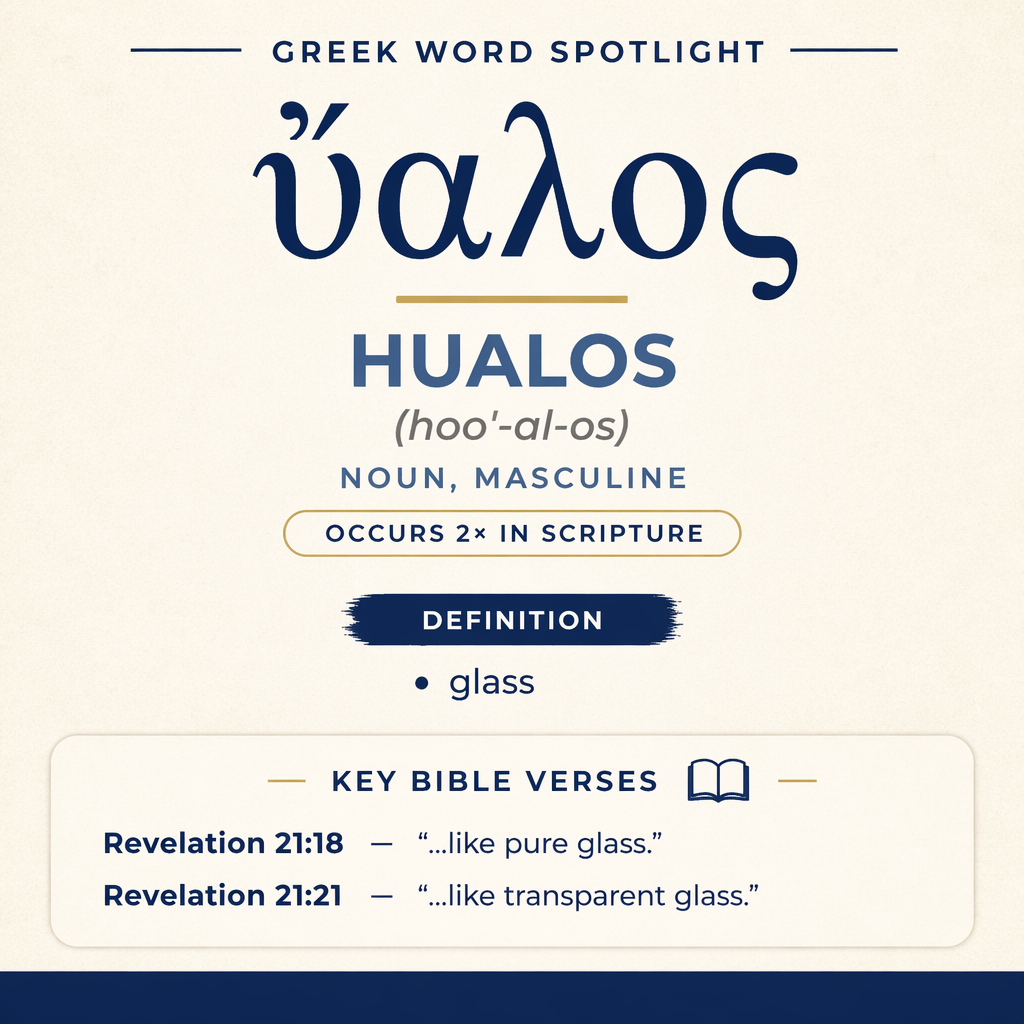
ὕαλος (Hualos) means “glass” and appears twice in Scripture, both in Revelation 21:18 and Revelation 21:21.
Meaning
ὕαλος means “glass.” In Revelation 21 it is used for comparison in describing the New Jerusalem.
Learn More →Biblical Usage
Revelation 21:18 says the city was pure gold, like pure glass. Revelation 21:21 continues the description of the city’s materials.
Learn More →Context in Revelation
Both occurrences are in Revelation 21, within the vision of the New Jerusalem. The word serves the passage’s portrayal of the city’s purity and splendor.
Learn More →ὕαλος means “glass” and appears in Revelation’s description of the New Jerusalem. In both occurrences it serves as the point of comparison for the city’s gold, highlighting a striking visual quality within the imagery of the city’s materials.
Root and Related Words
ὕαλος is related to hyetos (ὑετός), “rain” (Strong’s G5205).
Occurrences
“The construction of its wall was jasper. The city was pure gold, like pure glass.” (Revelation 21:18)
Here ὕαλος enters as the second term in a simile: the city is “pure gold, like pure glass.” The immediate context contrasts two features of the city—its wall and the city itself—by naming the wall’s material (“jasper”) and then describing the city’s material (“pure gold”). The comparison to “pure glass” does not replace gold; it qualifies how the gold is to be imagined. In this sentence, “pure” is applied to both the gold and the glass, so ὕαλος strengthens the claim that the city’s gold is perceived in a form associated with cleanness and a refined appearance. The word therefore contributes to the portrayal of an otherworldly built environment: not merely valuable (gold) but visually intensified by resemblance to glass.
“The twelve gates were twelve pearls. Each one of the gates was made of one pearl. The street of the city was pure gold, like transparent glass.” (Revelation 21:21)
In Revelation 21:21, ὕαλος again stands in a simile that interprets gold through the lens of glass: “pure gold, like transparent glass.” The verse moves from the city’s entrances to its roadway: first “twelve gates” identified with “twelve pearls,” then each gate described as “made of one pearl,” and finally “the street of the city” described. Against the concrete, almost tactile emphasis of pearls and a street, the comparison to “transparent glass” gives the street’s gold an unexpected visual character. “Transparent” explicitly frames the glass as something that can be seen through, so ὕαλος here supplies the imagery by which the gold’s appearance is communicated. The effect is to depict the city’s street not simply as made of an expensive metal, but as possessing a clarity associated with glass—an appearance that matches the scene’s focus on crafted beauty and distinctive materials.
Sense and Usage
Across these two occurrences, ὕαλος functions as a comparison term for gold within an architectural description. The word appears only within “like … glass,” so the passages use glass not as a separate building component named in a list, but as a way of specifying what kind of gold is envisioned. The comparisons are not identical: Revelation 21:18 speaks of “pure glass,” while Revelation 21:21 speaks of “transparent glass.” Taken together, they show that the term can carry descriptive modifiers that guide the reader’s mental picture. In one verse, glass is paired with “pure,” reinforcing the portrayal of an unmarred, refined quality; in the other, it is paired with “transparent,” pushing the imagery further toward clarity and visual openness.
In both scenes, glass is invoked precisely where the text is already stressing preciousness and crafted splendor: jasper for the wall, pearls for the gates, gold for the city and its street. Within that cluster of materials, ὕαλος does not compete with them; it sharpens the portrayal of gold by drawing on a recognizable material whose defining feature in these lines is its visual effect. The similes place glass in the service of describing surfaces—“The city was pure gold” and “The street of the city was pure gold”—so ὕαλος is tied to the way the city’s most prominent spaces look. The word’s contribution is therefore strongly pictorial, attached to brightness and clarity as communicated by the modifiers “pure” and “transparent.”
The placement of ὕαλος within Revelation 21 also shows that the term participates in the text’s layered description: first naming a substance (gold), then guiding perception through comparison (glass), and then adding an adjective to specify the kind of glass imagined. Revelation 21:21, in particular, combines “pure” (for the gold) with “transparent” (for the glass) in a single line, creating a tightly focused visual: gold characterized through the quality of transparent glass. In this way ὕαλος serves as a literary instrument of precision, allowing the description to be both materially concrete (“gold,” “pearls”) and visually intensified through a secondary comparison (“glass”).
Imagery
In Revelation 21:18 and 21:21, ὕαλος contributes to a portrayal of the New Jerusalem in which even the most familiar markers of wealth are described as exceeding ordinary expectation. The city and its street are not only “pure gold” but are set alongside the image of glass—“like pure glass” and “like transparent glass”—so the reader is invited to imagine gold with a glasslike quality. Within these verses, glass becomes a way of expressing a luminous, clarified beauty appropriate to the city’s walls, gates, and streets as they are presented in the passage’s accumulating descriptions.
Sources: Lexical data from Strong’s Exhaustive Concordance and the Translators Brief Lexicon of Extended Strongs for Greek (STEPBible, CC BY). Occurrence data from the Translators Amalgamated Greek New Testament (STEPBible, CC BY). Scripture quotations from the World English Bible (public domain).




