Exploring the Meaning of Hualinos in Greek
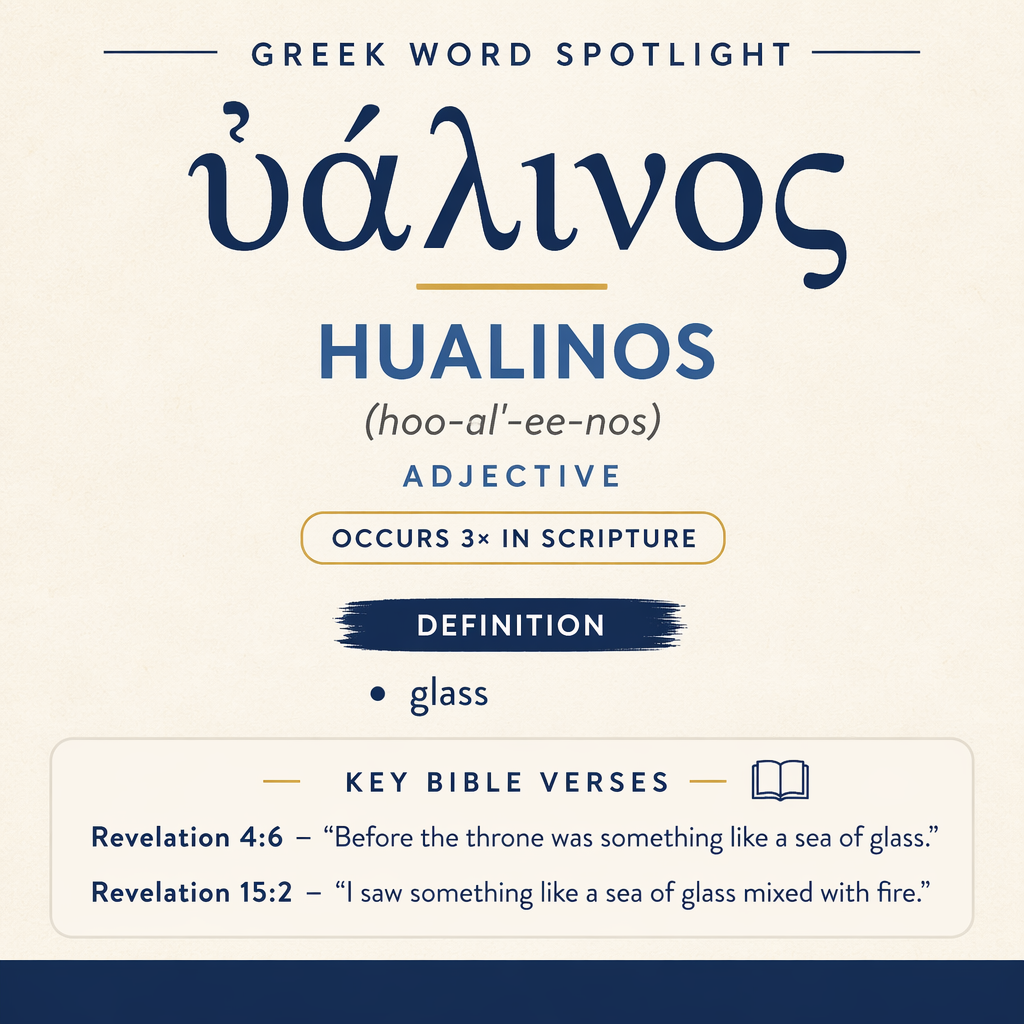
ὑάλινος means “glass” and appears in Revelation, including scenes of a sea of glass before God’s throne (Revelation 4:6; 15:2).
Scripture Occurrences
This word occurs 3 times in Scripture. It appears in Revelation.
Learn More →Revelation Scenes
Revelation 4:6 describes something like a sea of glass, similar to crystal, before the throne. Revelation 15:2 describes something like a sea of glass mixed with fire.
Learn More →ὑάλινος means “glass” and appears in Revelation’s throne-room visions, describing a “sea” whose surface is likened to glass. In these scenes, the word helps portray a vast expanse before God’s throne, first in crystalline terms and later as glass “mixed with fire.”
Root and Related Words
ὑάλινος (Hualinos) corresponds to the noun ὕαλος (hyalos), “glass” (Strong’s G5194). The adjective form carries the quality of what belongs to glass, enabling Revelation’s imagery to speak of something “like” a glassy expanse.
Occurrences
Revelation 4:6: “Before the throne was something like a sea of glass, similar to crystal. In the middle of the throne, and around the throne were four living creatures full of eyes before and behind.”
Here ὑάλινος is attached to the phrase “sea,” presenting an immense, sea-like spread that is characterized as “of glass.” The description is careful and comparative: it is “something like a sea of glass,” and it is further qualified as “similar to crystal.” In this setting, the “sea” is located “before the throne,” so the glass-like quality belongs to what lies immediately in the throne’s presence. The effect in the verse is to mark the space in front of the throne as visually striking—expansive like a sea, yet with the clarity, brightness, or sheen suggested by “glass” and reinforced by “similar to crystal.”
The verse also places living creatures “in the middle of the throne, and around the throne,” “full of eyes before and behind.” The “sea of glass” functions as part of the throne-room’s layout: a prominent feature in front of the throne, while the living creatures occupy the region in and around it. By describing the sea in glass terms, the word contributes to the overall sensory portrayal of the scene as one of awe and heightened perception—an environment where surfaces and beings are depicted with extraordinary visual intensity (a sea that looks like glass; creatures full of eyes).
Revelation 15:2: “I saw something like a sea of glass mixed with fire, and those who overcame the beast, his image, and the number of his name, standing on the sea of glass, having harps of God.”
In this occurrence, the same “sea of glass” returns, again introduced with the careful comparison “something like.” The glass-like expanse is now described as “mixed with fire,” adding a second element to the visual impression. The word ὑάλινος still anchors the primary characterization—this is a sea whose defining quality is glass—yet the scene’s coloration or appearance is intensified by the note of fire mingled with it.
The narrative action in this verse is also different: people are present in relation to the glassy sea. The text depicts “those who overcame the beast, his image, and the number of his name” as “standing on the sea of glass,” and they are “having harps of God.” The sea is therefore not only a feature observed before the throne; it becomes a kind of platform on which the victors stand. The adjective “glass” contributes to this portrayal by making the standing place extraordinary: it is still “sea”-like in scale, but its surface is described in glass terms. The verse thus holds together two impressions—immensity (“sea”) and the distinctive material quality (“of glass”)—while positioning the overcomers visibly upon it with harps in hand.
Sense and Usage
Across these passages, “glass” functions as a descriptive quality applied to a “sea” in visionary space. The word does not identify an ordinary object held in the hand; it characterizes a vast feature of the scene. Revelation’s repeated phrasing—“something like a sea of glass”—keeps the description in the realm of likeness: ὑάλινος marks what the seer’s vision resembles when it is rendered in human language.
In Revelation 4:6 the glass-like quality is paired with “similar to crystal,” which tightens the focus on appearance. The verse stacks comparisons: sea-like in breadth, glass-like in nature, crystal-like in similarity. The cumulative effect is that “glass” points readers toward a surface that is visually remarkable—fitting for what lies “before the throne.” The sea is not described by motion or waves, but by its look. In that way, ὑάλινος helps shift “sea” away from the usual associations of water and movement toward a visionary expanse defined by brilliance and a distinctive surface quality.
In Revelation 15:2 the usage develops by adding “mixed with fire” and by introducing people who stand on it. The “glass” quality remains central, but the scene now includes a dramatic blending of elements (“mixed with fire”) and a human posture (“standing on the sea of glass”). This usage shows that the term can sustain more than a static descriptive role; it can also support the scene’s staging, providing a setting where the victors are displayed. The overcomers’ stance on the glassy sea, together with their “harps of God,” makes the “sea of glass” not only an object of sight but a location within the vision where worshipful readiness is implied by their instruments.
Because ὑάλινος is used with “sea” both times, its sense in these occurrences is consistent: it marks a glass-like character attributed to an immense expanse. Yet each context shades the imagery differently. In Revelation 4:6, glass is linked with crystal and the immediate throne setting, forming part of the throne-room’s luminous architecture. In Revelation 15:2, glass is linked with fire and the presence of those who overcame, making the same architectural feature serve as the ground for a gathered company. The word’s contribution is therefore both visual and spatial: it helps depict what the expanse looks like and what role it plays in the arrangement of the vision.
Imagery
The “sea of glass” imagery shaped by ὑάλινος presents a paradox-like scene: a “sea” that is characterized by glass. In Revelation 4:6, that glass-like sea stands “before the throne,” establishing a striking foreground to the throne-room and complementing the surrounding creatures “full of eyes.” In Revelation 15:2, the same kind of expanse appears again, now “mixed with fire,” and becomes the place where the overcomers are shown “standing” with “harps of God.” In both verses, “glass” is part of Revelation’s way of rendering transcendent scenes with concrete, vivid description—an expanse seen and named by what it resembles.
Sources: Lexical data from Strong’s Exhaustive Concordance and the Translators Brief Lexicon of Extended Strongs for Greek (STEPBible, CC BY). Occurrence data from the Translators Amalgamated Greek New Testament (STEPBible, CC BY). Scripture quotations from the World English Bible (public domain).