Exploring the Meaning of Houtos in Greek
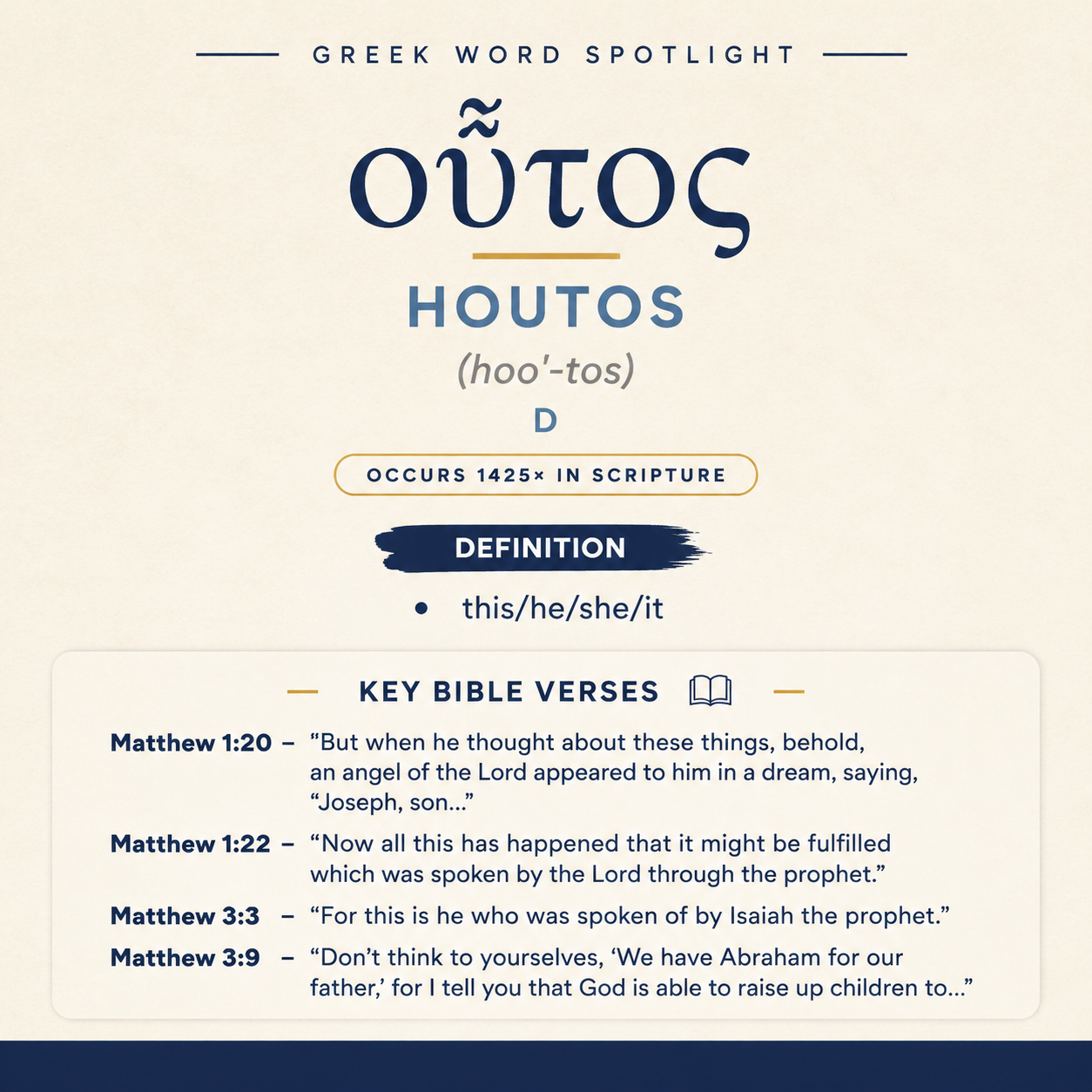
οὗτος means “this/he/she/it” and occurs 1425 times in Scripture, including Matthew 1:20; 1:22; 3:3; 3:17; 4:3; 4:9; 5:19.
οὗτος points to something present in the discourse—“this” and, by context, “he/she/it”—and in these passages it repeatedly singles out a specific person, event, word, or set of things already in view. The citations below show it functioning in narration, direct speech, quotation, and explanation, always sharpening reference rather than adding new content.
Occurrences
“But when he thought about these things, behold, an angel of the Lord appeared to him in a dream, saying, “Joseph, son of David, don’t be afraid to take to yourself Mary, your wife, for that which is conceived in her is of the Holy Spirit.” (Matthew 1:20)
In Joseph’s inner deliberation, “these things” gathers up the matters occupying his mind and makes them a defined cluster: not a vague worry, but particular concerns that the narrative has already set before him. The angel’s message then addresses the situation as a concrete, immediate issue.
“Now all this has happened that it might be fulfilled which was spoken by the Lord through the prophet, saying,” (Matthew 1:22)
“All this” compresses the preceding events into a single, pointed whole, presenting them as the specific complex of happenings that stand in view for the explanatory purpose that follows. The demonstrative helps the narrator tie what has occurred to what is about to be cited.
“For this is he who was spoken of by Isaiah the prophet, saying, “The voice of one crying in the wilderness, make the way of the Lord ready! Make his paths straight!”” (Matthew 3:3)
Here “this” functions like a verbal finger-point: the speaker identifies a particular person as the one referred to in the prophetic words that are quoted. The effect is to narrow the prophecy’s referent to the individual currently being discussed, not to an abstract theme.
“Don’t think to yourselves, ‘We have Abraham for our father,’ for I tell you that God is able to raise up children to Abraham from these stones.” (Matthew 3:9)
“These stones” makes the illustration vivid and local—stones that can be indicated as present rather than merely imagined. The demonstrative intensifies the contrast between the hearers’ claimed lineage and God’s power to bring forth children from something as immediately tangible as stones at hand.
“Behold, a voice out of the heavens said, “This is my beloved Son, with whom I am well pleased.”” (Matthew 3:17)
In the heavenly proclamation, “This” marks out a single, definite person as the subject of the declaration. The sentence does not speak generally about sonship; it identifies the particular one present at that moment as “my beloved Son.”
“The tempter came and said to him, “If you are the Son of God, command that these stones become bread.”” (Matthew 4:3)
Again “these stones” points to specific stones in the setting, making the temptation concrete: the proposal concerns particular objects that can be transformed. The demonstrative keeps the suggestion anchored to immediate circumstances rather than to a hypothetical scenario.
“He said to him, “I will give you all of these things, if you will fall down and worship me.”” (Matthew 4:9)
“All of these things” gathers the promised objects into a defined totality—an entire package being offered. The phrase frames the offer as comprehensive within the scope of what is being presented, and it sets that total offer against the single demanded act.
“Whoever, therefore, shall break one of these least commandments, and teach others to do so, shall be called least in the Kingdom of Heaven; but whoever shall do and teach them shall be called great in the Kingdom of Heaven.” (Matthew 5:19)
“These least commandments” identifies a particular set of commandments already under discussion, viewed from the perspective of their perceived smallness. The demonstrative does two things at once: it marks them as the definite referent, and it allows the warning to focus on even the smallest items within that known body of commands.
“But let your ‘Yes’ be ‘Yes’ and your ‘No’ be ‘No.’ Whatever is more than these is of the evil one.” (Matthew 5:37)
“These” refers back to the simple, stated words—‘Yes’ and ‘No’—and makes them the bounded standard for speech. By pointing to those two terms as the measure, the sentence treats anything beyond that defined limit as excess.
“Therefore I tell you, don’t be anxious for your life: what you will eat, or what you will drink; nor yet for your body, what you will wear. Isn’t life more than food, and the body more than clothing?” (Matthew 6:25)
In “your life: what you will eat, or what you will drink… what you will wear,” the discourse revolves around concrete needs; οὗτος in this verse operates in the background of that focus, pointing the listener to the particular concerns just named and treating them as the items anxiety tends to fasten onto.
“yet I tell you that even Solomon in all his glory was not dressed like one of these.” (Matthew 6:29)
“One of these” points to specific examples already in view in the surrounding imagery, and the comparison becomes immediate: Solomon’s glory is measured against a definite instance that can be indicated. The demonstrative supports the argument by making the comparison about an identifiable “one,” not a general category.
“For the Gentiles seek after all these things; for your heavenly Father knows that you need all these things.” (Matthew 6:32)
“All these things” twice collects the practical necessities just discussed into a recognized set—what people “seek after,” and what the Father “knows that you need.” The repetition of the demonstrative marks the same concrete bundle of concerns from two angles: human pursuit and divine knowledge.

Sense and Usage
Across these citations, οὗτος consistently performs the work of identification and delimitation. It can compress multiple events into a single referent (“all this has happened”), select a particular person for recognition (“This is my beloved Son”), and point to immediate, concrete items (“these stones”). In each case the demonstrative does not introduce a new topic; it tightens the listener’s focus on something already present—either physically in the scene (stones) or verbally in the discourse (the events that “have happened,” the commands under discussion, the simple “Yes” and “No”).
The word also scales naturally from singular to plural and from small to comprehensive. It can highlight an individual (“this is he,” “This is my beloved Son”) and it can gather a set into a total (“all of these things,” “all these things”). That ability to both pinpoint and collect is rhetorically important in these passages: it can make a temptation feel immediate (stones that can be indicated), make an offer sound exhaustive (all that is being shown), or make moral instruction precise (a known set of commandments, even those regarded as least).
Several uses show οὗτος bridging between speech and interpretation. Matthew 1:22 uses “all this” to package narrative events as the subject of explanation, and Matthew 3:3 uses “this” to align a present figure with quoted prophetic language. In those moves, the demonstrative acts as a hinge: it connects what has been seen or said in the immediate context to the meaning assigned to it in the next line of discourse.
Imagery in Context
Because οὗτος points, it often makes scenes tangible. “These stones” appears in both Matthew 3:9 and Matthew 4:3, grounding a theological claim and a moral test in the same kind of plain, touchable object. Likewise, “all these things” in Matthew 6:32 gathers ordinary needs into a visible bundle of concerns, while “This is my beloved Son” (Matthew 3:17) concentrates an entire declaration upon a single, present person. In these passages, the demonstrative repeatedly turns ideas into referents that can be indicated—events, people, words, commands, and necessities made specific by “this/these.”
Sources: Lexical data from Strong’s Exhaustive Concordance and the Translators Brief Lexicon of Extended Strongs for Greek (STEPBible, CC BY). Occurrence data from the Translators Amalgamated Greek New Testament (STEPBible, CC BY). Scripture quotations from the World English Bible (public domain).