Exploring the Meaning of Hoste in Greek
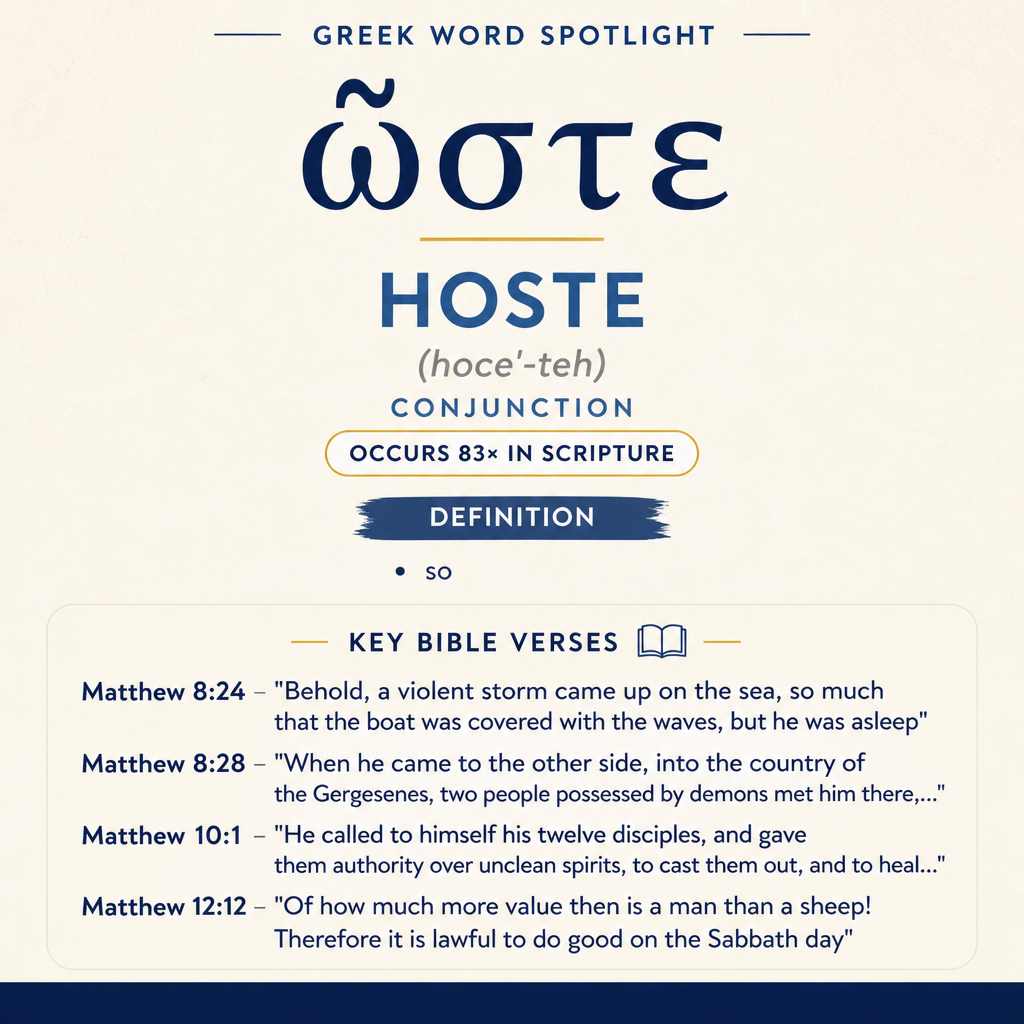
ὥστε means “so” in Greek and occurs 83 times in Scripture, including Matthew 8:24; 12:22; and 13:2.
Scripture Footprint
It occurs 83 times in Scripture. Listed examples include Matthew 8:24; 12:22; and 13:2.
Learn More →Example Contexts
In Matthew 8:24 and Matthew 13:2, it connects events to resulting situations. In Matthew 12:22, it links healing to the man’s restored abilities.
Learn More →ὥστε expresses result: “so,” marking what follows as the outcome of what has just been described. In these passages it regularly links a situation, action, or stated premise to its practical consequence in narrative, teaching, and response.
Occurrences
Matthew 8:24 — “Behold, a violent storm came up on the sea, so much that the boat was covered with the waves, but he was asleep.”
ὥστε introduces the storm’s effect as the measurable result of its violence: the sea’s upheaval reaches the point that the boat is covered. The conjunction makes the clause about the boat not merely descriptive detail, but the consequence that shows how severe the storm has become, set in stark contrast with the final note, “but he was asleep.”
Matthew 8:28 — “When he came to the other side, into the country of the Gergesenes, two people possessed by demons met him there, coming out of the tombs, exceedingly fierce, so that nobody could pass that way.”
Here ὥστε ties the description “exceedingly fierce” to a concrete social outcome: the road becomes impassable. The result clause (“so that nobody could pass that way”) functions as evidence of the intensity already stated; it explains what their fierceness produced in that setting.
Matthew 10:1 — “He called to himself his twelve disciples, and gave them authority over unclean spirits, to cast them out, and to heal every disease and every sickness.”
In this commissioning scene, ὥστε frames the giving of authority with its intended outcome in action: casting out unclean spirits and healing. The result is not abstract; it is spelled out in a pair of purpose-like consequences that define what the authority accomplishes in practice.
Matthew 12:12 — “Of how much more value then is a man than a sheep! Therefore it is lawful to do good on the Sabbath day.”
ὥστε links an evaluative comparison (“a man” being of greater “value” than “a sheep”) to the resulting ethical conclusion. The conjunction drives the reasoning forward: once the premise is granted, the statement “it is lawful to do good on the Sabbath day” is presented as the outcome that follows from it.
Matthew 12:22 — “Then one possessed by a demon, blind and mute, was brought to him and he healed him, so that the blind and mute man both spoke and saw.”
ὥστε introduces the immediate, observable results of healing in the formerly afflicted man: speech and sight. By marking “both spoke and saw” as the consequence, the conjunction spotlights restoration as the direct outcome of the act of healing described in the first half of the verse.
Matthew 13:2 — “Great multitudes gathered to him, so that he entered into a boat, and sat, and all the multitude stood on the beach.”
ὥστε connects crowd size to a practical adjustment in location and posture. The gathering of “great multitudes” results in him getting into a boat and sitting, while the crowd remains on shore; the conjunction makes the boat a response to the press of the people rather than a random choice.
Matthew 13:32 — “which indeed is smaller than all seeds. But when it is grown, it is greater than the herbs, and becomes a tree, so that the birds of the air come and lodge in its branches.”
In this growth description, ὥστε marks what the plant’s transformation produces: it becomes a place where “the birds of the air come and lodge.” The result clause depends on the prior development (“becomes a tree”) and shows consequence in terms of new capacity—branches now support lodging.
Matthew 13:54 — “Coming into his own country, he taught them in their synagogue, so that they were astonished, and said, “Where did this man get this wisdom, and these mighty works?”
ὥστε ties teaching to hearers’ reaction. The astonishment and the question that follows are treated as the outcome of what they have just experienced in the synagogue: his instruction elicits a response that spills into speech, probing the source of “wisdom” and “mighty works.”
Matthew 15:31 — “so that the multitude wondered when they saw the mute speaking, the injured healed, the lame walking, and the blind seeing—and they glorified the God of Israel.”
ὥστε introduces the combined effect of multiple restorations on the crowd: wonder leading into praise. The clause gathers a series of visible reversals (“mute speaking,” “lame walking,” “blind seeing”) and presents the crowd’s amazement—and then their glorifying of God—as the consequence of witnessing them.
Matthew 15:33 — “The disciples said to him, “Where should we get so many loaves in a deserted place as to satisfy so great a multitude?”
ὥστε (expressed in English here by “as to”) links the quantity of loaves sought to the intended result of meeting need: satisfying “so great a multitude.” The conjunction frames the disciples’ question around outcome: the issue is not merely finding bread, but finding enough to produce fullness for the crowd in “a deserted place.”
Matthew 19:6 — “So that they are no more two, but one flesh. What therefore God has joined together, don’t let man tear apart.”
ὥστε draws an inference about relational status as the result of what precedes: “they are no more two, but one flesh.” The conjunction makes oneness the outcome that grounds the following admonition; the result clause functions as the stated consequence that supports the imperative against separation.
Matthew 23:31 — “Therefore you testify to yourselves that you are children of those who killed the prophets.”
ὥστε introduces a self-incriminating outcome: their own testimony establishes their connection to “those who killed the prophets.” The conjunction makes the clause about testimony the consequence of what has been argued up to that point, turning reasoning into a concluding statement about what their words amount to.

Sense and Usage
Across these passages, ὥστε consistently signals result, but the kinds of results vary with genre and setting. In narrative scenes it often marks a physical or logistical consequence that reveals the pressure of circumstances: the storm’s violence is shown by waves covering a boat (Matthew 8:24), and the gathering crowds force a shift to teaching from a boat while the listeners remain on the beach (Matthew 13:2). In similar fashion, a description of threatening danger is anchored in a concrete outcome—no one can pass that way (Matthew 8:28)—so the reader is not left with an undefined intensity.
When the context is an act of restoration or power, ὥστε introduces observable change as the outcome that verifies the action. Healing is followed by specific reversals: speech and sight for the blind and mute man (Matthew 12:22), and a cascade of restorations that together produce wonder and doxology in the crowd (Matthew 15:31). In both, the result clause is not an extra detail but the point at which the action becomes publicly legible.
In teaching and argument, ὥστε has a more inferential force: it draws out what follows from a stated premise. The value comparison between a man and a sheep yields an ethical conclusion about doing good on the Sabbath (Matthew 12:12). The statement about becoming “one flesh” is cast as the result that undergirds the practical command not to tear apart what God has joined (Matthew 19:6). Likewise, the wording in Matthew 23:31 treats a self-description as an outcome of the preceding reasoning: the conclusion is that their own testimony places them within a lineage marked by the killing of prophets.
Even where a question is asked rather than an assertion made, ὥστε still keeps the focus on consequence. The disciples’ concern is framed by a required outcome—satisfying a multitude in a deserted place (Matthew 15:33). And in the parable-like growth description, result is expressed in imagery: becoming a tree yields the new consequence of providing lodging for birds (Matthew 13:32). In each case, ὥστε organizes the sentence so the reader hears not only what happened or what is true, but what that reality leads to.
Imagery
The results marked by ὥστε often paint vivid, tangible endpoints: a boat disappearing under waves (Matthew 8:24), a road effectively closed by fear (Matthew 8:28), a shoreline audience facing a teacher seated offshore (Matthew 13:2), birds settling into branches of a grown tree (Matthew 13:32), and crowds reacting as impairments give way to speech, movement, and sight (Matthew 15:31). Even in the more abstract conclusions (Matthew 12:12; 19:6; 23:31), the conjunction keeps the logic concrete by presenting the conclusion as the direct outcome of what has just been stated.
Sources: Lexical data from Strong’s Exhaustive Concordance and the Translators Brief Lexicon of Extended Strongs for Greek (STEPBible, CC BY). Occurrence data from the Translators Amalgamated Greek New Testament (STEPBible, CC BY). Scripture quotations from the World English Bible (public domain).