Exploring the Meaning of Hosos in Greek
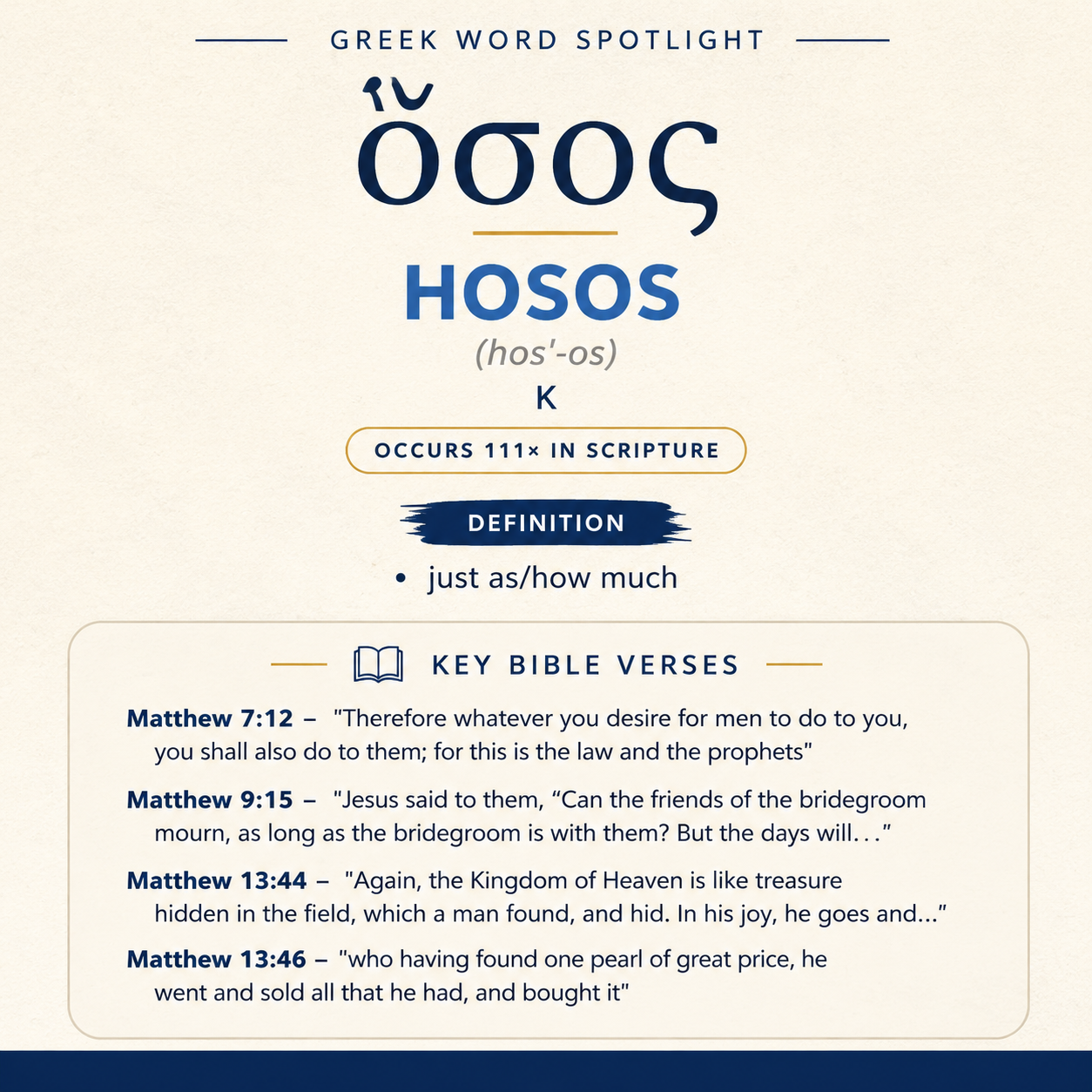
ὅσος means “just as/how much” and occurs 111 times in Scripture, including Matthew 7:12; 14:36; 18:18; and 18:25.
Core Meaning
ὅσος conveys comparison or extent: “just as/how much.” It can mark a measure, degree, or correspondence in a statement.
Learn More →Scripture Footprint
This word occurs 111 times in Scripture. Sample occurrences include Matthew 7:12; 9:15; 13:44; 13:46; 14:36; 17:12; 18:18; and 18:25.
Learn More →Usage Examples
In Matthew 14:36, it appears in “as many as touched it were made whole.” In Matthew 18:18, it frames “whatever things you bind… whatever things you release.”
Learn More →ὅσος expresses comparison and measure, focusing on “just as/how much” within statements about actions, extent, and response. In the passages gathered here it repeatedly frames the scope of what is done, what is asked, or what is found, often highlighting a matching or proportionate relationship.
Occurrences
“Therefore whatever you desire for men to do to you, you shall also do to them; for this is the law and the prophets.” (Matthew 7:12)
Here ὅσος sets the measure of the instruction: the pattern for one’s actions toward others is calibrated to the measure of one’s own desires—“whatever you desire … you shall also do.” The comparison is not abstract; it attaches the extent of outward action to the extent of inward expectation, linking the two sides in a strict correspondence.

Jesus said to them, “Can the friends of the bridegroom mourn, as long as the bridegroom is with them? But the days will come when the bridegroom will be taken away from them, and then they will fast.” (Matthew 9:15)
In this question-and-answer, ὅσος marks the time-span that governs the appropriateness of mourning: it is “as long as” the bridegroom is present. The word sets a boundary of duration and ties emotional practice to an objective condition—presence versus removal—so that the change in circumstance determines how long one response is fitting and when another begins.
“Again, the Kingdom of Heaven is like treasure hidden in the field, which a man found, and hid. In his joy, he goes and sells all that he has, and buys that field.” (Matthew 13:44)
In the treasure parable, ὅσος governs the extent of liquidation: the man “sells all that he has.” The measure is total—everything within his possession is included. By doing so, the narrative stresses the scale of the man’s action in proportion to the value he perceives in the hidden treasure.
who having found one pearl of great price, he went and sold all that he had, and bought it. (Matthew 13:46)
Likewise, ὅσος frames the comprehensive scope of what is sold: “all that he had.” The emphasis falls on the magnitude of exchange. The word contributes the idea that the buyer’s commitment is not partial or incremental; it reaches the full measure of his holdings in order to obtain the single pearl.
and they begged him that they might just touch the fringe of his garment. As many as touched it were made whole. (Matthew 14:36)
In this healing scene, ὅσος sets the count of those who benefited: “As many as touched it were made whole.” The word functions like a quantitative marker, sweeping together all the touchers as a complete set and matching their action (“touched”) with the resulting condition (“were made whole”) across the full extent of the group.
but I tell you that Elijah has come already, and they didn’t recognize him, but did to him whatever they wanted to. Even so the Son of Man will also suffer by them.” (Matthew 17:12)
Here ὅσος marks the extent of unrestrained intention: they did to him “whatever they wanted to.” The word gives breadth to the mistreatment by locating it in the range of their will—actions are described not item by item but as reaching as far as their desire extended, which sets up the stated parallel of suffering that follows.
Most certainly I tell you, whatever things you bind on earth will have been bound in heaven, and whatever things you release on earth will have been released in heaven. (Matthew 18:18)
In this saying, ὅσος draws the perimeter around the “things” in view—“whatever things you bind … whatever things you release.” The word contributes a comprehensive scope, presenting the earthly act and the heavenly result as corresponding across the whole range of the specified actions. The paired clauses also show ὅσος working symmetrically: the measure of “whatever” on earth matches the measure of what is described in heaven.
But because he couldn’t pay, his lord commanded him to be sold, with his wife, his children, and all that he had, and payment to be made. (Matthew 18:25)
Within the debt scenario, ὅσος again sets total extent: “all that he had” falls under the command. The word gathers the debtor’s assets into an all-encompassing sum, intensifying the severity of the remedy by indicating that nothing in his possession lies outside the demanded measure.
All things, whatever you ask in prayer, believing, you will receive.” (Matthew 21:22)
In this promise, ὅσος expands the scope of the objects of asking: “whatever you ask in prayer.” The statement links the breadth of possible requests to the stated condition (“believing”), presenting the receiving as corresponding to the asking across the range denoted by “whatever.” The word thus frames prayer’s content in terms of extent rather than specifying particular petitions.
Go therefore to the intersections of the highways, and as many as you may find, invite to the wedding feast.’ (Matthew 22:9)
In the wedding-feast instruction, ὅσος sets the breadth of the invitation list: “as many as you may find.” The directive is not to identify a predetermined number, but to extend the invitation proportionally to discovery—everyone encountered within the search becomes included, and the measure of inviting matches the measure of finding.
All things therefore whatever they tell you to observe, observe and do, but don’t do their works; for they say, and don’t do. (Matthew 23:3)
Here ὅσος defines the scope of what is to be observed: “whatever they tell you to observe.” The word functions as a boundary marker around instructions, presenting them as a total class of items (“whatever”) that are to be enacted. In the same sentence, that broad scope is contrasted with a refusal to imitate “their works,” so ὅσος helps sharpen the distinction between the range of what is said and the mismatch of what is done.
“The King will answer them, ‘Most certainly I tell you, because you did it to one of the least of these my brothers, you did it to me.’” (Matthew 25:40)
Although ὅσος is not overtly quantitative in English here, the scene’s logic is built on measured correspondence: an act done to “one of the least” is treated as an act done to the King himself. ὅσος contributes the force of “just as” by establishing an equivalence between two targets of action—what is done in one direction counts in the other—so that even the smallest-seeming recipient is not outside the measure of the King’s concern.

Sense and Usage
Across these passages, ὅσος consistently governs relationships of measure: the measure of one action is matched to another (“whatever you desire … do to them”), the measure of response is bounded by a condition (“as long as the bridegroom is with them”), and the measure of inclusion extends to a full set (“as many as touched,” “as many as you may find”). Even where the English reads with different surface forms—“whatever,” “as long as,” “as many as,” “all that he had”—the controlling idea is the same: ὅσος draws a line around the relevant extent and then uses that extent to express proportionality or correspondence.
Several patterns stand out. First, ὅσος frequently expands a statement to cover the entire range of its category: “whatever things” in Matthew 18:18, “whatever you ask” in Matthew 21:22, and “whatever they tell you to observe” in Matthew 23:3. The word does not enumerate; it generalizes, making the statement’s scope as wide as the category itself. Second, in scenes of valuation and cost (Matthew 13:44, 13:46; Matthew 18:25), ὅσος intensifies by moving from partial to total—“all that he has/all that he had.” The narratives hinge on totality: selling everything, or forfeiting everything, sets a maximum measure and thereby magnifies either the perceived worth (in the parables) or the harshness of the remedy (in the debt setting). Third, in group and mission settings (Matthew 14:36; Matthew 22:9), ὅσος marks open-ended quantity: the results or invitations extend to everyone who meets the stated condition (touching; being found), without narrowing the group by prior status.
Finally, ὅσος serves as a verbal hinge that allows a statement to move smoothly from one sphere to another while preserving measure: from inner desire to outward treatment (Matthew 7:12), from earthly binding and releasing to heavenly realities (Matthew 18:18), and from acts toward “the least” to acts toward the King (Matthew 25:40). In each case, the word’s force is comparative: it enables a “just as/how much” relationship so that the second side is not merely similar, but measured by the first.
Imagery in Context
The passages give ὅσος a vivid, practical feel: people sell “all that” they have to gain a treasure or pearl, crowds become well “as many as” reach out to touch, and servants are commanded to invite “as many as” they find at the crossroads. The word repeatedly presses the reader to think in terms of extent—how far an action goes, how widely it spreads, and how closely one deed corresponds to another.
Sources: Lexical data from Strong’s Exhaustive Concordance and the Translators Brief Lexicon of Extended Strongs for Greek (STEPBible, CC BY). Occurrence data from the Translators Amalgamated Greek New Testament (STEPBible, CC BY). Scripture quotations from the World English Bible (public domain).