Exploring the Meaning of Homophron in Greek
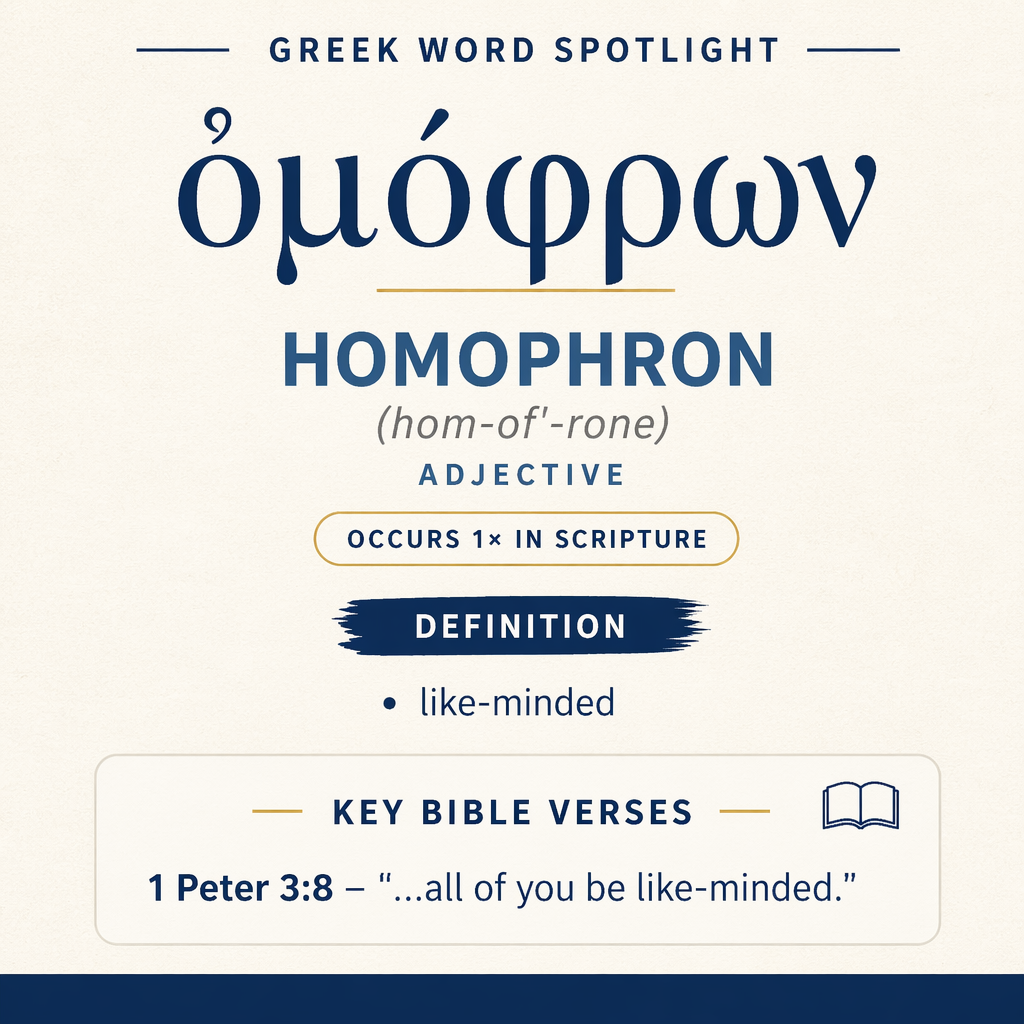
ὁμόφρων means “like-minded” and appears once in Scripture at 1 Peter 3:8.
Verse Context
In 1 Peter 3:8, it is part of an exhortation: “Finally, all of you be like-minded...”
Learn More →ὁμόφρων means “like-minded” and appears in a closing set of exhortations that gathers several relational qualities into one brief charge. In its lone New Testament occurrence, it stands at the head of a list that sketches the inner posture and outward manner expected of the whole community.
Root and Related Words
Homophron is formed from homou (ὁμοῦ), “together,” and phren (φρήν), “thinking.” The combination frames the idea of minds that are together in their thought, aligning the inner life of the group rather than merely coordinating external actions.

Occurrences
“Finally, all of you be like-minded, compassionate, loving as brothers, tenderhearted, courteous,” (1 Peter 3:8)
In 1 Peter 3:8, “like-minded” functions as the first and governing descriptor in a compact series of communal virtues. The verse’s opening word, “Finally,” signals a concluding summation, and the direct address “all of you” makes the exhortation comprehensive rather than selective: the whole church is called into the same posture. Placing “like-minded” first gives it a kind of framing force for what follows, not by replacing the other qualities but by setting a shared mental orientation alongside them.

The list that follows (“compassionate, loving as brothers, tenderhearted, courteous”) supplies the immediate atmosphere in which “like-minded” operates. In this sentence, “like-minded” is not an abstract ideal detached from relationships; it stands next to explicitly relational traits. Compassion and tenderness point to inward responsiveness to one another, while “loving as brothers” names a familial pattern of attachment. “Courteous” adds the dimension of manner and tone. Against that backdrop, “like-minded” contributes the sense of a shared mind that supports and stabilizes these other virtues, so that compassion and brotherly love do not remain isolated acts but express a common orientation within the group.
The syntax also matters: the verb “be” governs the entire chain of adjectives, presenting them as a unified call rather than a menu of optional traits. “Like-minded” in this context is therefore part of the basic shape of communal life. It suggests that the community’s harmony is not only a matter of keeping peace externally, but of holding together internally in the realm of thought, intention, and attitude—precisely the sphere implied by the element phren (“thinking”). At the same time, because the verse immediately names compassion, tenderness, and courtesy, the shared mind envisioned here expresses itself through merciful and respectful dealings rather than through uniformity for its own sake.
Sense and Usage
The sense “like-minded” in this passage is concrete and communal: it describes the way a plurality (“all of you”) is to be oriented in mind together. The word’s formation from “together” and “thinking” fits the verse’s movement from inner posture to outward behavior. In a sentence that strings together affective qualities (compassionate; tenderhearted) and relational commitments (loving as brothers; courteous), “like-minded” gives a mental cohesion to the whole set. It points to a shared mind that makes space for compassion and kindness to be consistent, not merely occasional.
Because “like-minded” is addressed to the entire group at once, the term naturally works at the level of community identity: it calls for a common disposition that can be held in common by many individuals. Yet the accompanying traits clarify what kind of shared mind is in view. This is not shared thinking in the sense of technical agreement or intellectual sameness; the verse itself steers the reader toward a unity characterized by compassion, family-like love, tenderness, and courtesy. The shared mind is therefore ethically and relationally shaped, a harmony of attitude that supports a community’s capacity to treat one another with warmth and respect.
In addition, the placement of “like-minded” at the front of the list gives it a programmatic role. It does not swallow up the other descriptors, but it helps interpret them as a coordinated pattern. Compassion without a shared mind could become sporadic; courtesy without a shared mind could become mere formality. By calling the whole group to be “like-minded” and then immediately specifying the tone of that common mind through the following adjectives, the verse sets a standard of communal coherence that is expressed in heartfelt and considerate conduct.
Imagery
The imagery carried by “like-minded” here is subtle but strong: many persons gathered under one shared orientation of thought. The verse presents that common mind not as a slogan but as a lived texture—compassionate, brotherly, tender, and courteous—so the picture is of a community whose inner alignment becomes visible in gentle and familial interaction.
Sources: Lexical data from Strong’s Exhaustive Concordance and the Translators Brief Lexicon of Extended Strongs for Greek (STEPBible, CC BY). Occurrence data from the Translators Amalgamated Greek New Testament (STEPBible, CC BY). Scripture quotations from the World English Bible (public domain).