Exploring the Meaning of Hodegeo in Greek
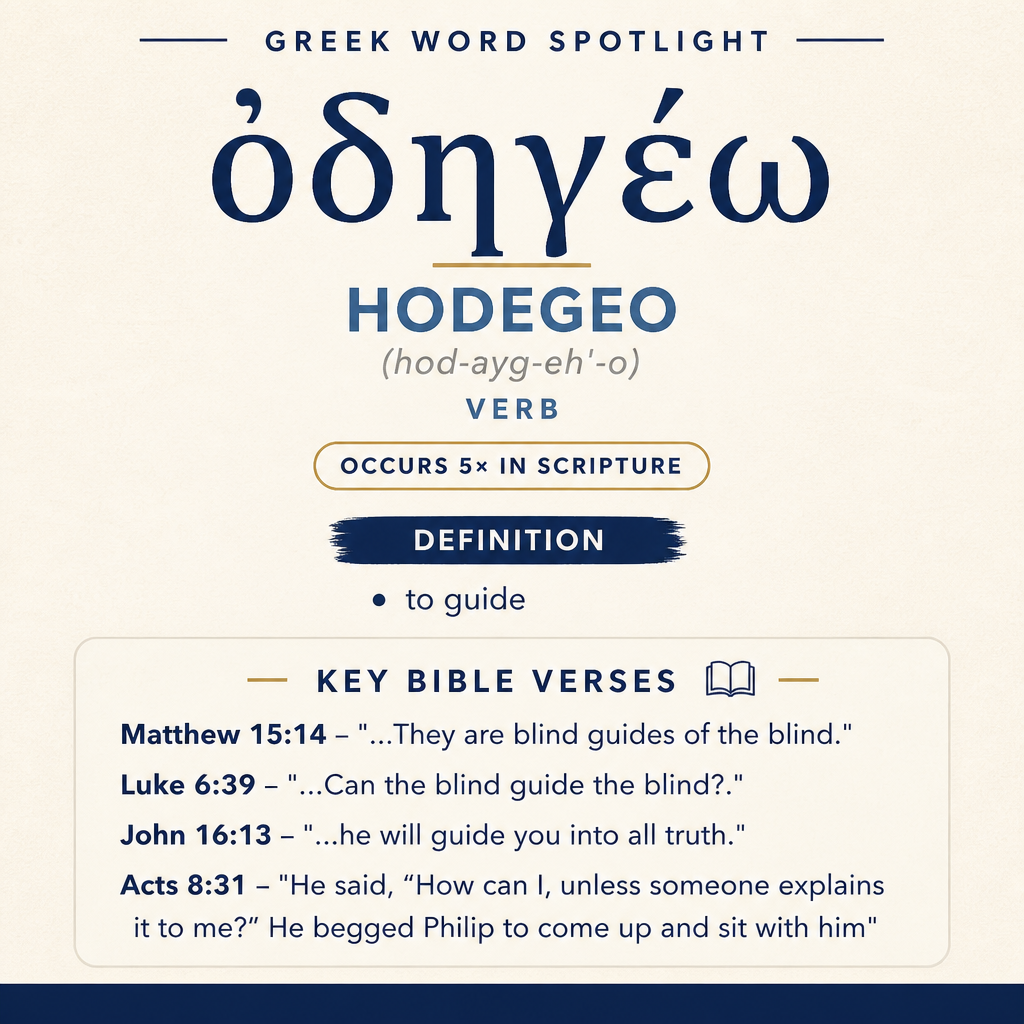
ὁδηγέω means “to guide” and occurs five times in Scripture: Matthew 15:14; Luke 6:39; John 16:13; Acts 8:31; Revelation 7:17.
Core Meaning
ὁδηγέω means “to guide.” The term is used for directing others, either rightly or wrongly.
Learn More →Gospel Warnings
In Matthew 15:14 and Luke 6:39, Jesus speaks of the blind guiding the blind, ending in a pit. These uses present guidance as dangerous when the guide lacks sight.
Learn More →Divine Leading
In John 16:13, the Spirit of truth guides into all truth. In Revelation 7:17, the Lamb leads to springs of life-giving waters.
Learn More →ὁδηγέω speaks of guiding, a verb used of direction and leadership in concrete and figurative settings. In its New Testament uses here, it ranges from warnings about misguided direction to promised guidance into truth and onward leading to life-giving waters.
Root and Related Words
ὁδηγέω is related to hodegos (ὁδηγός), “guide/leader” (Strong’s G3595), from which it is derived.

Occurrences
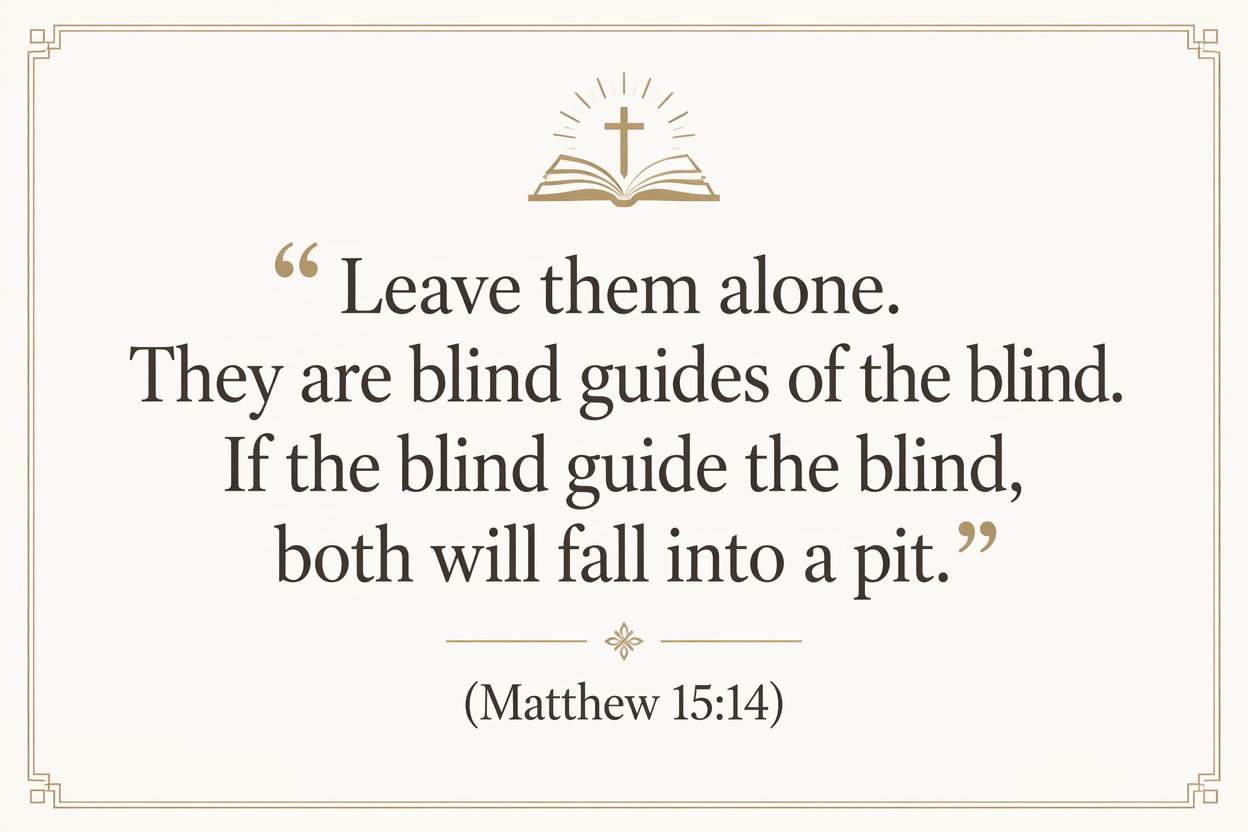
“Leave them alone. They are blind guides of the blind. If the blind guide the blind, both will fall into a pit.” (Matthew 15:14)
Here the verb depicts a “blind” person attempting to direct another “blind” person. The point is not mere ignorance but direction that carries real consequences: the act of guiding is presented as movement toward an end, and the end envisioned is disastrous—“both will fall into a pit.” Guidance, in this saying, is morally weighty because it sets a course; the failure is not simply that the guides lack sight, but that they still take the role of directing others.
“He spoke a parable to them. “Can the blind guide the blind? Won’t they both fall into a pit?” (Luke 6:39)
Luke frames the same imagery explicitly as a parable. The rhetorical questions sharpen the impossibility: “Can the blind guide the blind?” The verb functions as the hinge of the warning, because the outcome (“both fall into a pit”) is tied directly to the action of guiding. Guidance is pictured as shared travel—leader and follower are bound together in the same trajectory, and so the failure of the guide becomes the ruin of both.
“However when he, the Spirit of truth, has come, he will guide you into all truth, for he will not speak from himself; but whatever he hears, he will speak. He will declare to you things that are coming.” (John 16:13)
This occurrence sets the verb in a positive and promised context. The “Spirit of truth” is the subject, and the object is “you,” with the destination described as “into all truth.” Guiding is portrayed as purposeful direction toward a defined sphere. The remainder of the sentence explains the character of this guidance: it is coordinated with what the Spirit “hears” and “speaks,” and it includes declaration of “things that are coming.” In this setting, guiding is not merely pointing out information; it is leading someone into a fuller grasp of truth through ongoing communication.
“He said, “How can I, unless someone explains it to me?” He begged Philip to come up and sit with him.” (Acts 8:31)
Though the verb itself is not visible in the English quotation here, the scene plainly turns on the need for direction in understanding. The speaker admits inability—“How can I”—and ties comprehension to the presence of someone who can “explain.” The request that Philip “come up and sit with him” gives guidance a concrete shape: it happens alongside another person, in close proximity, with patient clarification. In this narrative moment, guiding is interpersonal and dialogical, meeting a real need for help rather than assuming self-sufficiency.
“for the Lamb who is in the middle of the throne shepherds them and leads them to springs of life-giving waters. And God will wipe away every tear from their eyes.” (Revelation 7:17)
In Revelation, guiding is cast as protective and life-sustaining leadership. The Lamb “shepherds them and leads them,” pairing direction with care. The destination is vivid: “springs of life-giving waters.” Guidance here is not abstract instruction but movement toward refreshment and life, set in a context where suffering is being removed—“God will wipe away every tear from their eyes.” The verb thus participates in an image of safe passage, where the one who leads also tends.
Sense and Usage
Across these passages, “to guide” consistently involves taking responsibility for direction—one agent acts upon another by setting a course. The sayings about “blind” guides in Matthew and Luke show that guidance can be tragically misdirected; the verb carries the idea of leading others along a path that has an outcome, and when the guide lacks the capacity to lead, the follower is endangered alongside the leader. The repeated “pit” imagery anchors the verb in the realm of movement with consequences: guiding is not neutral influence but direction that reaches a real end.
John 16:13 uses the same basic idea of direction but places it within promise and trustworthiness. The destination is “all truth,” and the action is sustained by what the Spirit “hears,” “speaks,” and “declare[s].” Guidance is shown as an unfolding process rather than a single instruction, and it is relational in that it depends on communication. The verse’s phrasing “guide you into” portrays truth not as a mere object to be possessed but as a realm into which people are led.
Acts 8:31 brings the sense of guidance into the practical matter of understanding. The request for someone to “explain” and the invitation to “sit” show that guiding can take the form of patient help that enables comprehension. Direction here is not toward a physical destination but toward grasping meaning; nevertheless, the same core action remains: one person requires another to lead them where they cannot go alone.
Revelation 7:17 returns to a strongly directional picture with a clear endpoint—“springs of life-giving waters.” Guidance is joined to shepherding, showing that leading includes care for those being led. In this setting, guiding is associated with comfort and final relief, set against the removal of tears. The verb thus spans warning, instruction, explanation, and safe leading, while keeping its central notion of directing others toward a destination.
Imagery
The passages cluster around two travel-images that illuminate what it means “to guide.” One is the peril of blind leadership: the guide and the guided move together toward a “pit,” a stark picture of misdirection that harms both parties (Matthew 15:14; Luke 6:39). The other is secure leading toward what sustains life: the Lamb “leads them to springs of life-giving waters,” where tears are wiped away (Revelation 7:17). Between these, John 16:13 frames guidance as entry “into all truth,” and Acts 8:31 portrays guidance as coming alongside someone who asks for help—different settings, yet all treating guidance as a directed movement from need toward an intended end.
Sources: Lexical data from Strong’s Exhaustive Concordance and the Translators Brief Lexicon of Extended Strongs for Greek (STEPBible, CC BY). Occurrence data from the Translators Amalgamated Greek New Testament (STEPBible, CC BY). Scripture quotations from the World English Bible (public domain).