Exploring the Meaning of Henotes in Greek
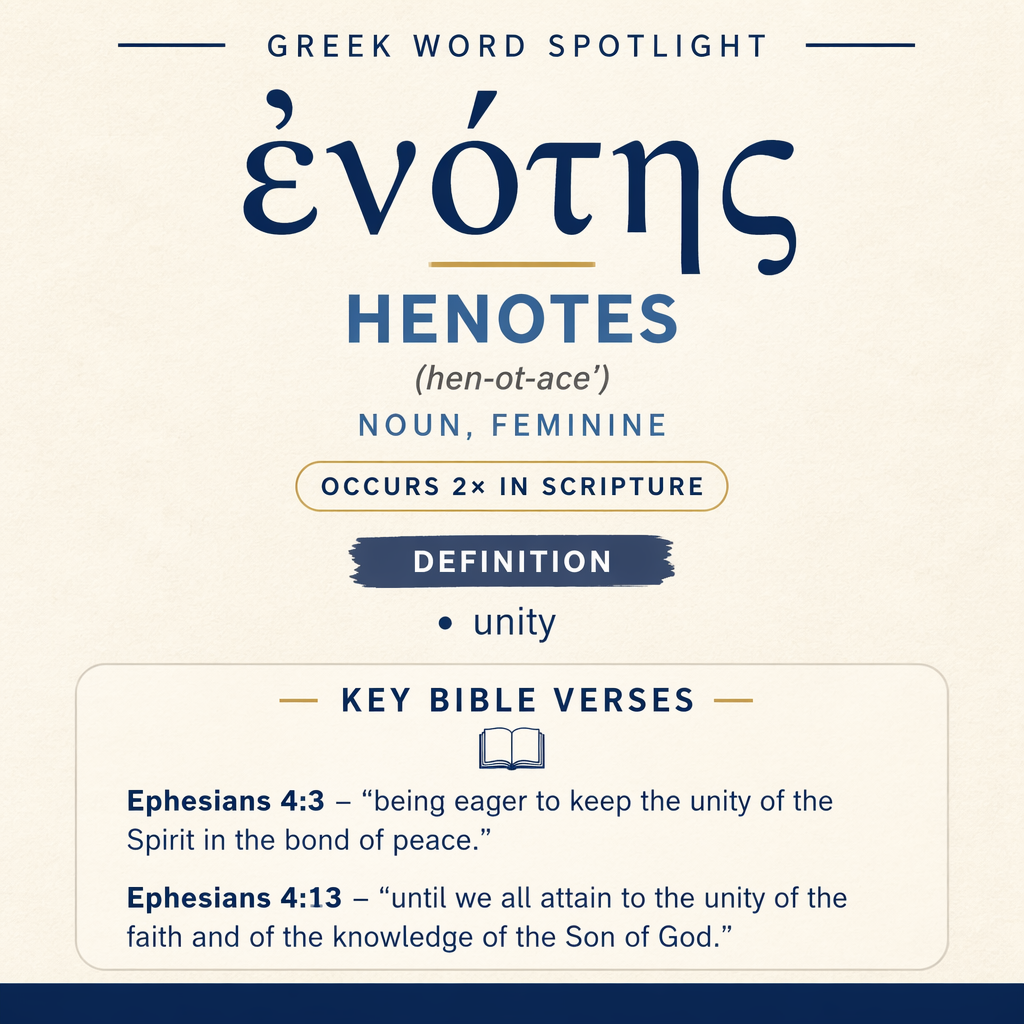
ἑνότης means “unity” and appears twice in Scripture, both in Ephesians 4:3 and Ephesians 4:13.
New Testament Occurrences
The word occurs 2 times in Scripture. Both occurrences are in Ephesians chapter 4.
Learn More →Ephesians Context
Ephesians 4:3 speaks of “the unity of the Spirit in the bond of peace.” Ephesians 4:13 speaks of “the unity of the faith and of the knowledge of the Son of God.”
Learn More →ἑνότης expresses “unity” and appears in Ephesians within exhortation about shared life and shared maturity. In both places it marks a togetherness that is guarded and also a togetherness that is reached.
Root and Related Words
ἑνότης (Henotes) is derived from heis (εἷς), “one” (Strong’s G1520). The connection to “one” frames unity as an oneness that holds multiple persons together without reducing them to a single individual.

Occurrences
Ephesians 4:3 — “being eager to keep the unity of the Spirit in the bond of peace.”
Here ἑνότης is something to be “kept,” and the verse places that keeping under the posture of being “eager.” Unity is not treated as automatic or self-sustaining; it is something that can be guarded, maintained, and protected. The phrase “of the Spirit” situates this unity as belonging to, or characterized by, the Spirit, and the prepositional phrase “in the bond of peace” gives the relational setting in which unity is preserved: peace functions as a binding tie. In this sentence, ἑνότης is not an abstract ideal floating above relationships; it is the togetherness that exists (and must be kept) where peace binds the community’s life.
The verb “keep” also suggests continuity. Unity is presented as a reality already present among those addressed, yet one that calls for active concern. The emphasis falls on readiness and responsibility—“being eager”—which makes unity a practical concern of communal conduct. Within the verse’s compact phrasing, ἑνότης names what holds people together, “the bond of peace” names the relational cord, and the Spirit names the source and character of that oneness.
Ephesians 4:13 — “until we all attain to the unity of the faith and of the knowledge of the Son of God, to a full grown man, to the measure of the stature of the fullness of Christ,”
In this occurrence ἑνότης is not described as something to be kept but as something to be reached: “until we all attain to the unity.” The verb “attain” gives unity a forward-looking dimension, as a shared goal toward which “we all” move together. The verse further specifies this unity with two genitives: “of the faith and of the knowledge of the Son of God.” Unity here is tied to common faith and common knowledge—specifically knowledge “of the Son of God”—so the oneness envisioned includes shared convictions and shared understanding, not merely outward cooperation.
The verse then stacks images of growth and proportion: “to a full grown man, to the measure of the stature of the fullness of Christ.” In this setting, ἑνότης belongs to the trajectory of maturity. Unity is linked with becoming “full grown,” and with arriving at a measured “stature” that is defined by “the fullness of Christ.” The picture is corporate movement toward a mature wholeness: “we all” progress until unity is attained, and that unity is intertwined with growth into a complete, well-proportioned maturity. Unity, in this sentence, functions as part of the description of what mature development looks like when the community is oriented toward Christ’s fullness.
Sense and Usage
Across its two uses, ἑνότης (“unity”) carries a double emphasis: unity as a present reality to be guarded and unity as a destination to be reached. Ephesians 4:3 speaks of a unity that already exists and therefore can be “kept.” The language of “bond” and “peace” places unity in the realm of relationships—something maintained through the binding power of peaceful life together. Because the unity is called “of the Spirit,” it is portrayed as belonging to the Spirit’s sphere and character; the community’s task is to preserve it in the concrete setting of peace that binds.
Ephesians 4:13, by contrast, puts unity within a timeline (“until”) and joins it to shared content (“the faith” and “the knowledge of the Son of God”). Here unity is not only relational harmony but a shared alignment in faith and knowledge as the community grows. The verse’s progression from unity to maturity (“full grown man”) and to measured fullness (“the measure of the stature of the fullness of Christ”) places unity alongside the idea of becoming complete. This does not redefine unity into something else; rather, it shows how “unity” functions when applied to the community’s intellectual and spiritual cohesion—oneness that includes a common grasp of the Son of God and a shared participation in mature fullness.
Together, the two occurrences present unity as both fragile and formative. It is fragile in the sense that it can be neglected and therefore requires eagerness to keep it within peace’s binding ties. It is formative in the sense that it is integral to the community’s movement toward maturity and a shared measure shaped by Christ’s fullness. The word’s derivation from “one” (εἷς) supports this usage: in Ephesians 4 unity is a lived oneness—protected in peace, and pursued through a shared faith and knowledge—so that “we all” move together toward a mature wholeness.
Imagery
The passages surround ἑνότης with concrete relational and developmental imagery. In Ephesians 4:3 unity is pictured as something held together by a “bond,” with “peace” functioning like the tie that keeps what is joined from coming apart. In Ephesians 4:13 unity is pictured along a path of growth: an “until” that ends in arrival, a community that becomes “full grown,” and a “measure” of “stature” shaped by “the fullness of Christ.” In these scenes, unity is both the binding of a peaceful life together and the shared attainment of mature fullness.
Sources: Lexical data from Strong’s Exhaustive Concordance and the Translators Brief Lexicon of Extended Strongs for Greek (STEPBible, CC BY). Occurrence data from the Translators Amalgamated Greek New Testament (STEPBible, CC BY). Scripture quotations from the World English Bible (public domain).