Exploring the Meaning of Henika in Greek
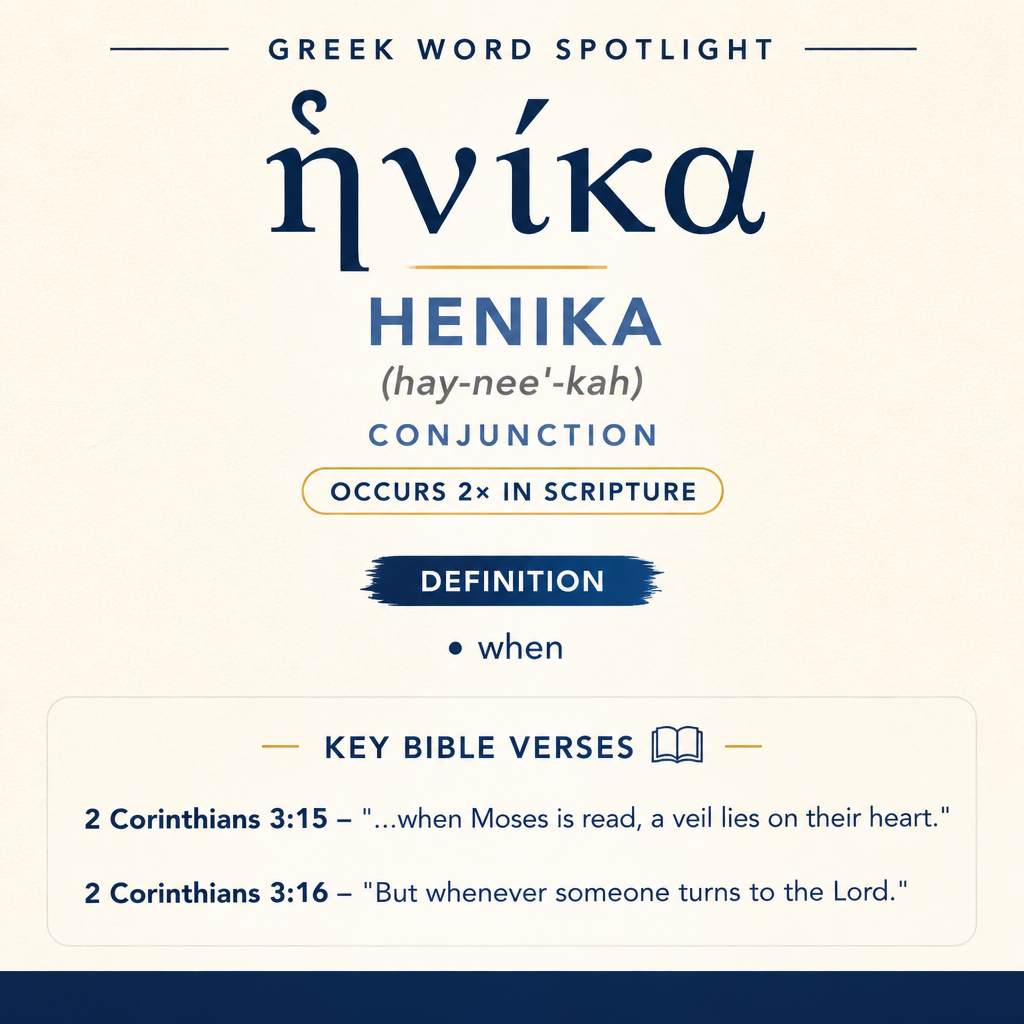
ἡνίκα means “when” and appears twice in Scripture, both in 2 Corinthians 3:15–16.
Core Meaning
ἡνίκα is defined as “when.” It marks a time or circumstance in a statement.
Learn More →Scripture Occurrences
It occurs two times in Scripture. Both occurrences are in 2 Corinthians 3:15 and 3:16.
Learn More →Context In Passage
In 2 Corinthians 3:15 it introduces the time “when Moses is read.” In 2 Corinthians 3:16 it introduces “whenever someone turns to the Lord.”
Learn More →ἡνίκα expresses a time relation, marking the point at which something takes place: “when.” In the New Testament it appears in Paul’s discussion of Moses being read and the imagery of a veil that lies on the heart and is removed upon turning to the Lord.
Occurrences
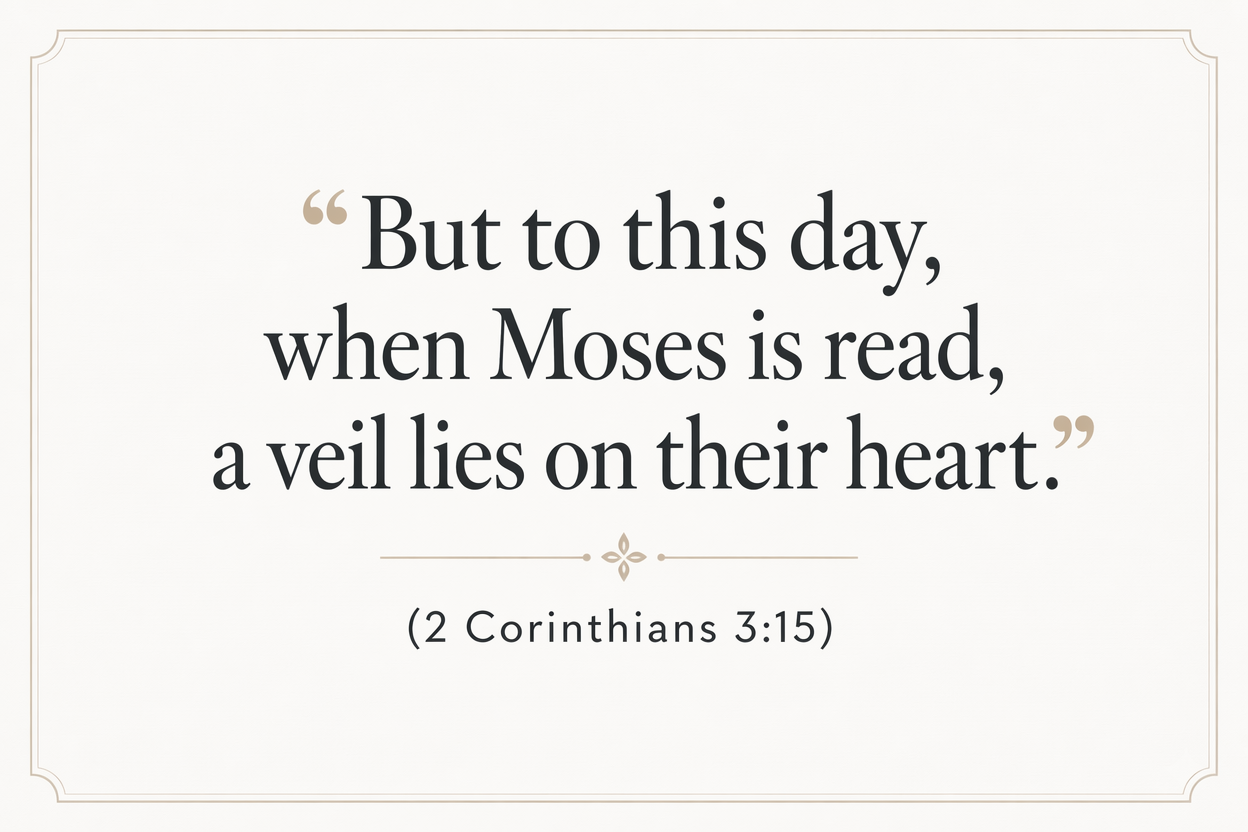
“But to this day, when Moses is read, a veil lies on their heart.” (2 Corinthians 3:15)
Here ἡνίκα introduces the temporal circumstance in which the stated condition holds: the veil’s presence is described as coinciding with the reading of Moses. The sentence frames an ongoing pattern (“to this day”) and then locates the recurring moment within that pattern: the time “when Moses is read.” By doing so, ἡνίκα helps tie the act of reading to the immediate spiritual effect described in the same clause—“a veil lies on their heart.” The conjunction does not add a new action of its own; it signals the time-frame in which the veil is experienced as lying upon the heart, so that the reading becomes the occasion in which the veil is encountered.
The verse’s structure is compact, and ἡνίκα carries weight by placing the emphasis on a repeated situation. The reading of Moses is presented as something that occurs, and with each such occurrence the veil is described as present. In this scene, ἡνίκα thus anchors the imagery of concealment (“a veil”) to a concrete setting (“Moses is read”), so the reader understands the veil not as a random or occasional hindrance but as something that is felt in a particular moment of engagement with what is read.
“But whenever someone turns to the Lord, the veil is taken away.” (2 Corinthians 3:16)
This verse states the contrasting moment in which the veil’s condition changes: “whenever someone turns to the Lord.” The English rendering “whenever” expresses a repeated or open-ended temporal setting; within that setting the key action (“turns to the Lord”) is the time at which the result occurs: “the veil is taken away.” In the flow of thought from the previous verse, the focus remains on temporal coincidence—there is a time of veiling associated with one situation, and there is a time of unveiling associated with another.
In this scene, the time-marker functions to show that the removal of the veil is not portrayed as a distant promise disconnected from the turning; it is described as happening in the very circumstance indicated by the conjunction’s time frame. The sentence does not linger over mechanics, but it links the decisive change (“is taken away”) to the moment of turning. The temporal connector, therefore, supports the passage’s strong contrast: in one temporal setting there is a veil lying on the heart, and in another temporal setting the veil is removed.

Sense and Usage
Across these two verses, ἡνίκα serves as a hinge between an identified occasion and what is true in that occasion. Its sense “when” is not merely a calendar-like timestamp; it is a way of presenting a condition that holds in a particular circumstance. In 2 Corinthians 3:15, the “when” clause places the reader in the moment of “Moses is read” and depicts the veil as present in that moment. In 2 Corinthians 3:16, the time clause places the reader in the moment of “someone turns to the Lord” and depicts the veil as removed in that moment. The conjunction thus participates in the passage’s juxtaposition: two different “when” situations, with two different outcomes regarding the veil.
The use of a time conjunction in both statements keeps the emphasis on occasions rather than abstractions. The first statement is not framed simply as a timeless description (“a veil lies on their heart”) but as a description that becomes pointed in an identified circumstance. The second statement is likewise not framed as a generalized theological summary detached from experience but as something that takes place in a describable time-situation. In both verses, the “when” relation allows the text to bind an internal condition (a veil lying, a veil taken away) to an externally describable occasion (reading Moses, turning to the Lord), showing how the veil imagery operates in concrete moments.
Because the two verses sit side by side, the time relation also helps organize the contrast with clarity. The first verse uses “to this day” to suggest an ongoing era, and within that era it specifies the moment at which the veil is encountered. The second verse uses a repeated-time frame (“whenever”) and within that open frame it specifies the moment at which the veil is removed. The effect is to portray the veil not as a fixed, unchanging feature that is always present regardless of circumstance, but as something that corresponds to the time of a particular engagement and is removed at the time of a particular turning.
Finally, the temporal connector contributes to the passage’s rhetorical precision. The clauses introduced by “when/whenever” are not mere background; they are decisive in the logic. The veil is not described in isolation; its presence and removal are narrated as happening in relation to identifiable occasions. In this way, ἡνίκα functions as a connector that ties the passage’s vivid imagery to moments of reading and turning, so that the imagery is read as situational and responsive within the flow of the text.
Veil Imagery
In these verses the veil is presented through time-linked snapshots. There is the moment “when Moses is read,” and in that moment “a veil lies on their heart” (2 Corinthians 3:15). There is the moment “whenever someone turns to the Lord,” and in that moment “the veil is taken away” (2 Corinthians 3:16). The repeated use of time framing makes the veil imagery dynamic: it lies in one circumstance and is removed in another, with the conjunction marking the pivot points where the reader is meant to see that change.
Sources: Lexical data from Strong’s Exhaustive Concordance and the Translators Brief Lexicon of Extended Strongs for Greek (STEPBible, CC BY). Occurrence data from the Translators Amalgamated Greek New Testament (STEPBible, CC BY). Scripture quotations from the World English Bible (public domain).