
Exploring the Meaning of Hellas in Greek
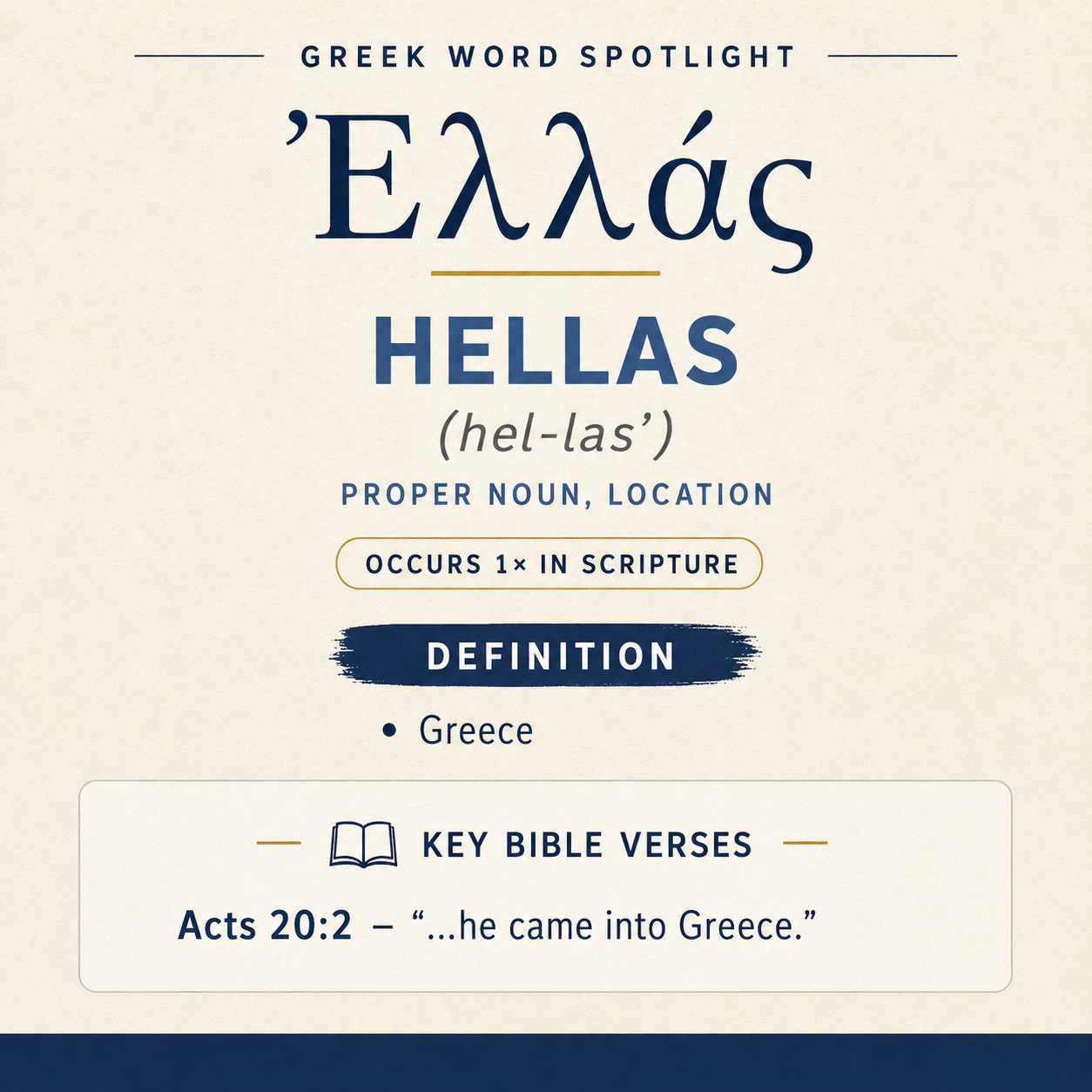
Ἑλλάς (Hellas) means Greece and appears once in Scripture in Acts 20:2.
Acts Context
In Acts 20:2, Paul travels through various regions and comes into Greece.
Learn More →Ἑλλάς names “Greece,” appearing in the travel narrative of Acts 20:2 as a geographic destination reached after an extended itinerary of exhortation and movement.
Occurrences
“When he had gone through those parts, and had encouraged them with many words, he came into Greece.” (Acts 20:2)
Here Ἑλλάς functions as the endpoint of a sequence of actions: going “through those parts,” offering encouragement “with many words,” and then arriving. The verse presents Greece as a concrete place entered after a period of travel and pastoral activity. The prepositional phrasing “into Greece” frames the location as a region one can come into—an arrival that follows movement through other locales (“those parts”) and that marks a new stage in the journey. In the sentence’s rhythm, the mention of Greece provides narrative closure to the travel summary: the reader is meant to register not only that the speaker continued onward, but that the movement culminated in reaching a recognizable land.


Sense and Usage
As “Greece,” Ἑλλάς is used in Acts 20:2 with the ordinary force of a place-name, identifying the territory entered at the end of the verse’s travel report. The term’s contribution is not descriptive (it supplies no adjectives, boundaries, or city names), but orienting: it situates the action geographically and implicitly invites the reader to hear the preceding verbs—passing through regions and encouraging with many words—as activities carried out on the way to, and in connection with, a wider destination.
The construction “he came into Greece” is especially spatial. It casts Greece as an area that can be crossed into, which in turn suggests a transition from one set of “parts” to another. The narrative does not pause to explain what Greece is; the name itself carries the weight of recognition as a known land. In this compact form, Ἑλλάς serves the historian’s aim of tracking movement: the term anchors the itinerary in a way that is both economical and specific, allowing the reader to follow the route without being slowed by extended geographic explanation.
Because the verse couples arrival in Greece with “encouraged them with many words,” the place-name also takes on a contextual association with the ongoing work of exhortation. The encouragement is not portrayed as a single speech but as something abundant (“many words”) occurring across a journey. Greece, then, is not merely a dot on a map in the narrative; it is the next locale within a continuing pattern of traveling and strengthening others. Even in a single mention, the word contributes to the sense of purposeful movement: travel is narrated as the vehicle by which encouragement is carried from one region to another, and Greece is the next named region in that unfolding sequence.
Imagery
In Acts 20:2 the imagery attached to Ἑλλάς is that of arrival after sustained movement: a traveler passing through multiple “parts,” speaking extensively to encourage, and then crossing into a new land. The word evokes the moment when an itinerary reaches its next geographic frame—an entering into Greece that signals the continuation of the journey’s wider course.
Sources: Lexical data from Strong’s Exhaustive Concordance and the Translators Brief Lexicon of Extended Strongs for Greek (STEPBible, CC BY). Occurrence data from the Translators Amalgamated Greek New Testament (STEPBible, CC BY). Scripture quotations from the World English Bible (public domain).




