Exploring the Meaning of Helkoo in Greek
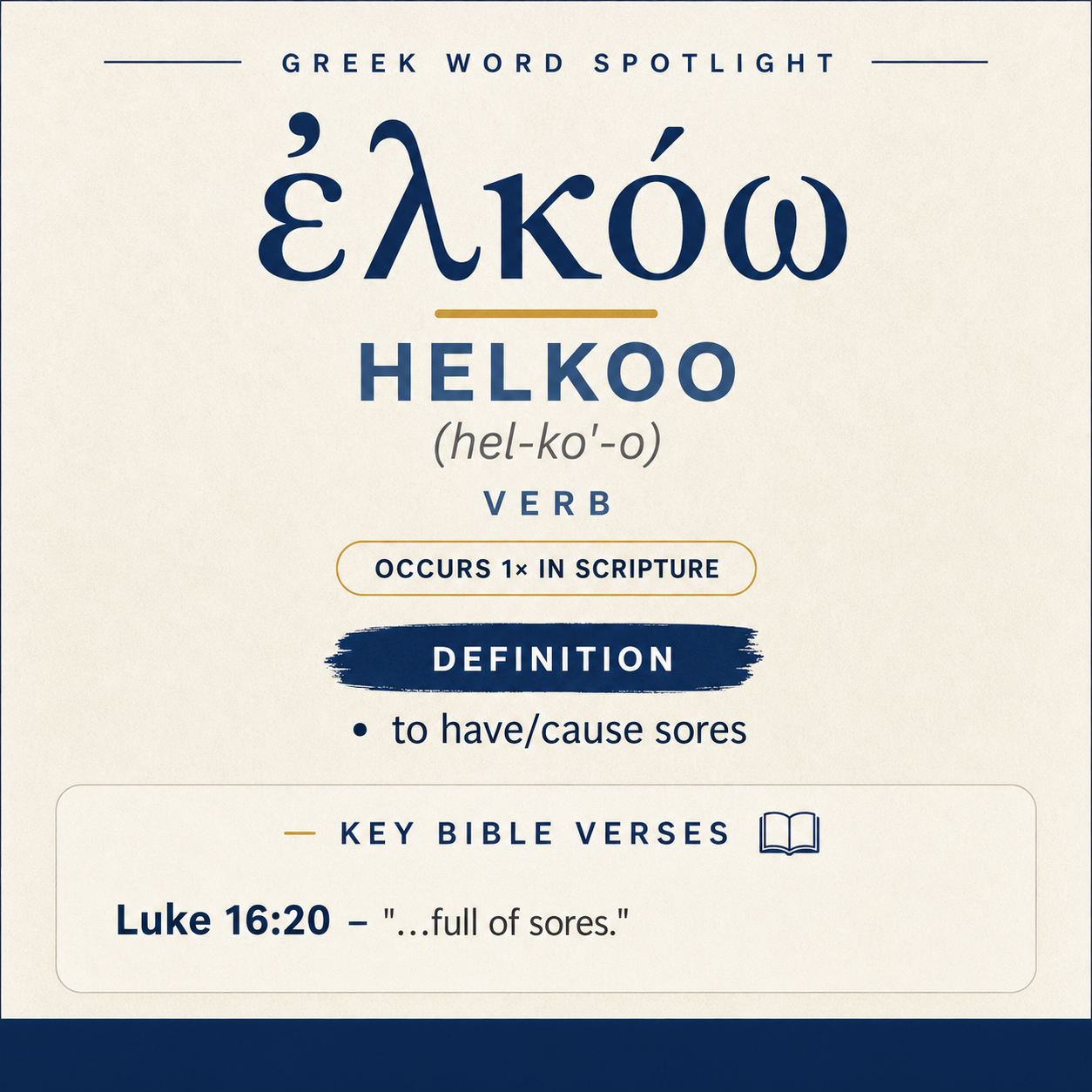
ἑλκόω means “to have/cause sores” and appears once in Scripture in Luke 16:20 describing Lazarus as full of sores.
Core Meaning
ἑλκόω means “to have/cause sores.” It describes the condition or causing of sores.
Learn More →Scripture Occurrence
This word occurs 1 time in Scripture. Its single occurrence is in Luke 16:20.
Learn More →Verse Context
In Luke 16:20, Lazarus is described as “full of sores.” The term is used in the description of his condition at the gate.
Learn More →ἑλκόω means “to have/cause sores” and is used once in the New Testament, in the description of Lazarus at the rich man’s gate. In its single setting, the verb supplies a stark physical detail that frames Lazarus’s condition in public view.
Root and Related Words
ἑλκόω (Helkoo) is related to the noun ἕλκος (helkos), “sore” (Strong’s G1668). The relationship is visible at the level of form: the verb is built on the noun that names the condition, so that the action or state expressed by the verb is tied directly to “sores” as such.

Occurrences
“A certain beggar, named Lazarus, was taken to his gate, full of sores,” (Luke 16:20)
In Luke 16:20 the verb stands within a compact portrait: Lazarus is introduced as “a certain beggar,” he is located at “his gate,” and his bodily state is summed up as “full of sores.” The clause does more than add color; it anchors Lazarus’s beggary in visible suffering. The wording links his identity (“beggar”) with a condition that can be seen and assessed by anyone who passes the gate. In that setting, “to have/cause sores” contributes the idea of a body marked by multiple lesions, not a single isolated wound, since he is described as “full of sores.”
The immediate narrative effect of the verb is to intensify the contrast between Lazarus and the place where he lies. A “gate” is an architectural boundary, the entry point to someone’s property; Lazarus is positioned at that boundary, not inside. The detail of sores underscores his vulnerability at that threshold. He is not merely poor in resources; he is physically afflicted in a way that would have been plain to those who came and went. The verb therefore functions as a concrete descriptor of misery, tied to a specific location where his condition is exposed rather than hidden.
The verse also presents Lazarus as acted upon—“was taken to his gate”—and then immediately as afflicted—“full of sores.” Within this short depiction, the verb helps portray suffering that accompanies dependence. Lazarus’s placement at the gate suggests passivity in his circumstances, and the sores add a dimension of bodily weakness that fits the portrayal of a beggar being carried or placed. The verb thus works with the surrounding phrasing to depict a condition that is enduring enough to define how he appears at the gate.
Sense and Usage
The definition “to have/cause sores” allows for two related directions: it can describe the state of being sore-covered, and it can describe the bringing about of such a condition. In Luke 16:20, the sense is expressed through a description of Lazarus’s condition as he lies at the gate: he is “full of sores.” The verb’s contribution is bodily and clinical in character; it names a condition that is not merely painful but also visible, measurable, and pluralized by the phrase “full of.”
Because the only attested use here is tightly linked to the noun-like notion of “sores,” the verb’s force is largely descriptive rather than interpretive. It does not explain why Lazarus has sores, nor how they came about; instead it presents the sores as part of the observable reality of his life as a beggar at the gate. The verb’s sense therefore serves characterization: Lazarus is introduced not through speech or action but through name, social status, location, and bodily condition, with the sores acting as a defining feature.
The collocation “full of sores” also gives the sense a distributive feel: the condition is extensive across the body, not confined to one spot. That breadth of affliction shapes how the verb is heard: it signals a pervasive state of suffering rather than a momentary injury. In a scene centered on a gate—a place of passing and exposure—this pervasive bodily affliction becomes part of what is publicly evident about Lazarus.
Finally, the verb’s link to ἕλκος (“sore”) keeps the meaning anchored in the physical symptom. The language does not move into metaphor within the verse; it remains on the level of concrete bodily distress. As a result, the verb’s semantic contribution in this passage is straightforward and heavy: it names a condition that would elicit recognition and response, even if the narrative does not yet tell how others respond.
Imagery
The single use of ἑλκόω in Luke 16:20 evokes an image of suffering at a doorway: a named beggar lying at the boundary of someone else’s home, his body marked by many sores. The word’s imagery is tactile and visible—affliction that can be seen at a glance—set against the solid permanence of a gate that separates the one who has property from the one who lies outside it.
Sources: Lexical data from Strong’s Exhaustive Concordance and the Translators Brief Lexicon of Extended Strongs for Greek (STEPBible, CC BY). Occurrence data from the Translators Amalgamated Greek New Testament (STEPBible, CC BY). Scripture quotations from the World English Bible (public domain).