Exploring the Meaning of Harpage in Greek
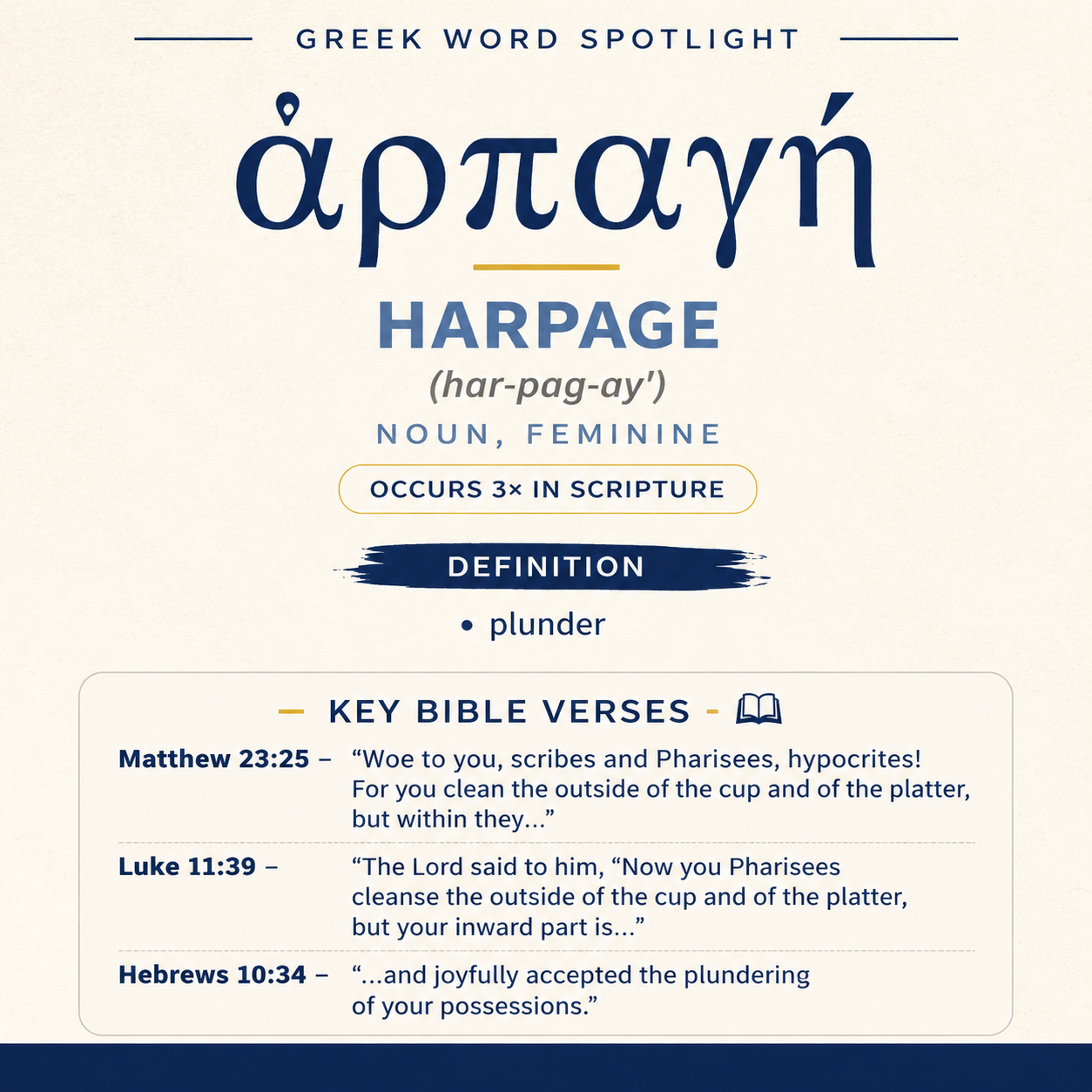
ἁρπαγή means “plunder” and appears three times in Scripture: Matthew 23:25, Luke 11:39, and Hebrews 10:34.
Gospel Occurrences
In Matthew 23:25 and Luke 11:39, Jesus says the inside is full of ἁρπαγή while the outside is cleansed.
Learn More →Hebrews Context
Hebrews 10:34 speaks of the plundering of possessions, using ἁρπαγή for what was taken from believers.
Learn More →ἁρπαγή means “plunder,” appearing in two sayings that expose inner corruption behind outward cleanliness and once in a description of believers enduring loss of property. In these contexts it names what fills the inside—whether a person’s “inward part” or a community’s experience of having goods taken away.
Root and Related Words
ἁρπαγή is related to the verb harpazō (ἁρπάζω), “to seize” (Strong’s G726). The relationship frames ἁρπαγή in terms of what results from seizing: goods treated as taken and possessed by force rather than by right.

Occurrences
“Woe to you, scribes and Pharisees, hypocrites! For you clean the outside of the cup and of the platter, but within they are full of extortion and unrighteousness.” (Matthew 23:25)
Here ἁρπαγή is set “within” the cup and platter, paired with “unrighteousness.” The point is not about the vessels themselves but about a mismatch between surfaces and contents: the outside receives careful attention, while the inside is pictured as “full.” In this rebuke, “plunder” functions as a moral substance that can pack the inner life to the brim—gain acquired by grasping and taking becomes what one is “full of,” even when the visible exterior appears managed and respectable. The image makes “plunder” something that clings like residue to what is consumed and handled; cleansing the outside leaves the contamination of takings intact on the inside.

The Lord said to him, “Now you Pharisees cleanse the outside of the cup and of the platter, but your inward part is full of extortion and wickedness.” (Luke 11:39)
This parallel saying shifts from “within they are full” to “your inward part is full,” applying the vessel imagery directly to the inner self. ἁρπαγή again stands beside another vice—here “wickedness”—and again is described as filling the interior. The word’s contribution is to name a specific kind of inner fullness: not merely general moral failure, but an inner storehouse shaped by taking. As in Matthew, the contrast is stark: the “outside” is cleansed, while the interior is occupied by what has been seized. The metaphor presses the listener to see the inward person as a container; when “plunder” fills it, outward washing is shown to be an inadequate response to what is fundamentally inside.
“For you both had compassion on me in my chains, and joyfully accepted the plundering of your possessions, knowing that you have for yourselves a better possession and an enduring one in the heavens.” (Hebrews 10:34)
In Hebrews, ἁρπαγή is no longer a metaphor for what fills a person but a concrete event that happens to “your possessions.” The community is commended for two related responses: compassion toward someone “in my chains,” and a joyful acceptance of having property plundered. The word evokes the experience of loss through seizure—possessions taken away—and it highlights that the loss is not portrayed as trivial or imaginary. Yet the emphasis falls on how they received it: “joyfully accepted,” because they “know” they possess something “better” and “enduring.” Within this sentence, “plunder” is the sharp, material contrast to “better possession”: it names what can be stripped, and therefore sets off the resilience of what cannot be stripped.
Sense and Usage
Across these three passages, “plunder” functions in two distinct but related ways: as an inward moral reality and as an outward act of dispossession. In Matthew and Luke, ἁρπαγή is treated like a substance that fills the interior. The sayings do not present it as an occasional lapse but as a settled fullness—an interior stocked with taken goods. That “full of” phrasing gives the word weight: it is not a thin smear but a dominant content, crowded inside while the exterior is polished. The cup-and-platter picture also makes “plunder” relational: it implies victims and illegitimate gain, but the focus stays on what the taker becomes on the inside when life is driven by seizure.
In Hebrews, the word’s force is more direct and tangible: possessions are plundered. The line does not linger over who did the plundering; instead it presses on the believers’ response and their perspective on ownership. “Plunder” here marks what is vulnerable in earthly holding—property can be taken—while “better possession” and “enduring one in the heavens” expresses a different kind of security. The term therefore stands at the intersection of violence against property and the spiritual posture that refuses to let such loss define one’s hope.
Read together, the passages show how ἁρπαγή can expose both sides of the same reality: on one side, plunder as what a person hoards inwardly through grasping; on the other, plunder as what a person suffers outwardly through being stripped. The cup imagery targets the hypocrisy of appearing clean while being inwardly packed with seized gain; Hebrews targets the faithfulness of enduring the seizure of goods without surrendering joy. In both settings, “plunder” is not neutral—it is a pressure point that reveals what truly fills a person and what truly counts as lasting possession.
Imagery
The cup and platter sayings cast ἁρπαγή in domestic imagery: everyday items associated with eating and cleanliness become a stage for exposing what is hidden. “Within” and “inward part” make the word feel enclosed, accumulated, and kept out of sight, as though plunder can be stored where only God’s scrutiny reaches. Hebrews, by contrast, pulls the word out into public experience—possessions are plundered—and joins it to “joyfully accepted,” giving the term a stark edge: what can be taken away becomes the occasion for demonstrating confidence in an “enduring” possession beyond the reach of plunder.
Sources: Lexical data from Strong’s Exhaustive Concordance and the Translators Brief Lexicon of Extended Strongs for Greek (STEPBible, CC BY). Occurrence data from the Translators Amalgamated Greek New Testament (STEPBible, CC BY). Scripture quotations from the World English Bible (public domain).