
Understanding the Meaning of Aiphnidios in Greek
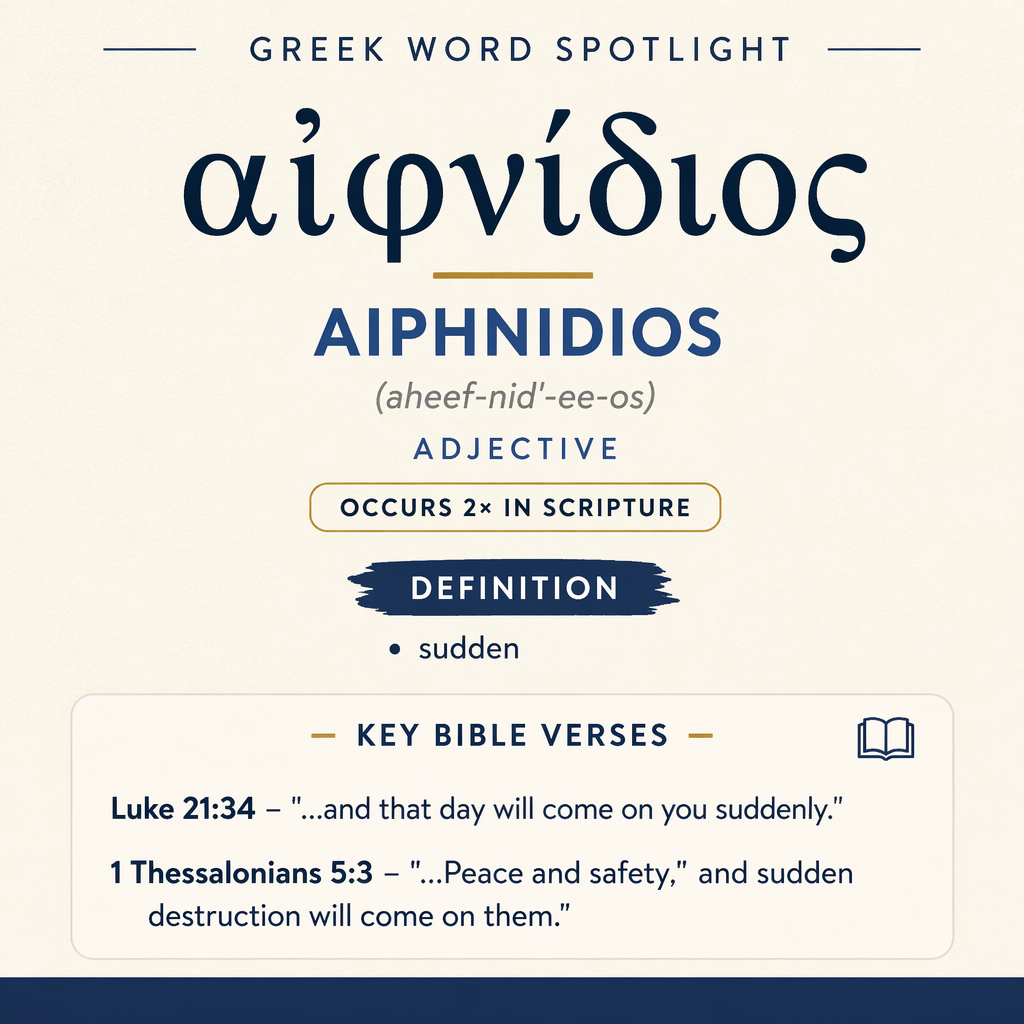
αἰφνίδιος means “sudden” and appears twice in Scripture: Luke 21:34 and 1 Thessalonians 5:3.
Scripture Occurrences
This word occurs 2 times in Scripture: Luke 21:34 and 1 Thessalonians 5:3.
Learn More →Verse Contexts
In Luke 21:34 it relates to “that day” coming unexpectedly amid life’s distractions. In 1 Thessalonians 5:3 it describes “sudden destruction.”
Learn More →αἰφνίδιος describes what happens “suddenly,” with a focus on an event’s abrupt arrival rather than a slow, signposted approach. In the New Testament it appears in two eschatological warnings: Jesus’ call to watchfulness and Paul’s depiction of unexpected judgment.
Root and Related Words
αἰφνίδιος is connected with ἐξαίφνης (exaiphnes), “suddenly” (Strong’s G1810), and with φαίνω (phaino), “to shine/appear” (Strong’s G5316). Strong’s also links it to α (Alpha, “Alpha”; Strong’s G1).

Occurrences
Luke 21:34 — “So be careful, or your hearts will be loaded down with carousing, drunkenness, and cares of this life, and that day will come on you suddenly.”
Here αἰφνίδιος modifies the arrival of “that day,” presenting it as an event that overtakes a person without giving time for last-minute recovery from distraction. The immediate setting names three weights that can “load” the heart: “carousing,” “drunkenness,” and “cares of this life.” In that picture, the suddenness does not describe the lifestyle itself; it describes the way the day arrives upon people whose inner life has been made heavy and dull. The verb phrase “will come on you” places the listener in the position of being approached and caught; αἰφνίδιος sharpens the warning by portraying the day’s coming as abrupt—an arrival that does not wait for someone to become ready once the danger is noticed. The word therefore supports the command “be careful” by supplying a reason: watchfulness is necessary because the decisive moment is not predictable in the way a slowly developing situation might be.
1 Thessalonians 5:3 — “For when they are saying, “Peace and safety,” then sudden destruction will come on them, like birth pains on a pregnant woman. Then they will in no way escape.”
In this occurrence αἰφνίδιος characterizes “destruction,” and it is placed directly after a scene of confident speech: “when they are saying, ‘Peace and safety.’” The effect is to show a sharp contrast between what is being claimed and what arrives. The adverbial “then” connects the moment of reassuring talk to the onset of judgment; αἰφνίδιος makes that onset immediate and jarring. The simile “like birth pains on a pregnant woman” adds a concrete image for how abruptly the experience begins once the time comes; within the verse’s own logic, the pains represent an onset that cannot be managed away by calm words. The closing line, “Then they will in no way escape,” presents the suddenness as part of an inescapable sequence: the event comes on them, and the window for avoiding it is already closed. In this setting, αἰφνίδιος serves the rhetorical purpose of undercutting false security by insisting that the transition from “peace and safety” to calamity is not gradual.
Sense and Usage
Across both passages αἰφνίδιος marks an abrupt arrival that catches its objects as they are. In Luke the emphasis falls on preparedness: the heart can be “loaded down,” and the day can “come on you” with a suddenness that exposes the danger of delay. The word presses the point that spiritual carelessness is not merely risky in the long run; it is perilous because the decisive moment may break in without the kind of lead time that would allow a person to disentangle from “cares of this life.” The suddenness therefore functions as a moral and pastoral intensifier within the warning.
In 1 Thessalonians the same quality of abruptness is set against a communal mood of confidence: “they are saying, ‘Peace and safety.’” There αἰφνίδιος does more than describe timing; it creates a collision between perception and reality. The rhetoric depends on the shock value of an unforeseen reversal: speech of stability is answered by the onset of “destruction.” The comparison to “birth pains” reinforces the idea that once the moment arrives, the change is no longer theoretical; it is felt, unavoidable, and not postponed by optimism. Thus, in both texts αἰφνίδιος supports a sober view of eschatological accountability by portraying the turning point as one that does not announce itself in a way that accommodates complacency.
Imagery
The word’s imagery in these verses is the imagery of being overtaken. Luke pictures an approaching “day” that comes upon distracted hearts; Paul pictures “destruction” arriving at the very moment confident slogans are being spoken, with the sudden onset of “birth pains” as the experiential parallel. In both, αἰφνίδιος evokes the snap of transition from ordinary life to crisis—an arrival that does not wait for recognition, but breaks in and makes escape impossible.
Sources: Lexical data from Strong’s Exhaustive Concordance and the Translators Brief Lexicon of Extended Strongs for Greek (STEPBible, CC BY). Occurrence data from the Translators Amalgamated Greek New Testament (STEPBible, CC BY). Scripture quotations from the World English Bible (public domain).




