Exploring the Meaning of Harmos in Greek
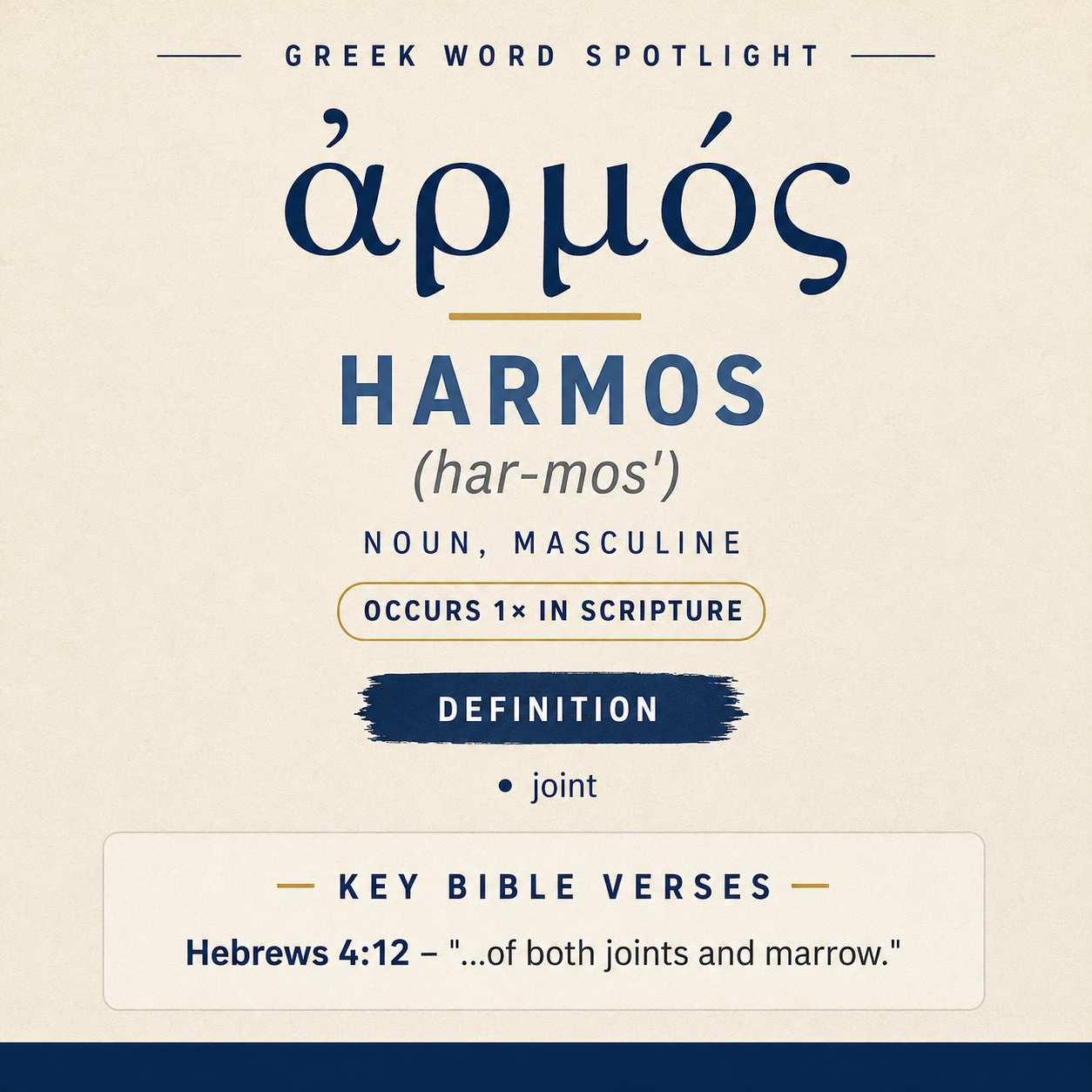
ἁρμός means “joint” and appears once in Scripture, in Hebrews 4:12.
Scripture Occurrence
It occurs 1 time in Scripture. The occurrence is in Hebrews 4:12.
Learn More →Verse Context
In Hebrews 4:12, it appears within the description of the word of God as living, active, and piercing.
Learn More →ἁρμός refers to a “joint” and appears in the New Testament in Hebrews 4:12. In that passage it belongs to a vivid description of how “the word of God” penetrates and distinguishes what lies deep within a person.
Root and Related Words
ἁρμός (Harmos) is related to ἅρμα (harma), “chariot” (Strong’s G716).

Occurrences
“For the word of God is living and active, and sharper than any two-edged sword, piercing even to the dividing of soul and spirit, of both joints and marrow, and is able to discern the thoughts and intentions of the heart.” (Hebrews 4:12)
In Hebrews 4:12, ἁρμός stands within a tightly packed sequence of images that move from a weapon (“sharper than any two-edged sword”) to an act of penetration (“piercing”) and then to a series of internal separations (“to the dividing of soul and spirit, of both joints and marrow”). The word “joints” evokes a concrete point of articulation within the body—where one part meets another and movement becomes possible—so it naturally fits the passage’s emphasis on reaching what is inward, structural, and hidden from surface view.
The syntax places “joints” alongside “marrow,” another bodily interior. By coupling the two (“of both joints and marrow”), the verse frames the sword-like “piercing” as going beyond what is outwardly accessible. A joint is not merely a body-part that can be seen like skin; it is part of the body’s inner framework. The pairing functions rhetorically: the reader is taken from the external image of a sword to the internal reality of what such sharpness can reach, as if the point is able to pass into the body’s most tucked-away places.
Within the verse’s layered parallelism, “dividing” operates as the hinge that makes the bodily language speak to the psychological and moral language that follows. The sentence does not stop with bodily interiors; it culminates in discernment: the word of God “is able to discern the thoughts and intentions of the heart.” The mention of “joints” therefore plays a supporting role in the passage’s movement: it supplies a physical analogue for an evaluative action that reaches and separates what is intertwined. The image is not presented as an anatomy lesson but as a way of making the penetrative and discriminating power of God’s word feel concrete and unavoidable.
Because the verse has already invoked a “two-edged sword,” the reader hears “joints” in an atmosphere of precision rather than blunt force. Joints are places where separation can be envisioned with exactness: the boundary between connected elements. In that sense, “joints” strengthens the scene’s impression that what is being described is careful, incisive, and searching—an action that does not merely strike but penetrates, locates boundaries, and exposes what lies within.
Sense and Usage
The definition “joint” gains its force in Hebrews 4:12 from the way a joint functions as a meeting point: a place of connection and articulation within a body. That basic idea serves the author’s aim of describing a penetration that reaches into what holds a person together. The word sits between two kinds of “inside”: the immaterial (“soul and spirit”) and the bodily (“joints and marrow”). The passage does not explain these pairs; it uses them as paired examples of depth. In that rhetorical setting, “joint” contributes a sense of internal structure—something beneath the surface where separation is imaginable and consequential.
Hebrews 4:12 also places “joints” in a sequence where the emphasis is not on the joint as an object by itself, but on what can happen at that point. The sword “pierc[es] even to the dividing,” and the joint is one of the places named in connection with that dividing. The joint, as a locus where parts meet, naturally aligns with the language of dividing because it suggests a boundary that can be reached, traced, and distinguished. The verse’s logic does not depend on the reader’s technical knowledge; it depends on the reader’s intuitive sense that joints are internal, real, and essential.
In this single attestation, ἁρμός is also instructive in how physical imagery can carry moral and cognitive weight. The verse begins with “the word of God” and ends with “the thoughts and intentions of the heart.” Between those ends, the word “joints” helps bridge the gap by providing a tangible middle term: a deep bodily point of contact and separation. The result is an integrated picture in which God’s word is portrayed as capable of reaching into the most inward layers of human life, including the structures that are not readily visible yet are decisive for what a person is and does.
The noun’s placement—embedded within a chain of genitives (“of … joints and marrow”)—also contributes to the pace and intensity of the verse. The language accumulates: living, active, sharper, piercing, dividing, discerning. “Joints” participates in this accumulation as one more step deeper, one more item that pushes the image inward. The effect is to convey thoroughness: nothing is too internal, too integrated, or too hidden to be reached by the word described in the verse.
Imagery
Hebrews 4:12 frames ἁρμός within an image of a blade that can reach where ordinary sight and ordinary probing do not. “Joints” brings to mind the body’s inner articulations—quiet, covered places that nonetheless govern motion and strength. In the verse’s picture, that hidden articulation becomes a way of speaking about how deeply “the word of God” can penetrate and how precisely it can “discern the thoughts and intentions of the heart.”
Sources: Lexical data from Strong’s Exhaustive Concordance and the Translators Brief Lexicon of Extended Strongs for Greek (STEPBible, CC BY). Occurrence data from the Translators Amalgamated Greek New Testament (STEPBible, CC BY). Scripture quotations from the World English Bible (public domain).