Understanding the Meaning of Hapas in Greek
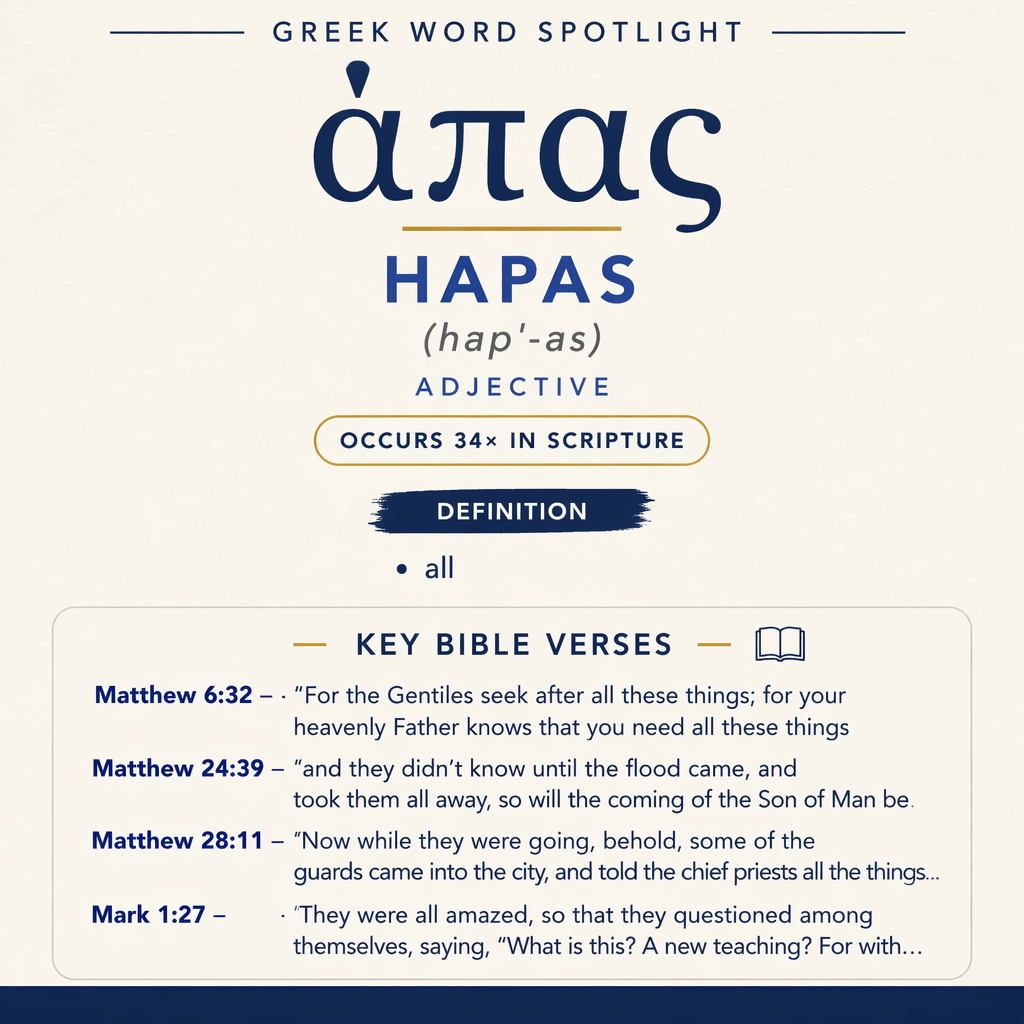
ἅπας means “all” and occurs 34 times in Scripture, including Matthew 6:32, Mark 16:15, and Luke 3:21.
Core Meaning
ἅπας is defined as “all.” In the cited verses it refers to people, things, or the whole scope of something.
Learn More →Scripture Occurrence
ἅπας occurs 34 times in Scripture. Examples include Matthew 24:39, Mark 1:27, and Luke 3:21.
Learn More →Example Phrases
It appears in statements like “all these things” (Matthew 6:32) and “all the world” (Mark 16:15). It also describes total groups, such as “all the people” (Luke 3:21).
Learn More →ἅπας expresses totality (“all”) and appears in a range of sayings and narrative moments that stress the full scope of needs, knowledge, judgment, witness, astonishment, mission, crowds, authority, healing, and communal reaction. In these passages it consistently gathers items or people into a single, undivided whole within the scene being described.
Occurrences
Matthew 6:32 — “For the Gentiles seek after all these things; for your heavenly Father knows that you need all these things.”
Here “all” gathers “these things” into a complete set—what is sought and what is needed. The line sets seeking (“the Gentiles seek after all these things”) alongside divine awareness (“your heavenly Father knows that you need all these things”), so the word marks the entire bundle of concerns as already fully known.

Matthew 24:39 — “and they didn’t know until the flood came, and took them all away, so will the coming of the Son of Man be.”
“All” describes the reach of the flood’s removal: it “took them all away.” The word presses the action to its limit—no remainder is implied within the group in view—so the scene’s suddenness is sharpened by the breadth of what the flood accomplishes.
Matthew 28:11 — “Now while they were going, behold, some of the guards came into the city, and told the chief priests all the things that had happened.”
“All” frames the guards’ report as complete: “all the things that had happened.” In this setting, the word functions like a claim of full disclosure—nothing relevant is held back from the chief priests in the telling, at least as the report is characterized.
Mark 1:27 — “They were all amazed, so that they questioned among themselves, saying, “What is this? A new teaching? For with authority he commands even the unclean spirits, and they obey him!””
“All” spreads amazement across the whole group observing the event: “They were all amazed.” The word turns astonishment from an individual reaction into a shared, collective response, which then gives rise to communal questioning (“they questioned among themselves”).
Mark 8:25 — “Then again he laid his hands on his eyes. He looked intently, and was restored, and saw everyone clearly.”
“Everyone” (the “all” idea) defines the extent of the restored sight: he “saw everyone clearly.” The word sets the outcome as comprehensive in scope—vision is not partial or selective in whom it can recognize; it reaches across the whole field of people before him.
Mark 11:32 — “If we should say, ‘From men’ ”—they feared the people, for all held John to really be a prophet.
“All” characterizes the people’s judgment as unanimous: “for all held John to really be a prophet.” The word explains why fear of the crowd is decisive; the leaders face not a divided public but a broadly unified conviction.
Mark 16:15 — “He said to them, “Go into all the world, and preach the Good News to the whole creation.”
“All” stretches the mission’s field outward: “Go into all the world.” The command is not confined to a region or subset; the word pushes the destination to the widest possible horizon in the sentence, paired with similarly expansive language (“the whole creation”).
Luke 3:21 — “Now when all the people were baptized, Jesus also had been baptized, and was praying. The sky was opened,”
“All” paints the baptismal moment as a mass event: “when all the people were baptized.” The word provides a backdrop of comprehensive participation, against which Jesus’ baptism and prayer are placed within the same public movement.
Luke 4:6 — “The devil said to him, “I will give you all this authority, and their glory, for it has been delivered to me; and I give it to whomever I want.”
“All” intensifies the offer by describing the authority as total: “all this authority.” The word makes the temptation sound maximal—nothing less than the full measure of the authority being pointed to—linked with “their glory” as part of the same proposed transfer.
Luke 4:40 — “When the sun was setting, all those who had any sick with various diseases brought them to him; and he laid his hands on every one of them, and healed them.”
“All” gathers the bringers into an inclusive category: “all those who had any sick with various diseases.” The scene then reinforces that breadth by adding individualized touch within the total group: “he laid his hands on every one of them.” “All” thus frames the crowd, while “every one” highlights the comprehensive reach of his action within that crowd.
Luke 5:26 — “Amazement took hold on all, and they glorified God. They were filled with fear, saying, “We have seen strange things today.””
“All” again marks a shared, group-wide reaction: “Amazement took hold on all.” The word binds together the emotional and religious responses that follow—glorifying God and being filled with fear—as the communal outcome of what they have witnessed.
Luke 8:37 — “All the people of the surrounding country of the Gadarenes asked him to depart from them, for they were very much afraid. Then he entered into the boat and returned.”
“All” makes the request universal within the described population: “All the people of the surrounding country of the Gadarenes asked him to depart.” The word gives the departure request the weight of collective will, and it is tied directly to a shared motive: “for they were very much afraid.”

Sense and Usage
Across these passages ἅπας works as a totalizing term: it gathers either (1) a set of things into a single whole (“all these things,” “all the things that had happened,” “all this authority”), or (2) a group of people into a single collective (“they were all amazed,” “all held John to really be a prophet,” “all the people were baptized,” “Amazement took hold on all,” “All the people…asked him to depart”). In both kinds of use, the word does more than increase quantity; it reshapes how the reader is meant to take the scene. The difference between “some” and “all” is the difference between a localized reaction and a defining atmosphere.
When ἅπας modifies “things,” it often signals completeness of concern or completeness of report. In Matthew 6:32 the repeated “all these things” encloses human seeking and divine knowledge within the same comprehensive set, keeping the focus on the entire range of needs rather than on one anxiety at a time. In Matthew 28:11, “all the things that had happened” frames the guards’ testimony as an undivided narrative package delivered to the chief priests; the point is the total account as an object that can be “told.” Luke 4:6 uses “all” to make an offer sound absolute; by labeling the authority as “all this,” the proposal gains a sweeping, exhaustive character that heightens the pressure of the moment.
When ἅπας modifies “people” or stands for “all” in a reaction, it frequently marks unanimity—whether of wonder, belief, fear, or request. Mark 1:27 and Luke 5:26 portray amazement as a communal possession: it “took hold” of everyone present, producing shared speech (“What is this?” / “We have seen strange things today”). Mark 11:32 makes “all” the ground of political caution: fearing “the people” is rational because the opinion about John is not mixed. Luke 8:37 shows how “all” can describe a unified pushback; the request for departure is not a single household’s preference but the surrounding region’s collective plea.
ἅπας also expands scope outward to the widest setting. Mark 16:15 uses “all the world” to define a mission-field without internal boundaries in the wording; the phrase pushes the command beyond a limited audience and matches the vastness implied by “the whole creation.” In Luke 3:21 “all the people” provides a panoramic public setting for the baptismal moment, portraying it as something that has swept through the populace rather than an isolated act.
Finally, ἅπας can frame the completeness of an effect in what someone can now perceive. Mark 8:25 uses the “all” idea (“everyone clearly”) to convey that restored sight reaches across the entire set of persons in view, not merely a portion. Luke 4:40 pairs the crowd-level “all those who had any sick” with individualized attention (“every one of them”), presenting comprehensive reach both in who comes and in how fully each is treated.
Imagery
These scenes repeatedly place “all” at moments of overflow: a flood that “took them all away” (Matthew 24:39), a cityward report that covers “all the things that had happened” (Matthew 28:11), crowds whose amazement grips everyone at once (Mark 1:27; Luke 5:26), and a sweeping commission into “all the world” (Mark 16:15). Even where the mood is fear rather than wonder, the word paints fear as socially shared (“they were very much afraid,” with “All the people…asked him to depart,” Luke 8:37), showing how totality can describe both receptive and resistant crowds.
Sources: Lexical data from Strong’s Exhaustive Concordance and the Translators Brief Lexicon of Extended Strongs for Greek (STEPBible, CC BY). Occurrence data from the Translators Amalgamated Greek New Testament (STEPBible, CC BY). Scripture quotations from the World English Bible (public domain).