Exploring the Meaning of Graptos in Greek
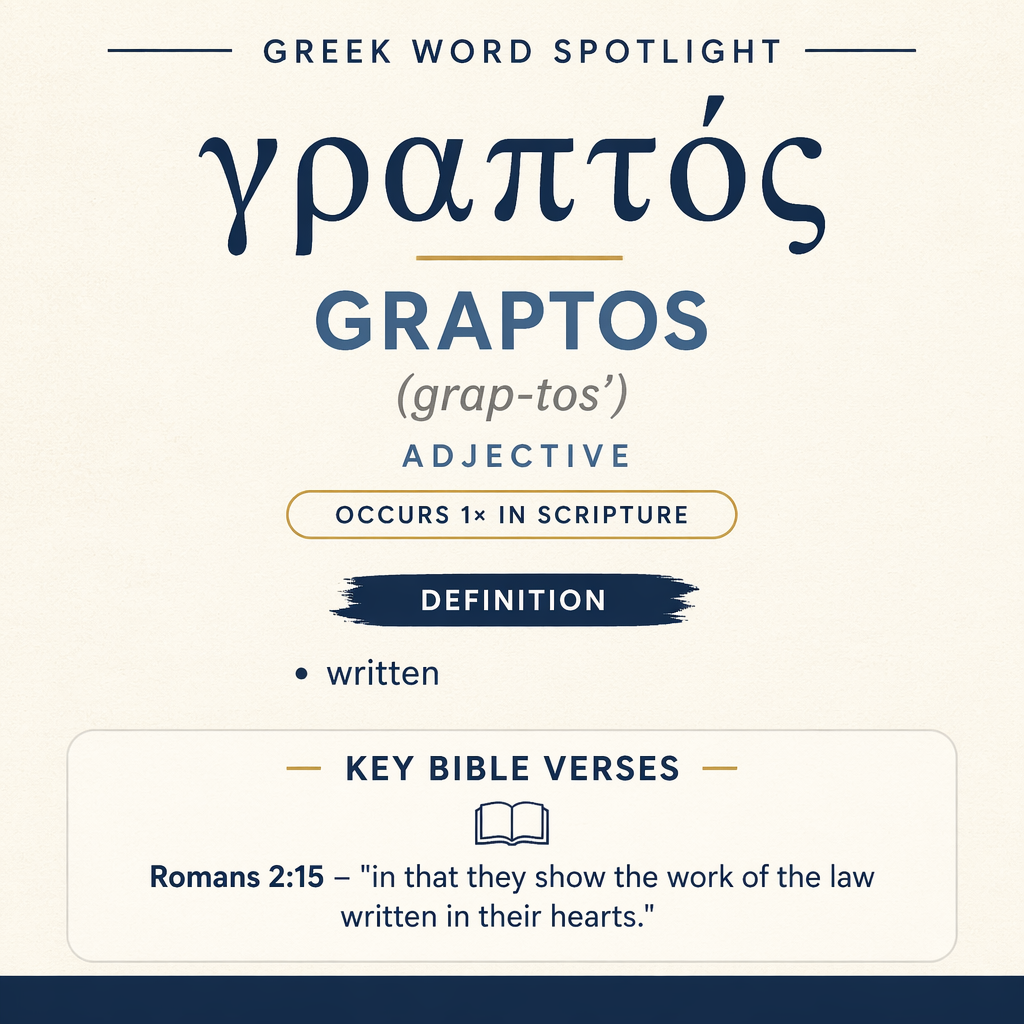
γραφτός means “written” and appears once in Scripture, in Romans 2:15.
Context in Romans
In Romans 2:15, it describes “the work of the law written in their hearts,” alongside conscience and thoughts.
Learn More →γραπτός means “written” and appears once in the New Testament. In Romans 2:15 it describes how “the work of the law” is present as something inscribed within the human interior rather than merely encountered externally.
Root and Related Words
γραπτός is related to the verb grapho (γράφω), “to write” (Strong’s G1125). The adjective draws on the idea of writing as an act that produces a fixed, legible result.

Occurrences
“in that they show the work of the law written in their hearts, their conscience testifying with them, and their thoughts among themselves accusing or else excusing them)” (Romans 2:15)
Here γραπτός modifies “the work of the law” and locates that “written” reality “in their hearts.” The immediate context frames this inner writing as something demonstrable: “they show the work of the law written in their hearts.” The adjective therefore helps the sentence present “the work of the law” not as a vague influence or passing impression but as something with the character of a record—something that can be “shown” because it stands as an identifiable imprint within a person.
The verse then describes two forms of internal testimony that correspond to that “written” work: “their conscience testifying with them” and “their thoughts among themselves accusing or else excusing them.” In this setting, γραπτός supports a picture of the heart as a place where moral reality is set down in a way that engages the conscience and provokes evaluation. The conscience is portrayed as an active witness “with them,” and the thoughts are portrayed as acting like an internal court, alternately “accusing” and “excusing.” The adjective “written” helps make sense of that courtroom-like activity: the inner moral awareness has content substantial enough to serve as a basis for testimony and verdict-like conclusions.
Because the writing is “in their hearts,” the term also carries a spatial emphasis within the verse. It is not presented as writing on an external object but as writing situated within the person’s inward life. The effect is to connect what is “written” with the deepest seat of moral response described in the verse: conscience and deliberative thought. The sentence structure builds from the written reality (“the work of the law written in their hearts”) to the confirming activities that arise from it (conscience testifying; thoughts accusing or excusing), so γραπτός functions as the anchor for the inner processes that follow.
Sense and Usage
The sense “written” in Romans 2:15 is not merely a statement that something exists, but that it exists in the mode of writing—set down, made definite, and able to be appealed to. Writing, by its nature, represents more than a momentary feeling: it has the form of an inscription that can be pointed to and read. In this verse, that basic idea is applied metaphorically to an interior location (“in their hearts”), producing a striking combination: something written, yet written within the human person.
Within the verse’s own logic, the “written” quality helps explain why conscience can “testify” and why thoughts can render competing judgments (“accusing or else excusing”). Testimony and judgment presume a standard or reference point. By using γραπτός, the text portrays the “work of the law” as having that reference-point character inside the person. The “work of the law” is not described here as an external code being consulted at the moment; instead, it is described as already present as something written within, and this internal presence is what the conscience and thoughts engage.
The adjective also contributes to the way the verse connects action and inner awareness. The clause “they show the work of the law written in their hearts” suggests that something inward becomes outwardly evident. The “written” work is internal, yet it can be “shown.” In that way, γραπτός underlines durability and visibility: what is written in the heart yields observable effects, because conscience and thought do not remain silent but “testify” and reason in a way that leads to accusation or excuse.
Because the verse speaks of “their thoughts among themselves,” it depicts an inner dialogue or contest of evaluations. The presence of something “written” provides the stable content around which those thoughts operate. The pair “accusing” and “excusing” indicates that the internal process can cut in more than one direction, but either direction still presupposes some perceived measure of rightness. γραπτός, by presenting that measure as written within, intensifies the idea that moral discernment is not purely improvised; it responds to something already inscribed.
In this usage, the force of “written” is less about the physical act of writing and more about the state produced by writing: a fixed marking, a durable record, an internalized reference. The verse integrates that state with the human faculties named—heart, conscience, and thoughts—so that the “written” aspect is not ornamental language but part of the causal chain the sentence describes. The conscience does not testify in a vacuum; it testifies “with them” in relation to what is “written.” Thoughts do not accuse or excuse randomly; they respond to the same written moral content.
Imagery
Romans 2:15 uses the imagery of writing to portray inward moral reality as something inscribed. By placing “written” in the heart and pairing it with conscience and evaluative thoughts, the verse evokes an interior record that speaks—through testimony and judgment-like reasoning—within the person.
Sources: Lexical data from Strong’s Exhaustive Concordance and the Translators Brief Lexicon of Extended Strongs for Greek (STEPBible, CC BY). Occurrence data from the Translators Amalgamated Greek New Testament (STEPBible, CC BY). Scripture quotations from the World English Bible (public domain).