Exploring the Meaning of Grapho in Greek
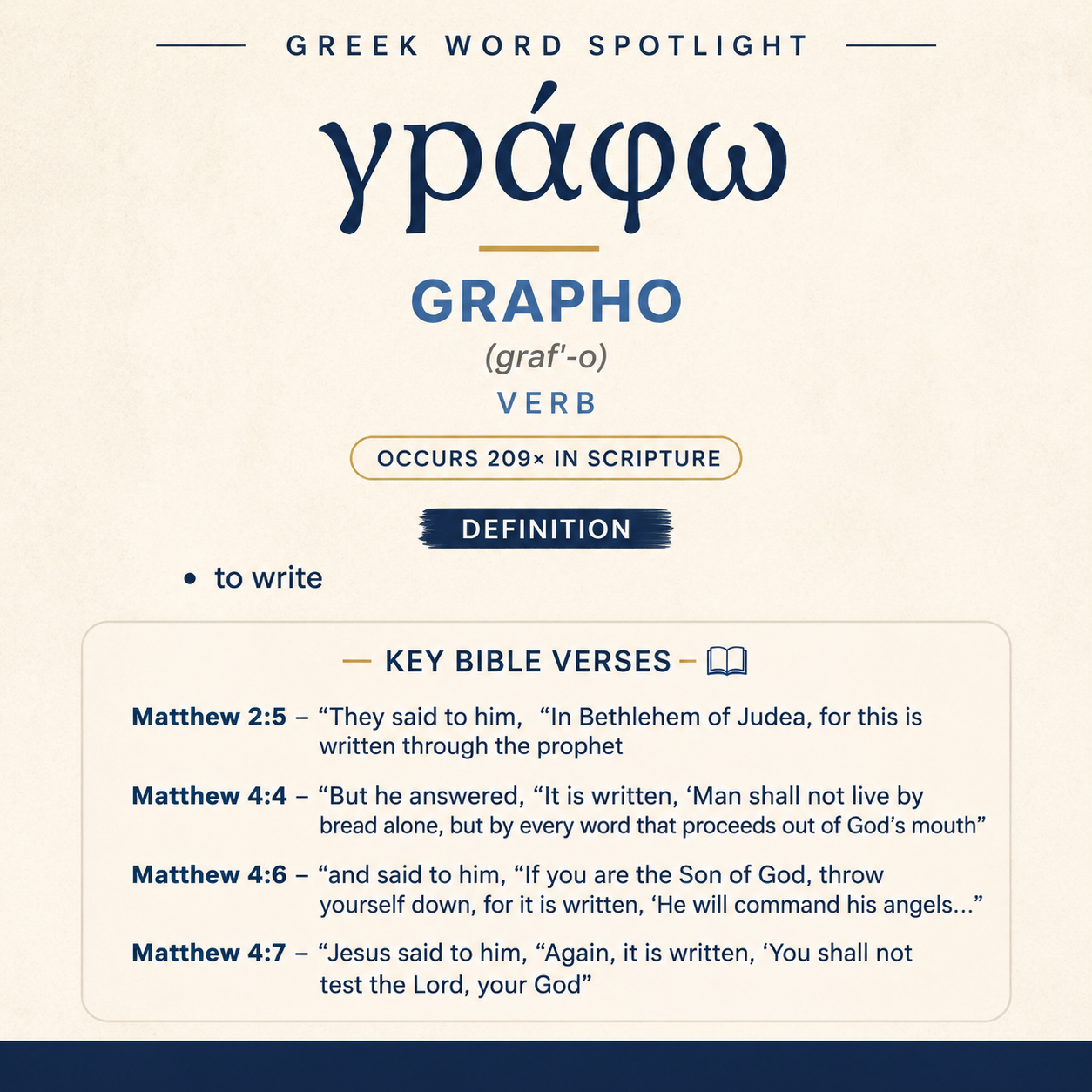
γράφω (Grapho) means “to write” and occurs 209 times in Scripture, including Matthew 2:5 and Matthew 4:4–10.
Core Meaning
γράφω means “to write.” In Matthew it frequently appears in the phrase “it is written.”
Learn More →Matthew Examples
Matthew 2:5 uses it for “this is written through the prophet.” Matthew 4:4, 4:6, 4:7, and 4:10 use “it is written” in Jesus’ replies.
Learn More →More Occurrences
Matthew 11:10 speaks of what “is written” about a messenger. Matthew 21:13 and 26:24 also use “it is written” in key statements.
Learn More →γράφω expresses the act of writing, and in these passages it most often appears in the fixed claim that something “is written.” Across the scenes quoted below, the verb anchors appeals to Scripture and also describes a public inscription placed over Jesus.
Occurrences
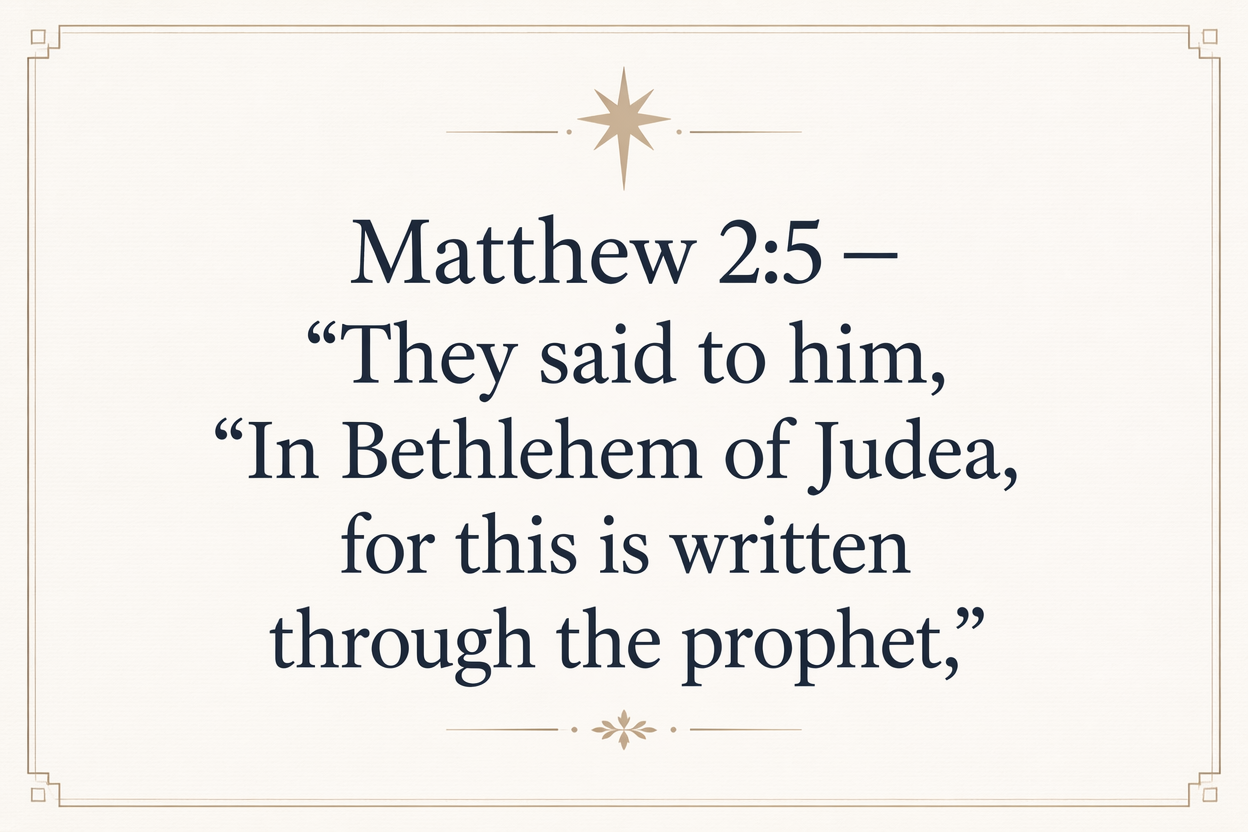
Matthew 2:5 — “They said to him, “In Bethlehem of Judea, for this is written through the prophet,”
Here γράφω stands behind “is written,” presenting the location “in Bethlehem of Judea” as something already set down in writing “through the prophet.” The verb functions as an appeal to an existing written source that is treated as decisive for answering the inquiry implied by “They said to him.” The force in the sentence is not simply that words exist, but that the written form provides an authoritative reference point for the claim being made.
Matthew 4:4 — “But he answered, “It is written, ‘Man shall not live by bread alone, but by every word that proceeds out of God’s mouth.’ ”
In the wilderness exchange, γράφω frames Jesus’ reply as grounded in what “is written.” The quotation that follows is treated as a stable, accessible written statement. By invoking writing, the response takes the form of citation: the content is not offered as a fresh saying but as a previously recorded word that governs how life is to be understood (“not…by bread alone”).
Matthew 4:6 — “and said to him, “If you are the Son of God, throw yourself down, for it is written, ‘He will command his angels concerning you,’ and, ‘On their hands they will bear you up, so that you don’t dash your foot against a stone.’ ”
Again γράφω appears in “it is written,” this time placed in the mouth of the tempter. The verb introduces a two-part quotation, and the argument depends on the premise that written words can be invoked to press a course of action (“throw yourself down”). In this scene, writing is treated as a text that can be cited in support of a proposal; the drama turns on how a written statement is brought to bear on a concrete decision.
Matthew 4:7 — “Jesus said to him, “Again, it is written, ‘You shall not test the Lord, your God.’ ”
Here γράφω carries the rhetorical weight of counter-citation. “Again, it is written” signals that another written statement also stands in view and must be applied. The verb supports the move from a cited text to an interpretive control on behavior (“You shall not test…”), showing writing as a norm that can answer an argument built on writing.
Matthew 4:10 — “Then Jesus said to him, “Get behind me, Satan! For it is written, ‘You shall worship the Lord your God, and you shall serve him only.’ ”
In this climax of the exchange, γράφω introduces a written demand that shapes allegiance and worship. The imperative “Get behind me, Satan!” is supported by “For it is written,” making the written word function as the stated ground for rejecting the temptation and for affirming exclusive worship and service. The verb thus marks the quotation not as ornamental, but as the controlling rationale in the confrontation.
Matthew 11:10 — “For this is he, of whom it is written, ‘Behold, I send my messenger before your face, who will prepare your way before you.’”
Here γράφω helps identify a person by linking him to what “is written.” The clause “of whom it is written” presents the written statement as directly referential: it is portrayed as speaking about “this” individual. Writing is not merely a record of general principles; it is treated as a text that can be read as pointing to a specific figure (“my messenger”) with a defined role (“will prepare your way”).
Matthew 21:13 — “He said to them, “It is written, ‘My house shall be called a house of prayer,’ but you have made it a den of robbers!”
In the temple setting, γράφω introduces a written description of what the house “shall be called.” The contrast that follows (“but you have made it a den of robbers!”) relies on the written statement as the standard by which present conduct is judged. The verb supports a rebuke: because something stands written about the house, actions that contradict that written characterization are exposed and condemned.
Matthew 26:24 — “The Son of Man goes, even as it is written of him, but woe to that man through whom the Son of Man is betrayed! It would be better for that man if he had not been born.”
Here γράφω is tied to the course of events surrounding “the Son of Man.” The phrase “as it is written of him” portrays the written word as corresponding to the path he “goes.” The verb thus links writing to the unfolding narrative: what is happening is not random but aligns with what stands recorded. In the same breath, the verse sets moral responsibility alongside that written correspondence (“woe to that man…”), showing that appeal to what is written does not erase accountability in the betrayal described.
Matthew 26:31 — “Then Jesus said to them, “All of you will be made to stumble because of me tonight, for it is written, ‘I will strike the shepherd, and the sheep of the flock will be scattered.’”
In this prediction of imminent failure, γράφω introduces a written portrayal that matches what Jesus says will occur “tonight.” The written image of a struck shepherd and scattered sheep becomes the interpretive frame for the disciples’ stumbling. The verb supports the claim that the coming scattering is not merely anticipated but stands in line with what has been set down in writing.
Matthew 27:37 — “They set up over his head the accusation against him written, “THIS IS JESUS, THE KING OF THE JEWS.””
Here γράφω moves from citation formula to physical inscription. The accusation is “written” and placed “over his head,” making writing a visible, public object in the scene. The verb highlights the tangibility of the message: a charge is not only spoken but fixed in written form and displayed, giving the crucifixion setting an official-looking notice that can be read by onlookers.
Mark 1:2 — “As it is written in the prophets, “Behold, I send my messenger before your face, who will prepare your way before you:”
In Mark’s opening, γράφω again appears in the formula “As it is written,” explicitly locating the writing “in the prophets.” The quotation is presented as a written introduction that sets expectations for what follows: a messenger is sent “before your face” to “prepare your way.” The verb functions programmatically here, presenting the narrative’s outset as aligned with words already written.
Mark 7:6 — “He answered them, “Well did Isaiah prophesy of you hypocrites, as it is written, ‘This people honors me with their lips, but their heart is far from me.”
Here γράφω introduces a written prophetic assessment applied directly to the interlocutors (“you hypocrites”). The written line contrasts outward speech (“honors me with their lips”) with inward distance (“their heart is far from me”), and the verb makes that contrast function as a standing written critique. Writing here is a textual mirror held up to present behavior, grounding Jesus’ confrontation in a cited, fixed statement.

Sense and Usage
Across these occurrences, γράφω operates in two closely related ways. First, it serves the citation formula “it is written / as it is written,” where writing is treated as enduring wording that can be invoked to settle questions (Matthew 2:5), to answer temptation and argument (Matthew 4:4, 4:6–7, 4:10), to identify persons and roles (Matthew 11:10; Mark 1:2), to judge conduct by a stated standard (Matthew 21:13; Mark 7:6), and to interpret events as corresponding to a written portrayal (Matthew 26:24; Matthew 26:31). In these uses, the act of writing lies in the background, and the spotlight falls on the status of what stands written: it is treated as a fixed reference that can be quoted and applied.
Second, γράφω appears with a concrete, spatial emphasis in Matthew 27:37, where writing is not primarily a source to be cited but a public inscription positioned “over his head.” That scene shows the same basic action—putting words into written form—but now the effect is visibility and display. Together, these uses show how writing can function both as a durable textual authority for speech and reasoning (“it is written”) and as a physical medium that broadcasts an accusation in a specific place.
The repeated appeal to what “is written” also shows how writing is treated as transferable across contexts: words written “through the prophet” (Matthew 2:5) or “in the prophets” (Mark 1:2) are brought into new moments—wilderness testing, temple confrontation, private prediction, and public execution—without being presented as needing reauthorization. The rhetoric assumes that written words can be lifted from their recorded form and made operative in live disputes and decisive moments.
Imagery
These passages attach γράφω to two strong images: the scroll-like authority of a text that can be quoted (“It is written…”) and the stark notice posted above a crucified man (“the accusation…written”). In the first, writing is heard as a cited voice that settles and confronts; in the second, writing is seen as an accusation fixed in place, silent yet legible, hovering over the scene in full view.
Sources: Lexical data from Strong’s Exhaustive Concordance and the Translators Brief Lexicon of Extended Strongs for Greek (STEPBible, CC BY). Occurrence data from the Translators Amalgamated Greek New Testament (STEPBible, CC BY). Scripture quotations from the World English Bible (public domain).