Exploring the Meaning of Genesia in Greek
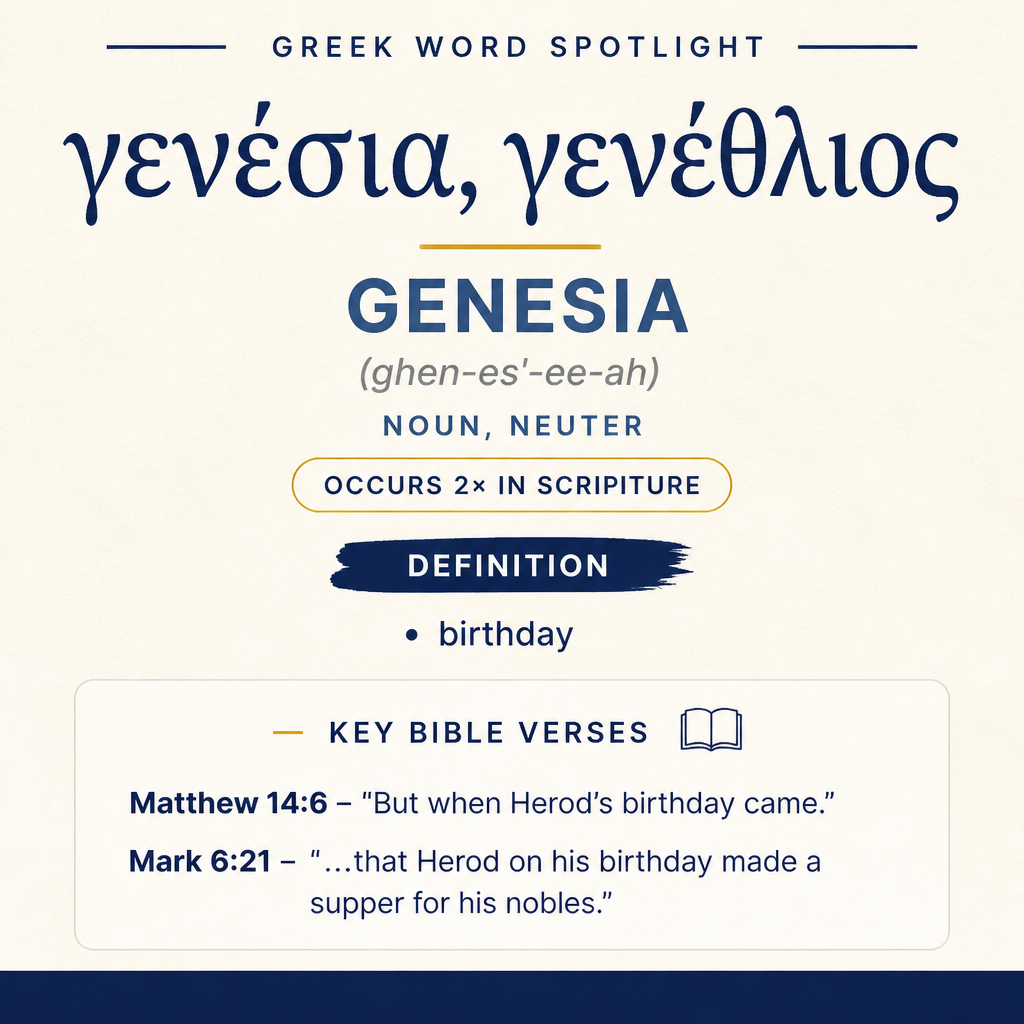
γενέσια / γενέθλιος (Genesia) means “birthday” and appears in Matthew 14:6 and Mark 6:21.
Narrative Context
Both occurrences describe Herod’s birthday celebration, including a gathering and festivities.
Learn More →γενέσια / γενέθλιος refers to a “birthday” and appears in the narratives of Herod’s court in Matthew and Mark. In both places it marks a calendrical occasion that becomes the setting for public celebration and political display.
Root and Related Words
γενέσια / γενέθλιος is related to γένεσις (genesis), “origin” (Strong’s G1078).

Occurrences
“But when Herod’s birthday came, the daughter of Herodias danced among them and pleased Herod.” (Matthew 14:6)
Here the birthday functions as the decisive time-marker that gathers an audience (“among them”) and frames the courtly atmosphere in which entertainment is offered. The word identifies the occasion not simply as any banquet or gathering, but as a celebration tied to Herod himself; the event’s center is his personal day, and the narrative’s action turns on what happens within that celebratory context. The dancing is presented as part of the birthday setting and is evaluated by its effect—she “pleased Herod”—showing how the day becomes an opportunity for actions intended to win favor at court.
“Then a convenient day came, that Herod on his birthday made a supper for his nobles, the high officers, and the chief men of Galilee.” (Mark 6:21)
Mark foregrounds the birthday as the reason for a formal supper and as the moment when Herod assembles a socially and politically significant guest list: “his nobles, the high officers, and the chief men of Galilee.” The word anchors the scene in an official-feeling celebration that is nevertheless personal to the ruler (“on his birthday”), and it helps explain why so many prominent figures are present at once. By calling it “a convenient day” and then immediately specifying the birthday, the verse portrays the occasion as a timely, strategic moment: the birthday supper creates a public setting, with elite witnesses, in which decisions and impressions can carry extra weight because they occur in front of the realm’s leading men.
Sense and Usage
Across these two scenes, “birthday” is not treated as a private anniversary observed quietly, but as a court occasion capable of drawing a crowd and prompting deliberate hospitality. In Matthew, the birthday provides the social environment in which performance and approval are highlighted: the daughter “danced among them,” implying a room of attendees, and the success of the performance is measured by the ruler’s pleasure. In Mark, the birthday is explicitly linked to a “supper” and to the presence of officials and regional leaders, indicating a celebration that functions as a public display of status and influence.
The word’s contribution in both accounts is to establish a particular kind of day—one connected to the ruler’s own person—that naturally invites festivity, spectacle, and attention. It sets expectations: a birthday is a time for feasting (Mark’s “made a supper”) and for entertainment (Matthew’s dancing), and therefore it is a setting where social dynamics become visible. The ruler is positioned as host and focal point, others are positioned as guests or performers, and the scene’s energy is shaped by what pleases and impresses in a public gathering.
Because the birthday is attached to Herod in both verses (“Herod’s birthday”), the term also serves as a narrative hinge: it explains why the court is assembled and why the subsequent actions occur before an audience. In Matthew, the dancing takes place “among them,” and the birthday supplies the implied occasion that has brought “them” together. In Mark, the guest list is spelled out, and the birthday supplies the occasion that legitimizes the gathering of such men around one table. In both, the word signals that what happens is occurring at a heightened moment—an event day with celebration, attention, and public memory.
Imagery
These passages associate “birthday” with the atmosphere of a ruler’s hall: a feast set for prominent guests and a performance offered in the midst of the gathered company. The term therefore carries the imagery of a marked day that concentrates people, food, and spectacle around one person’s honor, turning a calendar observance into a scene where power, favor, and public presence are on display.
Sources: Lexical data from Strong’s Exhaustive Concordance and the Translators Brief Lexicon of Extended Strongs for Greek (STEPBible, CC BY). Occurrence data from the Translators Amalgamated Greek New Testament (STEPBible, CC BY). Scripture quotations from the World English Bible (public domain).