
Exploring the Meaning of Genea in Greek
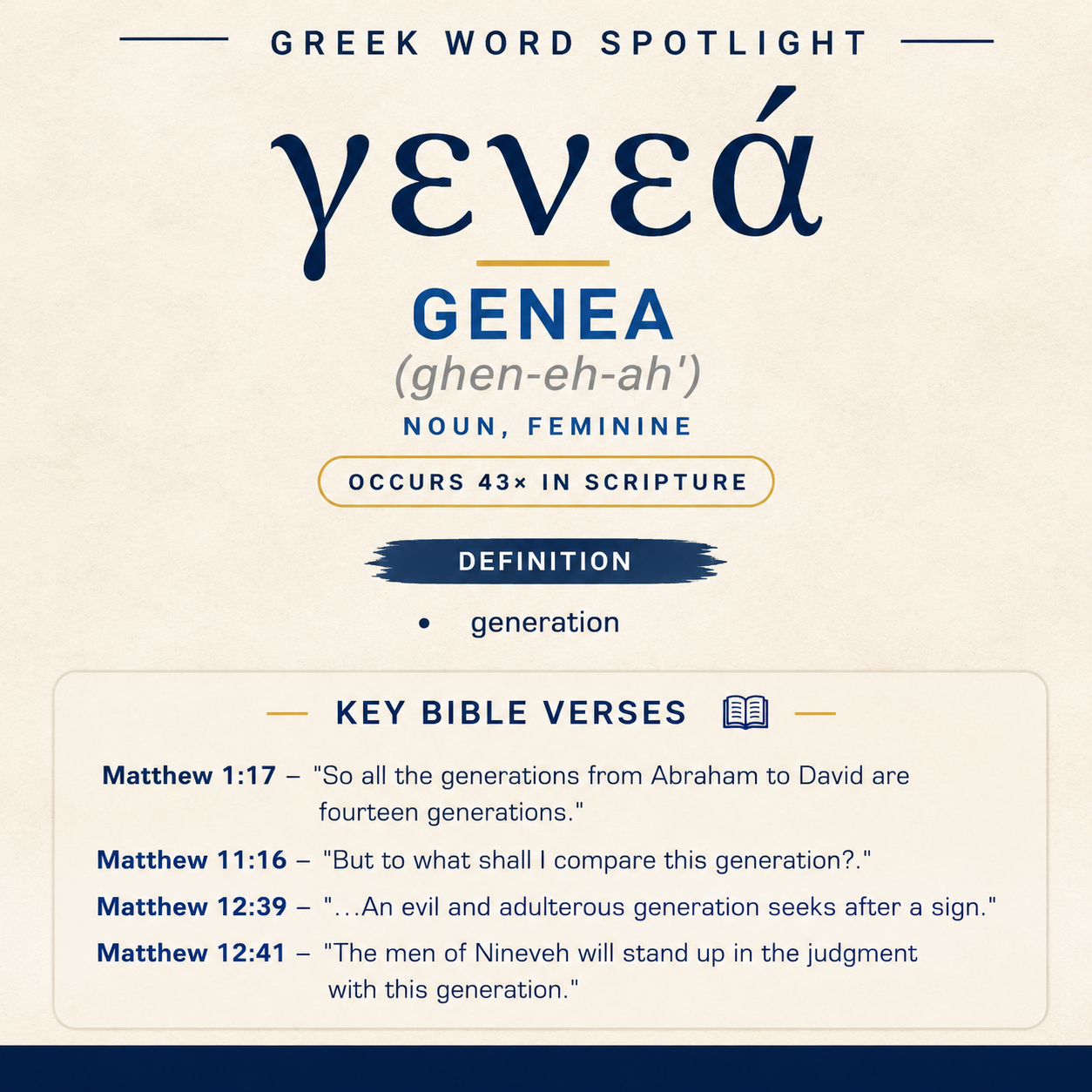
γενεά (Genea) means “generation” and occurs 43 times in Scripture, including multiple uses in Matthew.
Matthew Examples
Matthew 1:17 uses γενεά repeatedly for counted “generations” from Abraham to David and beyond. Matthew 11:16 compares “this generation” to children in marketplaces.
Learn More →Moral Descriptions
In Matthew 12:39 and 16:4, Jesus calls a generation “evil and adulterous” that seeks a sign. In Matthew 17:17, he addresses a “faithless and perverse generation.”
Learn More →γενεά means “generation,” and in these Gospel passages it can mark either a sequence of generations in a lineage or the present cohort addressed and evaluated in Jesus’ speech. The word also becomes a way to speak about a group’s moral and spiritual character, especially when contrasted with other groups called to witness or to judge.
Occurrences
Matthew 1:17 — “So all the generations from Abraham to David are fourteen generations; from David to the exile to Babylon fourteen generations; and from the carrying away to Babylon to the Christ, fourteen generations.”
Here γενεά functions as a counting unit within a structured genealogy. The verse uses the plural repeatedly and organizes time into three measured spans (“fourteen generations” each), so the word contributes a sense of successive human descent arranged into memorable blocks.
Matthew 11:16 — ““But to what shall I compare this generation? It is like children sitting in the marketplaces, who call to their companions”
In this comparison, γενεά points to the contemporary group Jesus addresses (“this generation”) and frames them as a single social body capable of being characterized by an illustration. The simile that follows casts the generation’s behavior in public, everyday space (“marketplaces”), so the word gathers many individuals into one evaluable collective.
Matthew 12:39 — “But he answered them, “An evil and adulterous generation seeks after a sign, but no sign will be given to it but the sign of Jonah the prophet.”
γενεά is modified by moral descriptors (“evil and adulterous”) and is portrayed as unified by a shared demand (“seeks after a sign”). The singular “it” treats the generation as a corporate agent, and the refusal (“no sign will be given”) addresses the generation as a whole rather than only particular questioners.
Matthew 12:41 — “The men of Nineveh will stand up in the judgment with this generation, and will condemn it, for they repented at the preaching of Jonah; and behold, someone greater than Jonah is here.”
γενεά anchors a contrast between groups separated by circumstance: “the men of Nineveh” and “this generation.” The word identifies the present cohort as the one sharing the courtroom scene (“in the judgment”), and it is the object of condemnation; the generation is evaluated against another group’s response (“they repented”).
Matthew 12:42 — “The Queen of the South will rise up in the judgment with this generation, and will condemn it, for she came from the ends of the earth to hear the wisdom of Solomon; and behold, someone greater than Solomon is here.”
Again γενεά designates the present group as a collective standing alongside a witness figure in judgment. The generation is positioned as blameworthy by comparison with one who made effort (“came from the ends of the earth”) to hear wisdom, sharpening the sense that a “generation” can be assessed by its receptiveness.
Matthew 12:45 — “Then he goes, and takes with himself seven other spirits more evil than he is, and they enter in and dwell there. The last state of that man becomes worse than the first. Even so will it be also to this evil generation.”
Here γενεά receives an application from a case example (“that man”) to a broader audience (“this evil generation”). The word allows a transition from an individual’s worsening “state” to a collective fate: the generation is treated as capable of ending in a worse condition than an earlier one.
Matthew 16:4 — “An evil and adulterous generation seeks after a sign, and there will be no sign given to it, except the sign of the prophet Jonah.” He left them, and departed.
γενεά repeats the earlier pattern of a morally marked collective defined by its demand for a sign. The phrasing frames the generation’s posture as persistent (“seeks after a sign”), and the decisive departure that follows underscores the distance between Jesus and the generation’s expectations.
Matthew 17:17 — “Jesus answered, “Faithless and perverse generation! How long will I be with you? How long will I bear with you? Bring him here to me.””
In direct address, γενεά becomes a vocative label for the group present. The emotional force of the rebuke (“How long…?” repeated) shows the word’s capacity to hold a whole audience responsible; the generation is characterized as “faithless and perverse” as the immediate context moves toward action (“Bring him here to me”).
Matthew 23:36 — “Most certainly I tell you, all these things will come upon this generation.”
γενεά functions as a temporal and communal target: “this generation” is the bearer of consequences (“all these things will come upon”). The wording presents the generation as a definable horizon of accountability—events are said to fall upon it as a unit.
Matthew 24:34 — “Most certainly I tell you, this generation will not pass away, until all these things are accomplished.”
Here γενεά sets a time-frame in relation to unfolding events. The generation is personified as something that can “pass away,” and the statement binds the endurance of “this generation” to the completion of “all these things,” making the word a marker of continuity until a specified accomplishment.
Mark 8:12 — “He sighed deeply in his spirit, and said, “Why does this generation seek a sign? Most certainly I tell you, no sign will be given to this generation.””
γενεά is embedded in a scene charged with internal grief (“He sighed deeply in his spirit”). The generation is defined by the same behavior as in Matthew—seeking a sign—and the doubled reference (“this generation… this generation”) intensifies the focus on the group’s collective demand and the firm denial that meets it.
Mark 8:38 — “For whoever will be ashamed of me and of my words in this adulterous and sinful generation, the Son of Man also will be ashamed of him, when he comes in his Father’s glory, with the holy angels.”
In this warning, γενεά identifies the moral environment (“this adulterous and sinful generation”) in which personal allegiance is tested (“ashamed of me and of my words”). The word frames the setting as a present communal climate, while the statement links behavior within that generation to a future, public response by “the Son of Man.”

Sense and Usage
Across these passages, “generation” operates in two main ways. In Matthew 1:17 it is a chronological unit within a family line, capable of being counted, grouped, and arranged to connect major stages (“from Abraham to David… to the exile… to the Christ”). In the remaining occurrences, “this generation” is a living cohort—an identifiable set of people in a shared moment—who can be addressed, compared, warned, and held accountable together.
The shift from counted succession to contemporary collective does not change the basic idea of “generation,” but it changes what the word is doing in the sentence. When the word is attached to qualifiers like “evil and adulterous,” “faithless and perverse,” or “adulterous and sinful,” the generation is treated as having a recognizable character. That character then explains actions (“seeks after a sign”) and sets the terms of evaluation (“will condemn it”). In this way, γενεά gathers individual responses into a portrait of a whole cohort’s stance toward what is happening “here,” where “someone greater than Jonah is here” and “someone greater than Solomon is here.”
These texts also show how “generation” can function as a boundary for judgment and fulfillment. In Matthew 12:41–42 the generation stands alongside figures who become witnesses against it. In Matthew 23:36 and 24:34 the generation is the subject of sweeping statements about what will “come upon” it and what will be “accomplished” before it “pass away.” The word therefore can mark a group not only sociologically (a cohort) but also temporally (a span that endures until certain outcomes occur), without ceasing to denote “generation.”
Imagery
The passages often paint a generation as a single body in a public scene: children in marketplaces, a crowd demanding a sign, a group receiving a rebuke, or a cohort standing in judgment alongside famous witnesses. Even when the word is used for quiet accounting in a genealogy, it still evokes a line of human lives moving through time; when used in confrontation, it evokes a present people whose shared posture is exposed by what they seek, what they refuse, and what ultimately “comes upon” them.
Sources: Lexical data from Strong’s Exhaustive Concordance and the Translators Brief Lexicon of Extended Strongs for Greek (STEPBible, CC BY). Occurrence data from the Translators Amalgamated Greek New Testament (STEPBible, CC BY). Scripture quotations from the World English Bible (public domain).




