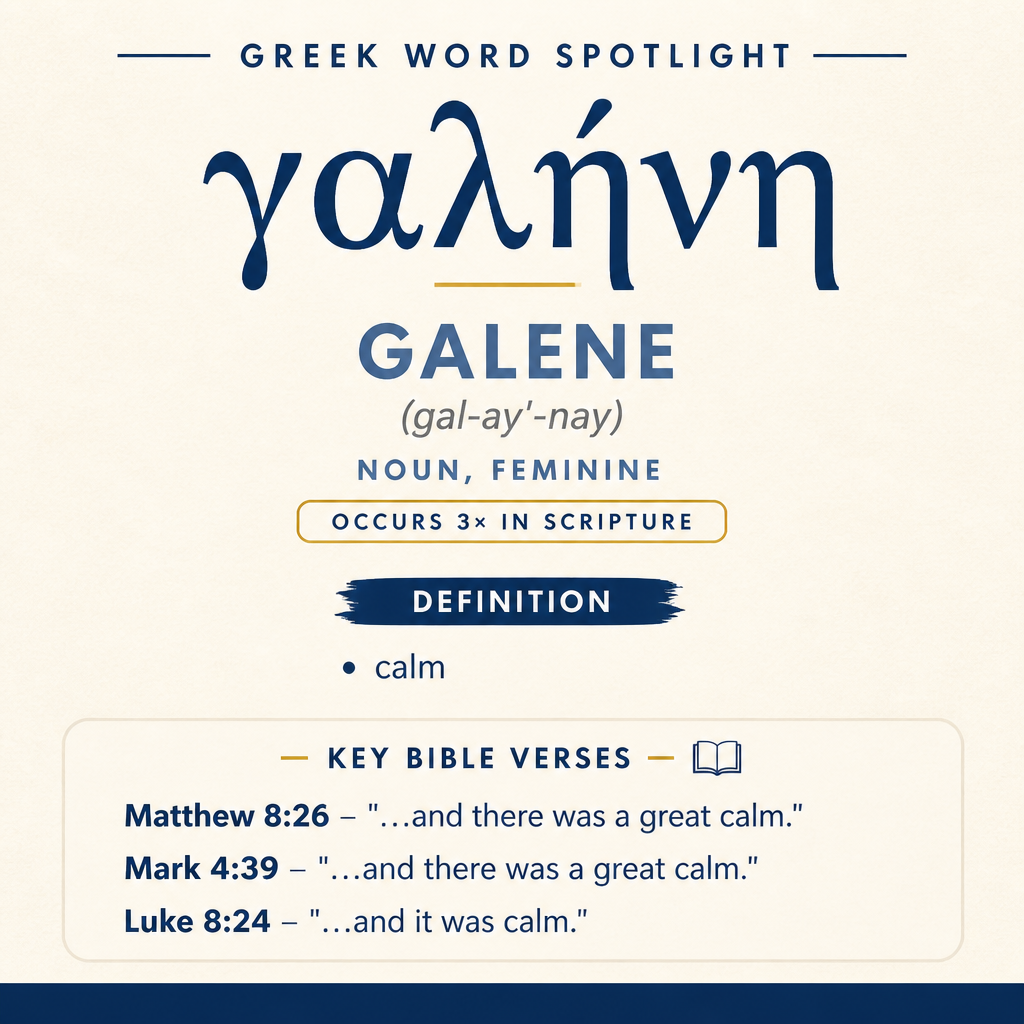
γαλήνη means “calm.” It appears in three Gospel narratives where wind, sea, and raging water are forcibly checked, and the scene ends in quiet.
Occurrences
He said to them, “Why are you fearful, O you of little faith?” Then he got up, rebuked the wind and the sea, and there was a great calm. (Matthew 8:26)
Here γαλήνη names the result that follows a sequence of actions: Jesus addresses the disciples’ fear, then “rebuked the wind and the sea,” and the narrative resolves with “a great calm.” The word marks the transition from an environment characterized by active, threatening motion (“wind and the sea”) to a settled condition strong enough to be described as “great.” Within the verse’s own logic, the calm is not gradual or accidental; it is the immediate state that comes into being after a rebuke directed at both wind and sea. As the concluding clause, “and there was a great calm,” γαλήνη functions as a narrative endpoint: the disturbance is answered, and the scene is defined by quiet.
He awoke, and rebuked the wind, and said to the sea, “Peace! Be still!” The wind ceased, and there was a great calm. (Mark 4:39)
Mark’s wording places γαλήνη after explicit commands addressed to the sea: “Peace! Be still!” The verse then gives two consecutive results: first, “The wind ceased,” and second, “there was a great calm.” In this scene γαλήνη is the condition that follows cessation; it is more than the stopping of wind alone, since the calm is presented as an additional outcome after the wind’s activity ends. The structure distinguishes between the termination of a force (“the wind ceased”) and the establishment of an overall settled state (“a great calm”). By naming that settled state, γαλήνη gathers the whole environment—wind and sea—into one final description of quiet order after spoken rebuke.
They came to him, and awoke him, saying, “Master, master, we are dying!” He awoke, and rebuked the wind and the raging of the water, and they ceased, and it was calm. (Luke 8:24)
Luke frames γαλήνη against the disciples’ alarm: “Master, master, we are dying!” The threatening condition is expressed as “the wind and the raging of the water.” After Jesus “rebuked” these, “they ceased,” and the final clause states, “and it was calm.” Here γαλήνη stands opposite “raging,” naming what replaces turbulent movement. The verse also links the calm closely to the ceasing of multiple elements (“the wind” and “the raging of the water”): once the sources of danger stop, the whole setting can be described simply as calm. Compared with the other accounts, Luke’s phrasing is especially spare at the end—no modifier like “great” is attached—so γαλήνη itself carries the weight of the scene’s resolution.
Sense and Usage
Across these passages γαλήνη consistently labels a settled condition that follows the halting of disruptive natural forces. The word appears where the text has already drawn attention to movement that threatens: “wind and the sea” (Matthew), “the wind” and the addressed “sea” (Mark), and “the wind and the raging of the water” (Luke). In each case, calm is not introduced as a background detail but as the climactic description after decisive intervention. The narrative pattern is stable: danger or turmoil is assumed in the mention of wind, sea, and raging water; Jesus is awakened or rises; he rebukes; the forces stop; and γαλήνη names what the environment becomes.
The contexts also show that γαλήνη can be intensified or left unmodified. Matthew and Mark both speak of “a great calm,” which presents the calm as striking in scale or effect within the scene, especially in contrast to the preceding disturbance implied by the mention of wind and sea. Luke’s account, while equally dramatic in the disciples’ cry of peril, ends with the straightforward “it was calm.” This variation demonstrates that the word can stand on its own as a complete description of the new state, while also allowing emphasis when the narrative wishes to underline how thorough the quiet is.
γαλήνη is tied to the verb of rebuke in all three verses. The calm is not merely the absence of wind; it is the state that results when the wind and sea are addressed as subject to command. Mark makes this especially vivid by recording direct speech to the sea (“Peace! Be still!”), after which the narrative reports both cessation and calm. Matthew and Luke summarize the same authority with the verb “rebuked,” and then present calm as the immediate outcome. In all three, γαλήνη therefore functions as a visible, describable consequence: it is what the characters can recognize once the threatening motion ends.
Because γαλήνη is located at the end of each verse, it also serves a literary purpose: it closes the moment with a single term that signals completion. The story’s tension—fear in Matthew (“Why are you fearful, O you of little faith?”), urgent command in Mark (“Peace! Be still!”), and desperation in Luke (“we are dying!”)—is met with a final description of quiet. In these scenes, calm is not only a meteorological change but the narrative’s punctuation mark: the environment that was dangerous is now stable enough to be named with one word.
Imagery
The imagery associated with γαλήνη in these passages is concrete and sensory: wind that drives the surface of the sea, water described as “raging,” and then a sudden stillness after rebuke. Each account draws the reader’s attention to the physical world—wind, sea, water—so that the arrival of calm can be felt as a change in sound and motion. Matthew and Mark sharpen this picture with “a great calm,” suggesting a conspicuous quiet that follows the ceasing of forces that had dominated the scene. Luke’s closing “it was calm” offers a plain, settled ending after the panic of “we are dying!”; the calm stands as the new atmosphere of the boat and water alike once the raging has stopped.
Sources:
Lexical data from Strong’s Exhaustive Concordance and the Translators Brief Lexicon of Extended Strongs for Greek (STEPBible, CC BY). Occurrence data from the Translators Amalgamated Greek New Testament (STEPBible, CC BY). Scripture quotations from the World English Bible (public domain).