Exploring the Meaning of Galates in Greek
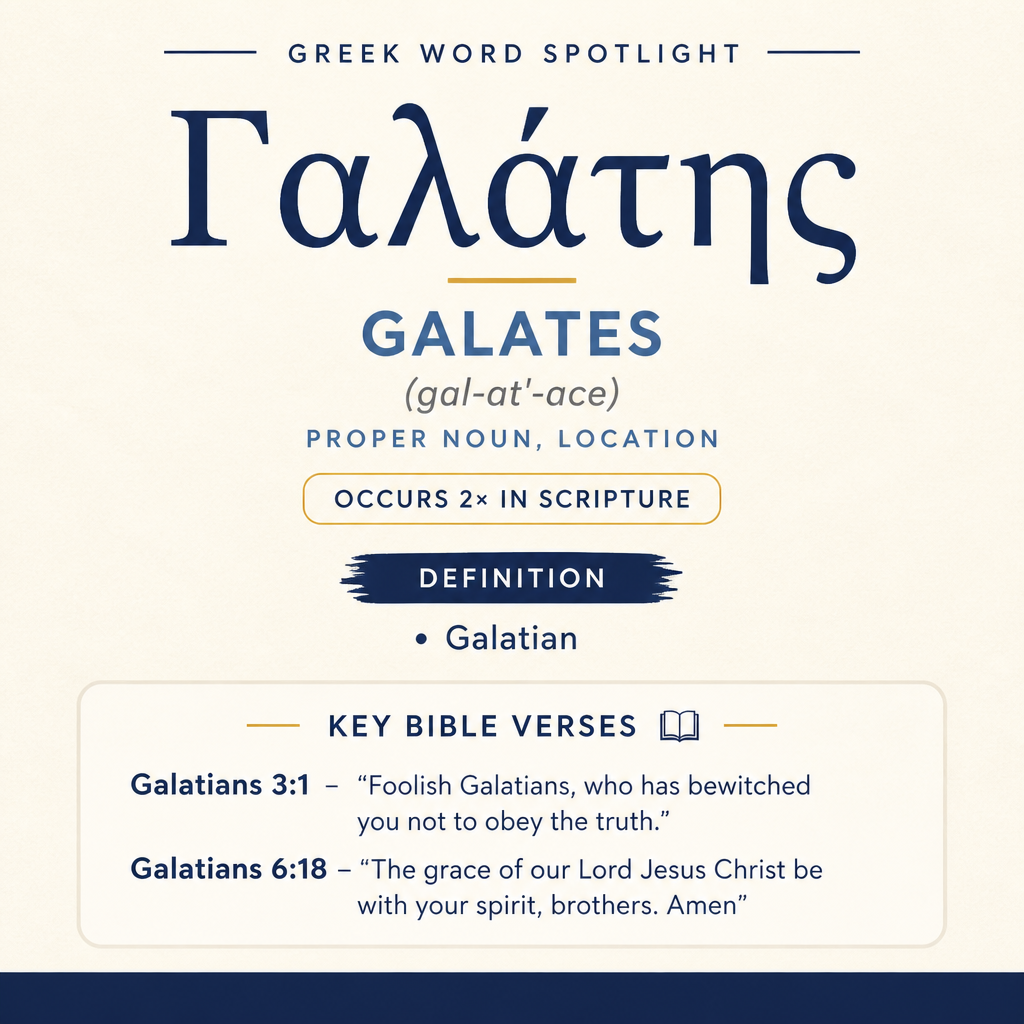
Γαλάτης (Galates) means “Galatian” and occurs twice in Scripture, in Galatians 3:1 and Galatians 6:18.
Scripture Occurrences
It occurs 2 times in Scripture. The references given are Galatians 3:1 and Galatians 6:18.
Learn More →Context Notes
In Galatians 3:1 it addresses “Foolish Galatians.” In Galatians 6:18 it appears in the closing blessing to “brothers.”
Learn More →Γαλάτης means “Galatian,” designating a person identified with Galatia. It appears in Paul’s letter in a direct address that frames his rebuke and appeal.
Root and Related Words
Galates corresponds to the place-name Γαλατία (Galatia), “Galatia” (Strong’s G1053), from which this designation is derived.

Occurrences
“Foolish Galatians, who has bewitched you not to obey the truth, before whose eyes Jesus Christ was openly portrayed among you as crucified?” (Galatians 3:1)
Here Galates functions as a pointed form of address. By naming them “Galatians,” Paul is not merely calling for attention; he is locating the rebuke within a defined community—people who share a recognizable identity as recipients of his instruction and as those who have been confronted with a vivid proclamation of Christ. The term carries the weight of communal responsibility: the ones addressed are a group who have been placed in a position to “obey the truth,” and the question “who has bewitched you” presumes that this group has undergone a change that demands explanation. Within the sentence, the address “Foolish Galatians” sets the emotional and rhetorical force for what follows: Paul contrasts their present confusion with what they had previously been shown “before whose eyes Jesus Christ was openly portrayed among you as crucified.” The word marks the audience as a particular body of believers whose shared experience (“among you”) becomes the ground of Paul’s astonishment.

“The grace of our Lord Jesus Christ be with your spirit, brothers. Amen.” (Galatians 6:18)
This closing blessing does not repeat the ethnic or regional designation explicitly in the quoted wording, yet it completes the same epistolary address by speaking to the same recipients as a collective (“your spirit”) and by naming them “brothers.” In the flow of the letter’s ending, Galates remains the implied addressee: the benediction is not abstract but directed toward the community previously confronted and instructed. The familial term “brothers” softens the tone and signals ongoing relationship, so that the group identified earlier by their Galatian identity is, at the end, gathered under a shared spiritual concern—Paul asks that “the grace of our Lord Jesus Christ” would be “with your spirit.” The address shifts from sharp correction to a closing wish of grace, showing that the community named in the letter is still treated as within the sphere of Christian fellowship.
Sense and Usage
Across these contexts, “Galatian” operates as a community identifier within a pastoral and argumentative letter. In Galatians 3:1 it is used in direct second-person address, giving the rebuke a concrete target: the admonition is aimed at a recognizable group rather than at an anonymous audience. This kind of usage turns a regional label into a way of speaking to a moral and spiritual situation shared by the group. The force of the term in the rebuke is sharpened by the immediacy of the questions that follow (“who has bewitched you…?”): the designation gathers the hearers into one audience capable of being addressed together, corrected together, and reminded together of what they have “seen” proclaimed.
Even where the label itself is not repeated in the closing line, the letter’s ending shows how such a designation functions within correspondence: the same audience remains in view from beginning to end, and the address can move between different ways of naming them—by regional identity in a moment of sharp appeal, and by relational identity (“brothers”) in a final prayer of grace. The definition “Galatian” thus serves the letter’s rhetorical structure: it anchors the admonition and encouragement to a distinct community, presenting them as a unified group responsible for their response to “the truth” and as those over whom Paul pronounces a blessing of grace.
Imagery
The word evokes the image of a gathered congregation being spoken to directly—first in a moment of startled confrontation (“Foolish Galatians”), and finally under a spoken blessing (“be with your spirit, brothers”). In these lines, the regional name becomes a way of picturing a real audience within earshot of apostolic exhortation: a community addressed with urgency because of the seriousness of “the truth,” and dismissed with grace because they are still treated as family.
Sources: Lexical data from Strong’s Exhaustive Concordance and the Translators Brief Lexicon of Extended Strongs for Greek (STEPBible, CC BY). Occurrence data from the Translators Amalgamated Greek New Testament (STEPBible, CC BY). Scripture quotations from the World English Bible (public domain).